Giant ichthyosaur with injuries discovered in Northern Bavaria, Germany

Based on its skull length of 1.5 meters, the animal is estimated to have been about 6.6 meters long.

The Mistelgau clay pit near Bayreuth, Germany, is known for its well-preserved marine fossils, particularly its abundance of ichthyosaurs. These large marine reptiles resembled modern dolphins in appearance and lived worldwide during the Early Jurassic period, around 180 million years ago.

The ichthyosaur from Mistelgau now under investigation belongs to the genus Temnodontosaurus. Several parts of its skeleton have been preserved: fragments of the skull and lower jaw, the shoulder girdle, forefins, the spine, and over 100 teeth. The exceptional three-dimensional preservation allows researchers detailed insights into anatomical structures that have rarely been documented before, such as those in the palate, orbital region, and the fins.

Comparisons reveal clear similarities, but also differences to Temnodontosaurus trigonodon—animals of this species are among the largest known ichthyosaurs. Based on its skull length of 1.5 meters, the animal is estimated to have been about 6.6 meters long. These findings are published in the open-access journal Zitteliana.

Fossil Temnodontosaurus cf. trigonodon (UMO BT 011237.00), viewed from below, showing the skull and body plate, including all isolated bones and teeth recovered from the surrounding sediment. Image credit: Urwelt-Museum Oberfranken.

“Our Temnodontosaurus fossil is one of the youngest finds of this ichthyosaur genus to date. Until now, representatives of this genus have mainly been known from older geological layers, such as the Posidonia Shale of Holzmaden. The discovery from Mistelgau now shows that these large marine reptiles survived longer in the Southwest German Basin than previously documented.”

Dr. Ulrike Albert, SNSB paleontologist

Albert conducts research at the Urwelt-Museum Oberfranken in Bayreuth, one of ten museums belonging to the Bavarian State Collections of Natural History. The team at the Urwelt-Museum Oberfranken has been conducting regular excavations in Mistelgau since 1998. The fossils recovered there are prepared at the Urwelt-Museum and subsequently subjected to scientific analysis.

Particularly striking are several modifications to the skeleton, presumably caused by injuries, including those affecting the reptile’s shoulder and jaw joints.

“The injuries likely significantly limited the animal’s ability to catch prey. The fact that it nevertheless survived is evidenced, among other things, by its heavily worn teeth and gastroliths, which we were able to identify in the abdominal region.”

Stefan Eggmaier, preparator at the Urwelt-Museum
Ulrike Albert and Stefan Eggmaier from the Urwelt-Museum Oberfranken at the excavation site in Mistelgau. Image credit: Mathias Orgeldinger.

Gastroliths are extremely rare in ichthyosaurs such as Temnodontosaurus. Eggmaier speculates that the animal may have had to change its diet in order to survive its injuries.

The current findings are part of ongoing research into the ecology of the Jurassic Sea in Upper Franconia. Analyses of teeth and bone structures are planned, with the aim of better understanding the ecology of these animals and their habitat.

Original study:

Eggmaier SA, Albert UEG (2026) A partial skeleton of Temnodontosaurus cf. trigonodon in three-dimensional bone preservation from the upper Toarcian of Mistelgau, Germany. Zitteliana 100: 39-80. https://doi.org/10.3897/zitteliana.100.172724

For more interesting articles about palaeontology, follow Zitteliana on Bluesky and Facebook.

New Jurassic ichthyosaur species discovered in Mistelgau

Ichthyosaurs were marine reptiles, with dolphin-like bodies, that lived during the time of the dinosaurs.

An international research team from Switzerland and Germany has described a new ichthyosaur species based on fossils curated at the Urwelt-Museum Oberfranken (Bayreuth, Germany). The study was published in Museum für Naturkunde Berlin’s open-access journal Fossil Record.

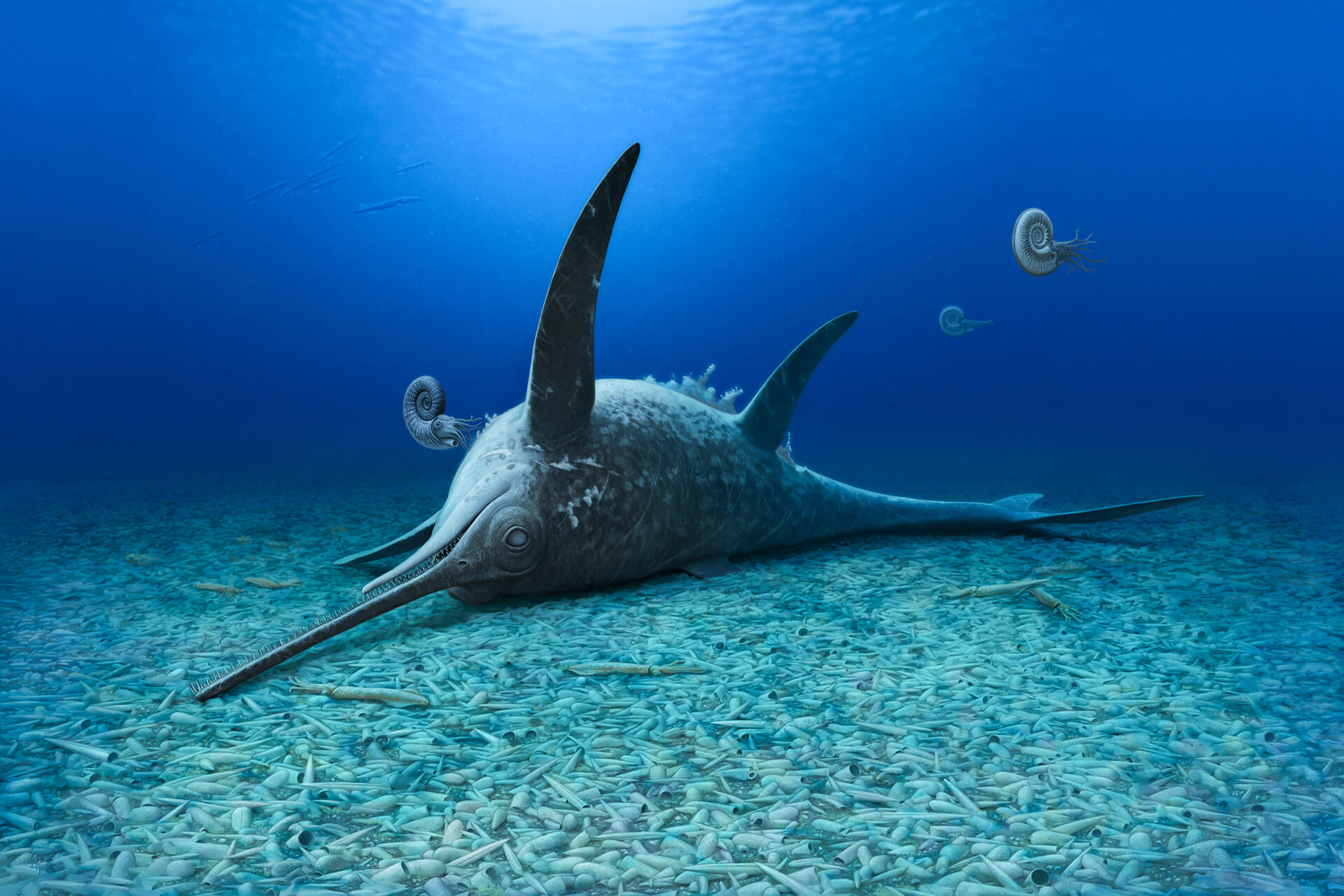
Artist's interpretation of Eurhinosaurus mistelgauensis on belemnite battleground. Credit: Andrey Atuchin.
Artist’s interpretation of Eurhinosaurus mistelgauensis on belemnite battleground. Credit: Andrey Atuchin.

Ichthyosaurs were marine reptiles, with similar body shapes to dolphins and tuna, that lived during the time of the dinosaurs. The research team behind the discovery, led by Gaël Spicher (JURASSICA Museum, Porrentruy, Switzerland), named the new species Eurhinosaurus mistelgauensis in reference to the clay pit of Mistelgau in Upper Franconia, a fossil site that has yielded numerous important finds. “We wanted to highlight the scientific importance of the Mistelgau locality,” explains Gaël Spicher.

Excavations in the clay pit have been conducted regularly since 1998 by the Urwelt-Museum Oberfranken, which recovered and prepared the fossils prior to their scientific study. One specimen originates from a so-called “belemnite battleground,” dense accumulations of Jurassic cephalopod remains that are characteristic of the site.

The newly described species shares the elongation of the upper jaw typical for othe species in the Eurhinosaurus genus, producing a pronounced “overbite” similar to that of modern swordfish. Eurhinosaurus mistelgauensis differs from previously known species by its notably robust ribs and special features in the joint connecting the skull and the neck.

Fossilised Eurhinosaurus mistelgauensis specimen.
Eurhinosaurus mistelgauensis specimen from the Urwelt-Museum Oberfranken on a belemnite battleground. The fossil plate is about 4 m long. Credit: Spicher et al.

“The naming of a new species emphasises the significance of the Urwelt-Museum Oberfranken’s fossil collections for understanding Jurassic marine ecosystems,” says museum director Dr. Serjoscha Evers. “The Mistelgau site continues to provide rare insights into a time period that is otherwise scarcely documented worldwide.”

Further studies on the Mistelgau material are in preparation. These include analyses of injuries preserved in the ichthyosaur skeletons, which may shed light on the ecology and life history of these ancient marine reptiles.

Original source

Spicher GE, Miedema F, Heijne J, Klein N (2025) A new Eurhinosaurus (Ichthyosauria) species from the Lower Jurassic (Toarcian) of Mistelgau (Bavaria, Southern Germany). Fossil Record 28(2): 249–291. https://doi.org/10.3897/fr.28.154203

Follow Fossil Record on Bluesky and Facebook.