TikTok Video Leads to Discovery of Rare Underground Eel in India

Gangaichthys indonepalicus is the first subterranean fish to be recorded from the Gangetic Basin.

Researchers have discovered a new genus and species of underground earthworm eel living beneath the Indo-Gangetic Plain in Bihar, northern India. The small, colourless creature, named Gangaichthys indonepalicus, is the first subterranean fish to be recorded from the Gangetic Basin.

Close-up of Gangaichthys indonepalicus. Image credit: Ishan Agarwal.

The research, published in ZooKeys, was carried out by an international team of scientists from the Thackeray Wildlife Foundation in Mumbai, India; Shivaji University in Kolhapur; the Shanghai Synchrotron Radiation Facility at the Chinese Academy of Sciences; and the Zoological Survey of India in Gopalpur-on-Sea.

The investigation began after a short video clip posted on TikTok in 2024 showed an unusual tiny fish emerging from a water borewell near the border between India and Nepal.

“The unique morphology of the fish in the video, and the fact that there are no known stygobitic fish known from the region, motivated us to track down the species to ascertain its identity.”

The Research Team

Securing physical samples required an intensive fieldwork effort in Bihar, where the scientists manually pumped thousands of litres of water from local handpumps.

“Procuring samples of this unusual fish was challenging. Identifying potential handpumps (borewells) and wells, and obtaining permission from their owners to extract water for the purpose of searching for the fish proved difficult. This became more intensive when we finally began manually pumping water.”

Akshay Khandekar, Thackeray Wildlife Foundation
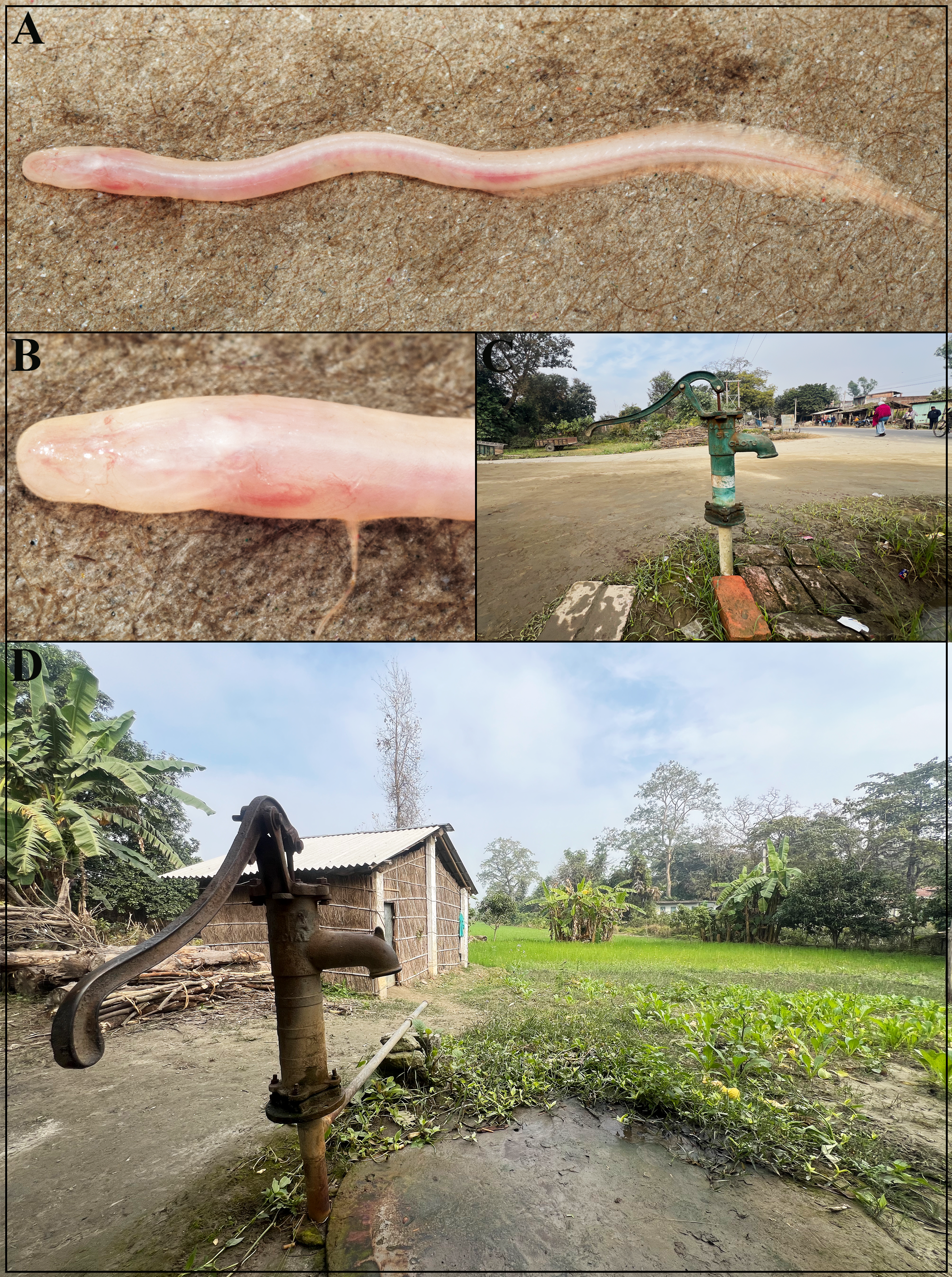
Live and habitat photos Gangaichthys indonepalicus
Live and habitat photos Gangaichthys indonepalicus: NRC AA 9519, holotype, 40.6 mm SL: Dorso lateral view of: A. Full body; B. Head; C. Bore-well from which holotype and one (damaged) paratype was collected; D. Bore-well from where another damaged specimen was collected. Image credit: Akshay Khandekar et al., 2026.

The first specimen emerged after pumping approximately 2000 litres of water but sustained damage during the process and died immediately. The second and only intact specimen (later designated as the holotype of this species) was found from the same borewell after pumping an additional 500 litres of water.

Gangaichthys indonepalicus in a syringe. Image credit: Ishan Agarwal.

The newly described fish measures roughly four centimetres in length and features physical adaptations suited to life in total darkness, including reduced eyes covered by skin, an unpigmented translucent body, and an apparent absence of ribs.

Advanced micro-CT scanning and genetic analysis confirmed that it represents a completely distinct genus within the earthworm eel family Chaudhuriidae.

“Gangaichthys means fish of the Ganga. The Ganga or Ganges is one of the most important rivers in India, both as a source of fresh water, food and livelihood for millions of people; besides having an important role in the Hindu religion.

This is the first stygobitic fish from the Indo-Gangetic plains and from the Gangetic basin.”

Ishan Agarwal, Thackeray Wildlife Foundation

As for the naming of the species itself, Tejas Thackeray commented:

“As the species occurs on the border between India and Nepal we picked indonepalicus as the specific epithet, which reflects the distribution of the species.”

Gangaichthys indonepalicus. Image credit: Ishan Agarwal.

Agarwal also reflected on the broader context of the find and the challenges of studying subterranean habitats:

“India is an incredibly diverse country, spanning huge gradients in climate and topography and multiple biogeographic regions. However, there is a huge gap in knowledge, both Linnaean and Wallacean shortfalls, with many more species yet to be discovered.

This exciting discovery is in some ways symptomatic of general biodiversity research in India, though sampling subterranean habitats is especially challenging.”

Original source:

Khandekar A, Thackeray T, He Y, Mohapatra A, Agarwal I (2026) Gangaichthys indonepalicus, a new genus and species of miniature stygobitic earthworm eel (Synbranchiformes, Chaudhuriidae) from alluvial aquifers in the Indo-Gangetic Plain, Bihar, northern India. ZooKeys 1289: 185-202. https://doi.org/10.3897/zookeys.1289.188089


For more articles on zoology, visit the ZooKeys website and follow the journal on BlueSky and Facebook.

Deep black as midnight: striking new moray eel discovered in Central Indo-Pacific river mouths, named after god of the underworld

This new moray eel is named after the underworld god Hades for its distinctive habitat, unique behaviors, and most notably, its deep, dark coloration.

The Hades’ snake moray (Uropterygius hades), a dark brown, slender snake moray eel, has chosen the road less traveled, thriving in dim and muddy river mouths, unlike most of its marine moray eel relatives. It is widely distributed across the Central Indo-Pacific, and has been found in southern Japan, Taiwan, the Philippines, southern Java, and Fiji. This new moray eel was named after Hades, the god of the underworld, due to its unique habitat, burrowing behavior, high sensitivity to light, and most notably, its deep, dark coloration.

Live photo of Uropterygius hades. Image credit: Dr Wen-Chien Huang

Scientists Dr Wen-Chien Huang, Dr Rodulf Anthony Balisco, Dr Te-Yu Liao, National Sun Yat-sen University, Taiwan, Western Philippines University, the Philippines, and Dr Yusuke Hibino, Kitakyushu Museum of Natural History and Human History, Japan, describe this new species in a paper published in the open-access journal ZooKeys. They named it after Hades, the underworld god, to emphasize its imposing appearance and its habitat in dim, turbid environments. This idea was inspired by Dr. Wen-Chien Huang, who was influenced by Ralph Fiennes’ portrayal of Hades in the movie Clash of the Titans.

Live photo of Uropterygius hades. Image credit: Dr Wen-Chien Huang

There are approximately 230 species of moray eels worldwide, with most inhabiting marine environments. Only one species has been confirmed to spend the majority of its life in freshwater. Some marine species, like the slender giant moray (Strophidon sathete), can tolerate and occasionally enter lower-salinity environments such as river mouths. However, moray eels specifically adapted to estuarine habitats are exceedingly rare.

The discovery of Hades’ snake moray was actually accidental, when the three researchers from National Sun Yat-sen University investigated the cave of the Puerto Princesa Subterranean River, aiming to survey the aquatic fauna and targeting a cave eel species, the bean-eyed snake moray (Uropterygius cyamommatus). This eel, with its highly reduced eye size, is considered an ideal example for studying the evolutionary processes that allow eels to adapt to cave environments. However, the researchers did not find any bean-eyed snake morays in the cave; instead, they collected a slender moray with a conspicuous, uniformly deep dark color.

Fresh specimen of Uropterygius hades. Credit: Dr Wen-Chien Huang

When kept in an aquatic tank, the Hades’ snake moray exhibits tail-first burrowing behavior, which is rarely seen in moray eels. Additionally, it is highly sensitive to light, consistently attempting to hide when exposed to it. Its small eyes—thought to be an adaptation to low-light environments—and its reduced number of head sensory pores—believed to help avoid clogging by the substrate—suggest that this species might be an excellent burrower, relying primarily on chemoreception rather than vision to detect prey or avoid predators.

Original source:

Huang W-C, Hibino Y, Balisco RA, Liao T-Y (2024) Description of a new uniformly brown estuarine moray eel (Anguilliformes, Muraenidae) from the Central Indo-Pacific Ocean. In: Ho H-C, Russell B, Hibino Y, Lee M-Y (Eds) Biodiversity and taxonomy of fishes in Taiwan and adjacent waters. ZooKeys 1220: 15-34. https://doi.org/10.3897/zookeys.1220.129685