

|
Getting your Trinity Audio player ready...
|
Some of the most important pollinators for South Africa’s mango industry aren’t bees at all – they’re houseflies and blowflies, according to a recently published study in Frontiers of Biogeography by scientists at University College London (UCL).
The study, led by Matthew Phillips Sánchez and Richard Pearson of UCL’s Centre for Biodiversity and Environment Research, set out to find not just which insects visit mango flowers, but which ones actually pollinate them effectively.
Not all visitors are pollinators

Mango flowers attract a huge range of insect visitors, but many never touch the flower’s reproductive parts and so transfer no pollen at all. To separate the true pollinators from the freeloaders, the researchers used a Pollen Deposition Effectiveness (PDE) metric, which combines how often a species visits mango flowers, how often those visits make contact with the flower’s reproductive organs, and how much pollen is deposited per visit.
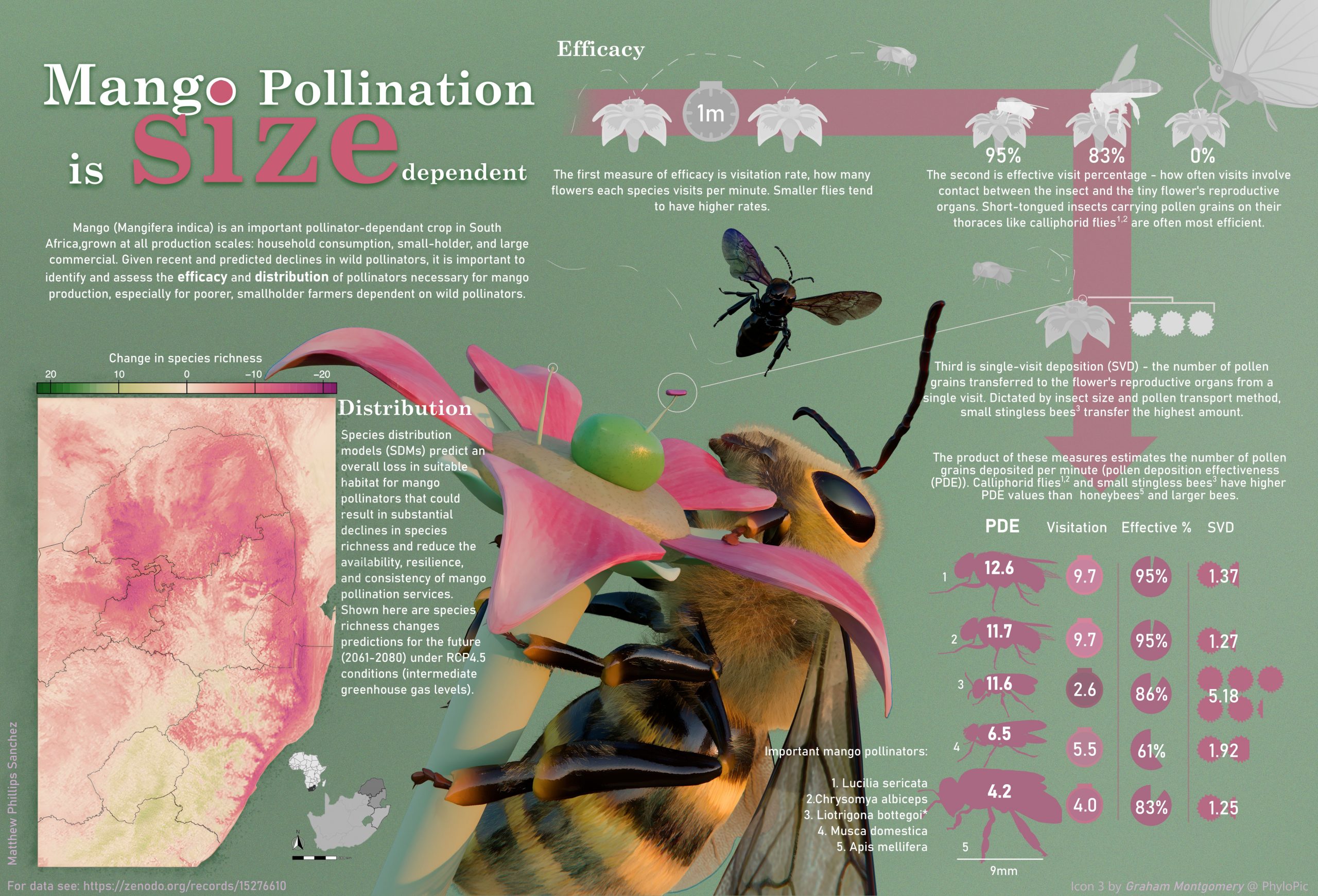
Applying this method to 61 known mango-visiting insect species found in South Africa, the team identified 38 true pollinators – and found that flies, not bees, were the amongst the more effective pollinators. Blowflies (family Calliphoridae), the housefly (Musca domestica), and a tiny stingless bee species, Liotrigona bottegoi, ranked as the most effective pollinators identified in the study. Larger insects such as honeybees and carpenter bees (Xylocopa) were generally less effective per visit, likely because their bigger bodies make less consistent contact with the small mango flower’s reproductive structures.
Insects from the orders Lepidoptera (butterflies and moths), Coleoptera (beetles) and Hemiptera (true bugs) were found not to contribute meaningfully to pollination, either because they don’t make contact with the flower’s reproductive parts or because there wasn’t enough data to assess them.
A shrinking future for mango pollinators
The researchers combined their pollinator effectiveness data with species distribution models, statistical tools that predict where a species can survive based on climate, to project how pollinator habitat in South Africa’s main mango-growing provinces (Limpopo, Mpumalanga and KwaZulu-Natal) might change under future climate scenarios.
The results point to widespread declines. On average, pollinator species are projected to lose 42% (under a moderate-emissions scenario) to 43% (under a high-emissions scenario) of their currently suitable habitat by 2061-2080 or 66,663 km2 and 73,608 km2 respectively.

Flies were projected to be hit hardest, while some bee species were projected to gain ground in parts of the region. The study also found that pollinator communities are likely to undergo substantial species turnover, with many current pollinators potentially shifting toward the country’s south as the climate changes.
Encouragingly, the researchers found that potential pollination service didn’t decline much faster than pollinator numbers overall – a sign of what ecologists call “functional redundancy,” where many species contribute moderate pollination value rather than the community depending on one or two irreplaceable species. This suggests the loss of some species is less likely to cause a sudden pollination collapse, provided enough functionally similar species remain.
The mango industry

Mango is a significant industry in South Africa, valued at more than US$25 million annually and supporting over 13,000 jobs in processing and related trades, in addition to many smallholder and subsistence growers who rely heavily on wild, unmanaged pollinators.
The authors stress that their study is intended primarily as a proof-of-concept for this new modeling approach, rather than a definitive forecast of mango production. The models estimate climatically suitable habitat, not realised populations, and do not account for land use, habitat availability, or the timing of mango flowering relative to pollinator activity.
Practical steps for growers

The researchers highlight several low-cost conservation measures that could help support wild pollinator populations in mango orchards, including reducing pesticide and herbicide use, setting up low-cost “stink stations” to attract pollinating blowflies, planting native flowering plants or allowing wildflowers to grow between orchard rows to provide food and nesting sites for pollinators, and increasing overall plant diversity within orchards.
Original source:
Sánchez MP, Pearson R (2026) Biogeography of pollination under climate change: integrating pollinator effectiveness into species distribution models for mango in South Africa. Frontiers of Biogeography 19: e180771. https://doi.org/10.21425/fob.19.180771