Scientists exploring seamounts off the coast of Costa Rica have discovered a new coral so genetically and morphologically distinct that it required the creation of an entirely new family for its classification.
Bright yellow and tree-like, the coral was found growing some 360 to 529 metres beneath the surface of the Pacific. The discovery is described in the open-access journal ZooKeys.
Map showing the geographic location of the collected samples within the Pacific Exclusive Economic Zone (EEZ) of Costa Rica. Made by Beatriz Naranjo (UCR).
The colonies, which can grow to over a metre tall, were collected using the remotely operated vehicle SuBastian aboard the research vessels Falkor and Falkor (too), operated by the Schmidt Ocean Institute, during expeditions to the seamounts off Isla del Coco and the Costa Rican Pacific margin in 2019 and 2023.
Researchers found the coral thriving in large numbers on rocky outcrops that were almost entirely blanketed by brittle stars, creating a shimmering, star-strewn seafloor from which the golden coral branches rose like glowing trees.
That image inspired the coral’s name. The new genus, Laurinque, comes from “Laurinquë”, meaning “golden tree” in Quenya, the Elvish language devised by J.R.R. Tolkien for The Lord of the Rings and The Silmarillion, chosen in reference to the colonies’ bright yellow, tree-like form.
Laurinqueelenya gen. et sp. nov., morphology of the holotype, in situ. Photographs by ROV SuBastian.
The species name, elenya, is Quenya for “stellar” or “of the stars”, a nod to the fields of brittle stars among which the coral was discovered. Together, the pairing evokes a scene the researchers likened to a mystical elvish landscape on the deep seafloor.
Working out where this coral belonged in the coral family tree proved unusually difficult. The team sequenced three genes commonly used to classify corals, and each one pointed to a different, unrelated family, an unusually high level of disagreement.
Holotype (ethanol preserved fragment) detail of anthocodiae and polyp arrangement of Laurinqueelenya. Photographs by Fiorella Vásquez (UCR).
To settle the question, researchers turned to phylogenomics, analysing hundreds of genes at once. This revealed that the coral does not belong to any known family at all, but represents a unique evolutionary lineage most closely related to the family Eunicellidae, but distinct enough in both its genetics and its anatomy to warrant a new family, Laurinqueidae, and a new genus, Laurinque, built specifically to house it.
“I saw the octocoral garden for the first time in 2019 and I was impressed by the beauty of the landscape, which inspired, later the elvish name of the taxa. I thought the species could belong to a known family and genera, but after the preliminar morphological analysis I realised that it was something very different that I could not match with the known taxa.
In 2023 we collected more samples and thanks to the exhaustive molecular analyses made by my colleagues, Cathy McFadden, Catalina Murillo and Andrea Quattrini, we were able to determine the taxonomic placement of the stunning species, in one of the most enigmatic sites.”
Laurinqueelenya gen. et sp. nov., in situ colonies in Las Gemelas II. Photographs by ROV SuBastian.
The research was led by Dr Breedy, working alongside an international team of collaborators. The expeditions were supported by the Schmidt Ocean Institute and a National Geographic Society research grant.
The discovery adds to a growing list of undocumented species being revealed on Costa Rica’s seamounts, and demonstrates how much of the deep ocean, which covers roughly two-thirds of the planet’s surface, remains unexplored.
Coral gardens such as these are considered vulnerable marine ecosystems, providing structurally complex habitat for a wide range of other deep-sea life.
Cover image
In situ colony of Laurinque elenya gen. et sp. nov. in Las Gemelas II. Credit: ROV SuBastian.
Original source
Breedy O, McFadden CS, Murillo-Cruz C, Yánez-Suárez A-B, Robert K, Quattrini AM (2026) A coral among stars: A new octocoral family (Anthozoa, Octocorallia, Malacalcyonacea) from seamounts in the tropical eastern Pacific. ZooKeys 1283: 253-272. https://doi.org/10.3897/zookeys.1283.191899
For more articles on zoology, visit the ZooKeys website and follow the journal on BlueSky and Facebook.
May 7th marks Deep Day, a global day of awareness and action dedicated to the deep sea. Founded by the Deep Sea Conservation Coalition, it aims to raise awareness of the deep sea’s immense ecological importance and call for its protection against threats like deep-sea mining and destructive fishing.
To celebrate the wonders of our oceans and raise awareness of the incredible biodiversity of the deep sea, we at Pensoft Publishers would like to highlight some of the remarkable marine studies that have recently been published in our scientific journals.
A Global Collaboration to Uncover Deep-Sea Amphipods
The 24 newly described deep-sea amphipod species. Image credit to: Eleanor Frost, National Oceanography Centre
Demonstrating the power of global teamwork, an international group of experts recently discovered 24 new deep-sea amphipod species in the central Pacific Ocean’s Clarion-Clipperton Zone (CCZ). Researchers from institutions worldwide, including the University of Lodz and the National Oceanography Centre, came together for a coordinated taxonomy workshop to achieve this. Their work revealed a completely new evolutionary branch with the discovery of a new superfamily, Mirabestioidea.
Crucially, their findings form part of the International Seabed Authority’s Sustainable Seabed Knowledge Initiative (SSKI) and its ‘One Thousand Reasons’ project, which aims to formally describe 1,000 new species by the end of the decade.
Highlighting the importance of this joint effort, Dr. Anna Jażdżewska from the University of Lodz shared:
This was a truly collaborative process that allowed us to achieve the ambitious goal of describing more than 20 species new to science within a year – something that would not have been possible if each of us worked independently. The team’s findings provide information that is crucial for future conservation and policy decisions.
😯Fascinating new #study recorded 108 morphotaxa from 4,500m down to the #hadal depths of 9,775m, revealing the hidden life of the NW Pacific trenches. 🎥They analyzed 460 hours of video from landers & submersibles across the Japan, Ryukyu, and Izu-Ogasawara trenches. 👇Full study here: https://doi.org/10.3897 /BDJ.14.e182172 📗You can read all about it on Pensoft’s blog 👇 https://blog.pensoft.net/2026/04/06/what-lives-10-km-below-the-surface-a-new-look-at-life-in-japans-deepest-ocean-trenches/ Research center: Minderoo-UWA Deep-Sea Research Centre. Main funders of the expedition: Inkfish, Caladan Oceanic #deepsea#sciencetok#research
Photo and video credit to Minderoo-UWA Deep-Sea Research Centre, Inkfish, Caladan Oceanic, Jamieson et al., 2026
Another recent expedition provided a profound look at life up to nearly 10 kilometers below the surface in the Japan, Ryukyu, and Izu-Ogasawara trenches, cataloging at least 108 distinct organism groups. The research captured rare footage of species interactions at extreme depths – and one baffling, unidentified animal that has left taxonomists worldwide perplexed.
The unknown organism or Animalia incerta sedis. Credit to Jamieson et al., 2026, o Minderoo-UWA Deep-Sea Research Centre, Inkfish and Caladan Oceanic.
Rather than using traditional trawls that can damage fragile organisms, the team utilized crewed submersibles and free-fall baited landers. Explaining the value of this non-destructive method, the research team noted:
This combination enabled us to build the most comprehensive visual baseline yet for abyssal and hadal megafauna in the Northwest Pacific to date.
They added that the study aims to establish a foundation for the future, emphasizing that:
More than anything, the hadal zone remains one of Earth’s least-explored and most intriguing frontiers.
Learn more: Jamieson AJ, Swanborn DJB, Bond T, Cundy MC, Fujiwara Y, Lindsay D, Stott MS, Kitazato H (2026) Faunal biodiversity of the lower abyssal and hadal zones of the Japan, Ryukyu and Izu-Ogasawara trenches (NW Pacific Ocean; 4534-9775 m). Biodiversity Data Journal 14: e182172. https://doi.org/10.3897/BDJ.14.e182172
Finally, highlighting a unique way the public can engage with science and taxonomy, a recently found deep-sea chiton was named by the internet after science YouTuber Ze Frank featured it in an episode of his “True Facts” series. Originally discovered in 2024 within the Izu-Ogasawara Trench at a depth of 5,500 meters, this new species belongs to the genus Ferreiraella, a rare and specialized group of mollusks that live exclusively on sunken wood in the deep sea.
From over 8,000 suggestions submitted across social media, the research team selected the name Ferreiraella populi. The epithet populi is a Latin singular noun in the genitive case meaning “of the people”.
Prof. Dr. Julia Sigwart, co-chair of the Senckenberg Ocean Species Alliance (SOSA), emphasized the broader significance of this public discovery:
Ferreiraella populi exemplifies the overwhelming biodiversity of the oceans, the vast majority of which remains unexplored. Many species go extinct before we even know they exist – this is especially true for marine invertebrates.
Learn more: (SOSA) SOSA, Chen C, Frank H, Kraniotis L, Nakadera Y, Schwabe E, Sigwart JD, Trautwein B, Vončina K (2026) Ocean Species Discoveries 28–30 — new species of chitons (Mollusca, Polyplacophora) and a public naming competition. Biodiversity Data Journal 14: e180491. https://doi.org/10.3897/BDJ.14.e180491
These studies highlight the vastness of the unexplored frontier that our deep seas and oceans offer. Revealing this hidden life – from entirely new evolutionary branches of amphipods to records of unknown organisms – requires global collaboration, cutting-edge exploration technologies, and the involvement of the general public.
Ultimately, this shared pursuit of discovery provides the fundamental knowledge crucial for conservation and policy decisions. As Deep Day reminds us of the encroaching threats from deep-sea mining, human-derived debris, and destructive fishing, we must work together to understand these fragile habitats so that we can effectively protect them and #DefendtheDeep.
Researchers have announced the discovery of 24 new deep-sea amphipod species – including one new superfamily – from the Clarion-Clipperton Zone (CCZ), in the central Pacific Ocean.
Researchers have announced the discovery of 24 new deep-sea amphipod species – including one new superfamily – from the Clarion-Clipperton Zone (CCZ), in the central Pacific Ocean.
The discoveries have been published as part of a new open-access ZooKeys special issue, mark a significant advance in identifying the biodiversity of the CCZ – an area which spans six million square kilometres between Hawai’i and Mexico.
The research revealed a number of firsts for science, with 24 newly described species spanning 10 amphipod families, including predators and scavengers.
Map of the Clarion-Clipperton Zone (CCZ), Central Pacific Ocean. A. Contract areas from which samples were collected; B. Detail of the central BGR exploration contract area; C. Detail of the eastern CCZ contract areas and APEI-6. (Image credit: Horton et al.).
Notable discoveries include:
A new family (Mirabestiidae) and superfamily (Mirabestioidea), revealing completely new evolutionary branches.
Two new genera (Mirabestia and Pseudolepechinella).
Deepest-known records for multiple genera.
First molecular barcodes for rare species.
“To find a new superfamily is incredibly exciting, and very rarely happens so this is a discovery we will all remember.
With more than 90% of species in the CCZ still unnamed, each species described is a vital step towards improving our understanding of this fascinating ecosystem.
Describing the species encountered during these studies is a critical step in documenting the rich biodiversity of the CCZ, enabling us to communicate effectively about the fauna.”
Dr Tammy Horton
Syrrhoe manowitzae sp. nov. (Image credit: Hughes et al.).
A Global Collaboration
Taxonomy is vital to understanding the fauna of the CCZ, providing fundamental knowledge of species, their distributions, and how each species contributes to the fragile ecosystem.
The collaborative project also demonstrated the effectiveness of running coordinated and focused taxonomic workshops, providing a model way of working for the future.
Participants of the taxonomic workshop at University of Lodz in 2024. (Image credit: Anna Jażdżewska).
“This was a truly collaborative process that allowed us to achieve the ambitious goal of describing more than 20 species new to science within a year – something that would not have been possible if each of us worked independently.
The team’s findings provide information that is crucial for future conservation and policy decisions, and it highlights how important it is for this work to continue.”
Anna Jażdżewska, University of Lodz
Through initiatives such as these describing around 25 species per year, the amphipods in the eastern CCZ could be almost completely known within 10 years.
What’s in a name?
New species must each be named, and that honour falls to the research team who often draw inspiration from those around them.
Many of the 24 new species have been given meaningful names by those who have spent time learning about them and describing them.
Co-leads Dr Tammy Horton and Anna Jażdżewska both saw species named for them, Byblis hortonae, Thrombasia aniaandByblisoides jazdzewskae (respectively).
Byblis hortonae sp. nov. (Image credit: Peart et al.).
A. CLSM photograph of Thrombasia ania sp. nov. B microscope photograph of Thrombasia ania sp. nov. (Image credit: Anna Jażdżewska).
Byblisoides jazdzewskae sp. nov. (Image credit: Peart et al.).
Dr Horton named one of the species in the new superfamily (Mirabestia maisie) after her daughter, who has waited several years to join her siblings in having that unusual honour.
A. Mirabestia maisie sp. nov. immature; B.Mirabestia maisie sp. nov. mature female. (Image credit: Horton et al.).
There was an opportunity to pay tribute to the World Register of Marine Species (WoRMS), with Eperopeus vermiculatus being given the name in recognition of WoRMS which researchers described as providing a ‘wonderful resource for all marine taxonomists’.
Eperopeus vermiculatus sp. nov., habitus of the female holotype. Photograph of preserved specimen. (Image credit: Tammy Horton).
Involving early‑career scientists (including students) also allowed them to leave their mark in the species names, by commemorating their relatives and by creating intriguing links between the deep sea and the virtual world. According to the author, one species, Lepidepecreum myla, resembles Myla (a character from a video game), as both ‘are just little arthropods trying to survive in total darkness.’
Lepidepecreum myla sp. nov. A. Photograph of unstained individual before manipulation; B. CLSM photography; C. Dorsal view of the animal. (Image credit: Horton et al.).
The team also drew inspiration from linguistics for one species, with Pseudolepechinella apricity representing the spirit of warmth of friendship that came from the week-long workshop.
“Apricity means the feeling of the warmth of the winter sun, and it is one of my favourite words. It was very apt to use during the workshop as we discussed our findings in the warmth of the February sun amid the snow of the Polish winter in Lodz. It was certainly fitting to also use it for one of our amphipod discoveries.
We came together as research colleagues, but the spirit of collaboration and shared experience shone through, so it was important to recognise that in our work.”
Dr Tammy Horton
Pseudolepechinella apricity sp. nov. (Image credit: Horton et al.).
ENDS
About the National Oceanography Centre (NOC)
The UK’s National Oceanography Centre (NOC) is one of the world’s top ocean research institutions. NOC’s scientists work around the globe, uncovering links between the ocean, climate change and biodiversity loss, to help every living thing on our planet flourish.
NOC solves challenging multidisciplinary, large scale, long-term marine science problems to underpin international and UK public policy, business and societal outcomes.
NOC is a company limited by guarantee set up under the law of England and Wales (11444362) and registered as a charity (1185265).
NOC operates the Royal Research Ships James Cook and Discovery and develops technology for coastal and deep ocean research.
Working with its partners NOC provides long-term marine science capability including: sustained ocean observations, mapping and surveying; data management; modelling and scientific research and advice.
Among the resources that the NOC provides on behalf of the UK are the British Oceanographic Data Centre (BODC), the Marine Autonomous and Robotic Systems (MARS) facility, the National Marine Equipment Pool (NMEP), the National Tide and Sea Level Facility (NTSLF), the Permanent Service for Mean Sea Level (PSMSL) and British Ocean Sediment Core Research Facility (BOSCORF).
About the University of Lodz (UL), Faculty of Biology and Environmental Protection and Department of Invertebrate Zoology and Hydrobiology
The University of Lodz is a vibrant academic community whose history began on 24 May 1945. Although we are one of the youngest universities in Poland, today we rank among the country’s largest public institutions of higher education.
More than 20,000 students learn across our 12 faculties, supported by an engaged academic community of teachers, researchers, and professional staff. Together, we create an environment shaped not only by knowledge, but by everyday collaboration and shared responsibility.
Scientific research at the Faculty of Biology and Environmental Protection (FB&EP) has been conducted since the establishment of the University of Lodz. The Faculty is one of the largest biological faculties in Poland that carries out research within the area of all disciplines of biological sciences at the European level. Research projects carried out at the FB&EP encompass basic, applied, as well as methodological studies.
The Department of Invertebrate Zoology and Hydrobiology is one of the oldest units established at the founding of the University of Lodz. As a dynamic and international group of researchers at various career stages, the Department conducts studies on biodiversity, taxonomy, and the ecology of diverse invertebrate groups (including marine fauna), using a wide range of methods—from traditional microscopy to advanced molecular analyses.
About Pensoft Publishers
Pensoft is an independent, open-access scholarly publisher and technology provider, best known for its 30+ biodiversity journals, including ZooKeys, Biodiversity Data Journal, PhytoKeys, MycoKeys, One Ecosystem, and Metabarcoding and Metagenomics. Ever since becoming the first to introduce semantic enrichments and hyperlinks within a scientific article in the field of biodiversity in 2010, Pensoft has been working on various tools and workflows designed to facilitate data findability, accessibility, discoverability and interoperability.
What is now celebrated globally as Taxonomist Appreciation Day began in 2013. 19 March was declared by Dr. Terry McGlynn – a researcher and professor at California State University, Dominguez Hills – as a new holiday to highlight the extraordinary importance of taxonomy and taxonomist scientists to research in other fields.
Last year saw fascinating discoveries in the world of marine life. And today, we are super excited to share with you the species that made it to the Top 10 this year, first published in Pensoft’s open-access journal ZooKeys.
How are these lists compiled? It is a rigorous process, where WoRMS first invites all their editors to nominate their favourites, and then asks a small committee of taxonomists and data managers to provide their votes.
Now, without further ado, join us into the Dark Side to find out exactly why and how this particular species turned up at the top.
The Supergiant Isopod
The head of Bathynomus vaderi. Image by Nguyen Thanh Son
Meet Bathynomus vaderi, a supergiant isopod belonging to the genus Bathynomus. Species from this genus can reach more than 30 cm in length and are known in Vietnam as bọ biển or “sea bugs.” Bathynomus vaderi marks the first record of such a species in Vietnamese waters.
As you might have guessed, the moniker vaderi is inspired by the appearance of its head, which closely resembles the distinctive and iconic helmet of Darth Vader, the most famous character of Star Wars.
From the Market to the Lab
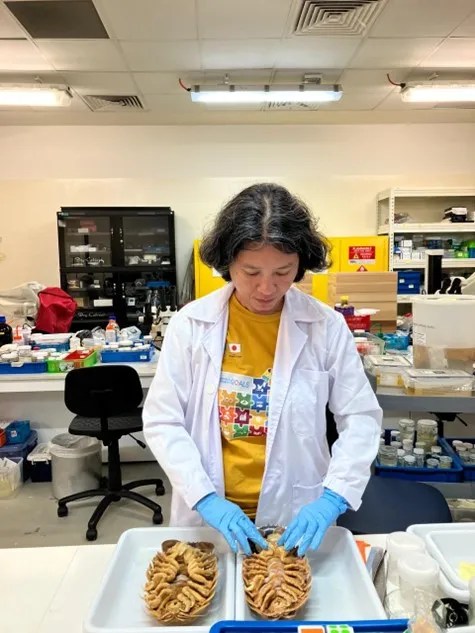
Prof. Peter Ng examining giant isopods from a seafood market in Hanoi, October 2024. Photo by Nguyen Thanh Son
Dr. Conni Sidabalok examining individuals of Bathynomus vaderi at Lee Kong Chian Natural History Museum, Singapore. Photo by Rene Ong
The story of how it was found is quite compelling. In contrast to the traditional image of deep-sea expeditions, Bathynomus vaderi was obtained from local sellers where the isopods are fished.
In March 2022, staff from Hanoi University purchased four giant isopod individuals from Quy Nhơn City and sent two of them to Peter Ng from the National University of Singapore for identification. Subsequently, this sparked an international collaboration between Ng, Conni M. Sidabalok (National Research and Innovation Agency, Indonesia), and Nguyen Thanh Son (Vietnam National University). Together, this expert team studied the specimens and confirmed they had discovered a species new to science.
Video by Kyle Hill on YouTube.
A Deep-Sea Delicacy
Giant isopods like Bathynomus vaderi have become an expensive delicacy in Vietnam. Until 2017, local fishermen only sold them as low-priced bycatch, but in recent years, the media has drawn public attention to this unusual seafood. Some even claim it is more delicious than lobster, the “king of seafood.”
The Importance of the Find
News story by Margherita Bassi via the Smithsonian magazine.
This discovery is a reminder of just how much we still don’t know about the vast deep-sea environment. If such a supergiant isopod could remain hidden for so long, it speaks to the extraordinary amount of work still needed to uncover the rich biodiversity of Southeast Asian waters – work that depends on the combined efforts of researchers and taxonomists, whose contributions are at the frontline of conservation.
The celebration is not over; we invite you to explore the Pensoft-published species that have previously made it to the WoRMS Top 10 and revisit the ocean’s most fascinating discoveries:
Ng PKL, Sidabalok CM, Nguyen TS (2025) A new species of supergiant Bathynomus A. Milne-Edwards, 1879 (Crustacea, Isopoda, Cirolanidae) from Vietnam, with notes on the taxonomy of Bathynomus jamesi Kou, Chen & Li, 2017. ZooKeys 1223: 289-310. https://doi.org/10.3897/zookeys.1223.139335
A new deep-sea chiton has been officially named by the public and described in the Biodiversity Data Journal. The name is the result of a viral, week-long collaboration between science communicator Ze Frank, Senckenberg, and Pensoft Publishers.
From over 8,000 suggestions submitted via social media, the research team responsible for describing the species selected the name Ferreiraella populi. The specific epithet populiis a Latin singular noun in the genitive case meaning “of the people”. Curiously, the name was independently suggested by 11 different contributors during the naming contest.
From a YouTube video to Taxonomy
It all began when Ze Frank featured the rare deep-sea chiton (genus Ferreiraella) in an episode of his “True Facts” YouTube series.
Equipped with an iron-clad radula (a rasping tongue) and eight protective shell plates, the chiton also hosts a tiny community of worms near its tail that feed on its excrements. Everyone was invited to propose a scientific name and justification; within a week the community responded with over 8,000 name suggestions.
“We were overwhelmed by the response and the massive number of creative name suggestions!” says Prof. Dr. Julia Sigwart, co-chair of SOSA at the Senckenberg Research Institute and Natural History Museum Frankfurt. “The name we chose, Ferreiraella populi, translates to “of the people”.
Other notable suggestions included Ferreiraella stellacadens meaning “Shooting star chiton” – named for its unique aesthete pattern and the fact that it “shot to fame” during the selection process.
Another was Fereiraella ohmu in reference to a chiton-like creature from Studio Ghibli, providing a nod to Japan, where the species was discovered.
A Specialized Resident of the Deep
Originally discovered in 2024 within the Izu-Ogasawara Trench at a depth of 5,500 meters, the new deep-sea chiton Ferreiraella populi belongs to the genus Ferreiraella, a rare and specialized group of mollusks that live exclusively on sunken wood in the deep sea.
Deep-sea sample extraction. Video Credit to Chong Chen/JAMSTEC
The new species represents an addition to a lineage of chitons that has been little researched to date and provides further evidence that deep-sea wood-fall ecosystems host highly specialized and still largely undiscovered communities,
explains Sigwart
Chitons are often described as a cross between a snail and a beetle. However, unlike common mollusks with a single shell, chitons possess eight separate shell plates(valves). This unique anatomy allows them to roll into a protective ball or cling to the irregular surfaces of deep-sea wood-falls.
Found in both warm coastal waters and coral reefs as well as the deep sea, chitons can live at depths of up to 7,000 meters under extreme conditions and in absolute darkness.
How is a scientific name formed?
Ever wonder how a creature goes from “that deep-sea thing” to a formal scientific entry? Every newly discovered species is assigned a scientific name as part of its original taxonomic description.
This follows Carl Linnaeus’s principle of binomial nomenclature and consists of two parts: the genus name (the first part, capitalized and italicised) and the specific epithet (the second part, lowercase and italicised).
The name is assigned by the author(s) of the first description in a scientific publication, adhering to international codes such as the ICZN (zoology) or the ICN (botany). The name must be novel, unique, and latinized. Usually, epithets are often derived from characteristics like color or size, geographic locations, mythology, or personal names used to honor a specific individual.
Ferreiraella populi in its natural habitat. Video credit to Chong Chen/JAMSTEC
Ferreiraella populi exemplifies the overwhelming biodiversity of the oceans, the vast majority of which remains unexplored. Many species go extinct before we even know they exist – this is especially true for marine invertebrates,
says Sigwart
“It can often take ten, if not twenty years, for a new species to be studied, scientifically described, named, and published. At SOSA, we have therefore made it our mission to streamline these processes while simultaneously engaging the public with these fascinating creatures. Finding a name for the chiton together on social media is a wonderful opportunity to do just that!” comments Sigwart.
“Ferreiraella populi has now been described and given a scientific name only two years after its discovery. This is crucial for the conservation of marine diversity, especially in light of the threats it faces such as deep-sea mining!” she says.
Research paper:
(SOSA) SOSA, Chen C, Frank H, Kraniotis L, Nakadera Y, Schwabe E, Sigwart JD, Trautwein B, Vončina K (2026) Ocean Species Discoveries 28–30 — new species of chitons (Mollusca, Polyplacophora) and a public naming competition. Biodiversity Data Journal 14: e180491. https://doi.org/10.3897/BDJ.14.e180491
Introducing Haploniscus hades, isopod of the underworld.
The deep sea is the largest yet least explored biome in the world, with estimates suggesting that up to 91% of marine species are yet to be discovered.
Indeed, when it comes to finding new species in the deep sea, things are more than a little tricky. Besides the obvious difficulties associated with scouring such vast, inaccessible depths, researchers also face the obstacle of so-called ‘cryptic’ species: groups of closely related taxa that are almost impossible to tell apart from looks alone.
The recently discovered Haploniscusbelyaevi isopod species complex is one such group, collected from the the abysso-hadal Kuril-Kamchatka Trench (KKT) region in the Northwest Pacific Ocean.
Distribution of haploniscid species of the belyaevi-complex in the greater Kuril-Kamchatka Trench and Sea of Okhotsk area of the Northwest Pacific. Stars indicate each species type locality.
Isopods collected from the region were initially believed to represent a single species, but are now known to represent at least six distinct species, five of which are new to science. Published in the journal Zoosystematics and Evolution, a new study combines classical morphology with DNA barcoding, confocal laser scanning microscopy, and the first-ever genomic sequencing of Haploniscidae isopods to distinguish these cryptic species.
In the research paper, lead author Dr Henry Knauber and his colleagues from the Senckenberg Research Institute and Goethe University Frankfurt provide detailed descriptions of each species and reveal the names of the new species, inspired by Greek mythology.
Meet the new isopods
Left to right: H.hades, H.belyaevi, and H.erebus.
Haploniscus hades
Who else could rule the hadal zone but Hades himself? This isopod’s pleotelson (tail segment) hides its uropods (tail appendages), which, to the endlessly creative research team, evoked the cap of invisibility used by Hades.
Haploniscus apaticus
Named after Apate, the goddess of deceit, this ‘deceptive’ isopod hides in plain sight thanks to its unassuming looks, which kept it hidden amongst its sibling species until recently.
Haploniscus erebus
Bearing the name of Erebus, the primordial god of darkness, this species lurks in the shadowy depths.
Haploniscus kerberos
Named after Kerberos (Cerberus), the multi-headed guardian of the underworld’s gates, this species is currently only known from the abyssal plains, watching over the borderlands between deep and deeper.
Haploniscus nyx
Nyx, the goddess of night, lends her name to this elusive species.
–
The isopod specimens were collected during deep-sea research expeditions between 2012 and 2016, covering depths of up to 8,000 meters.
While the names of these species represent little more than creative fun, the study’s findings help illuminate evolutionary processes across natural barriers such as the Kuril-Kamchatka Trench and underscore the potential for new discoveries in Earth’s least explored environments.
Who knows, perhaps Haploniscus hades has two brothers, H. zeus and H. Poseidon, hiding above, still waiting to be found.
Original source
Knauber H, Schell T, Brandt A, Riehl T (2025) Across trench and ridge: description of five new species of the Haploniscus belyaevi Birstein, 1963 species complex (Isopoda, Haploniscidae) from the Kuril-Kamchatka Trench region. Zoosystematics and Evolution 101(2): 813-853. https://doi.org/10.3897/zse.101.137663
Cover image credit: Isopods: Knauber et al.; Illustration: macrovector/Freepik.
Follow Zoosystematics and Evolution on X and Facebook