ANERIS at EGI2026: Bringing Operational Marine Biology to Europe Digital Research Infrastructure Community

Between 21-25 September 2026, our team joined the EGI2026 conference in Ghent, Belgium.

Between the 21st and the 25th of September 2026, the ANERIS project, joined the EGI2026 Conference in Ghent, Belgium, as an exhibitor and conference partner.

Group photo EGI 2026
Group photo provided by EGI Foundation


Every year, the EGI Conference brings together digital and research infrastructure providers, data scientists and innovators to advance data-intensive science. Organised by the EGI Foundation in collaboration with partners from the EGI Federation, this year’s edition took place at the Bijloke, a former hospital site turned arts and knowledge campus on the banks of the river Lys. The five-day programme covered topics ranging from AI for European science and the European Open Science Cloud (EOSC) to federated compute and data infrastructures for research.

For ANERIS, the conference was a natural fit as the EGI Foundation is one of the project’s 25 partners, and the project’s vision of faster, more reliable and accessible marine life data depends directly on the kind of digital infrastructure discussed in Ghent.
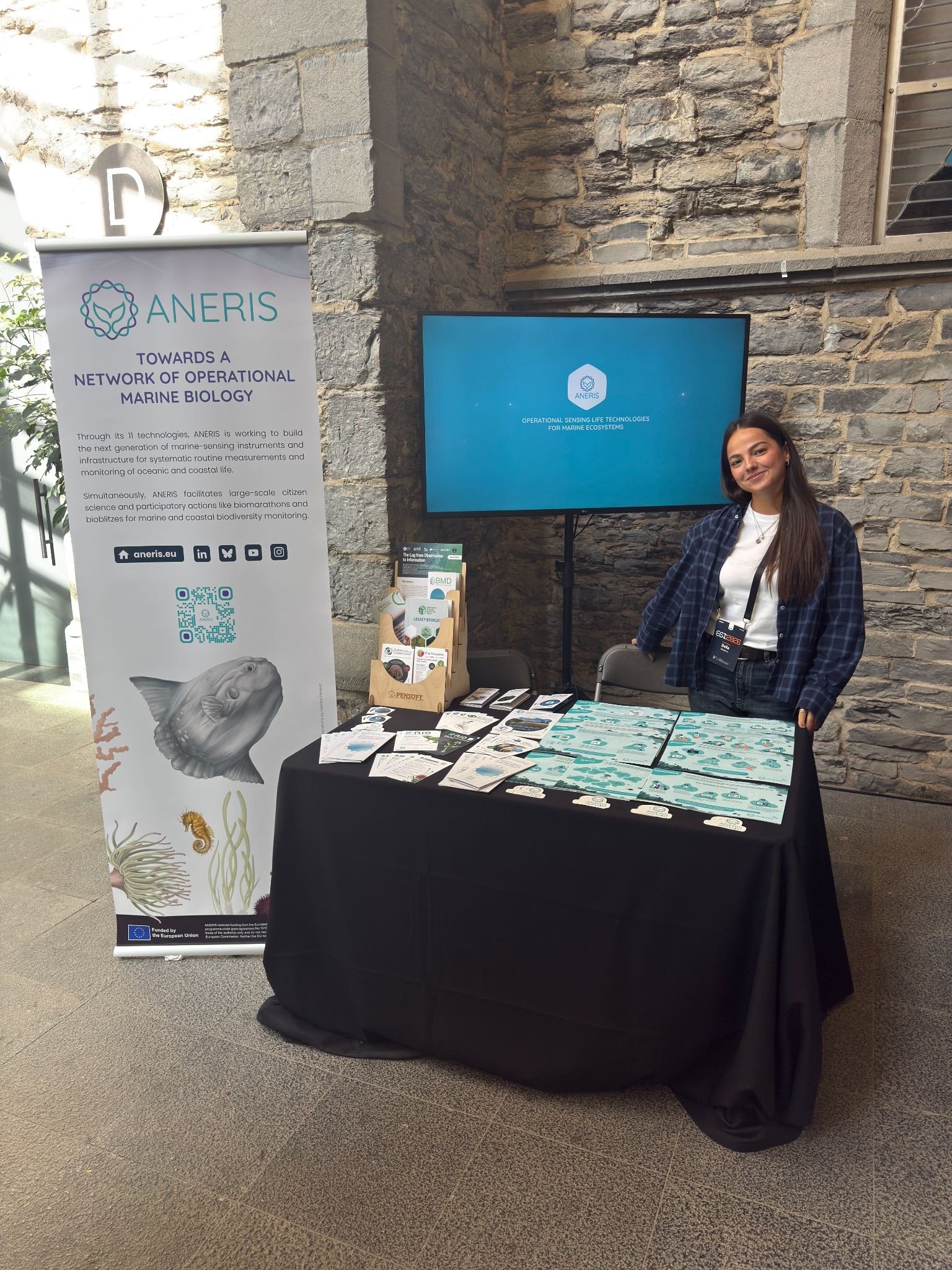
A person behind a stand
ANERIS booth at EGI2026 in Ghent.

During the opening ceremony, all exhibitors were invited to present their projects and initiatives to the audience in short pitches. Pensoft’s Communication Officer Bella Dimitrova used the opportunity to introduce ANERIS and its concept of Operational Marine Biology. Many attendees later came by the booth specifically to learn more about the project.

ANERIS materials
ANERIS materials.

The ANERIS booth welcomed a steady stream of visitors. Although most participants came from engineering and computing backgrounds, the project’s scientific illustrations and sticker sheets quickly became a highlight of the exhibition. The marine species featured on the stickers are among the most frequently observed and photographed during ANERIS citizen science campaigns. This made them a natural starting point for conversations about how volunteers, researchers and new technologies work together to monitor coastal biodiversity. Visitors also showed strong interest in the project’s newly produced case study factsheets and infographics, which made their print debut at the conference.

  • paper materials
  • paper materials
  • paper materials

At the booth, attendees could also learn more about Pensoft’s expertise and experience as a scientific publisher through a selection of journals aligned with the conference themes. They could also find out about Pensoft’s role as an active consortium member in the COAST-SCAPES, B-Cubed and Biodiversity Meets Data projects.   

Funded by the European Union’s Horizon Europe programme and coordinated by the Institute of Marine Sciences (ICM-CSIC), ANERIS brings together 25 partners from 13 countries. Over four years, the consortium has developed 11 technologies for marine life sensing and monitoring. They cover AI-assisted imaging of plankton and macrofauna, genomic and eDNA approaches and citizen science observatories such as MINKA.

As the project nears its end in December 2026, the focus is on making these tools usable beyond the project’s lifetime. This includes integrating them into European research infrastructures, which is why conversations with the EGI community were especially valuable. Combining large-scale imaging data, AI-based identification and citizen observations requires reliable storage, compute and data services. These are exactly the services EGI2026 participants build and operate.

The project’s results will be further showcased at the ANERIS Final Workshop “The future of marine monitoring – imaging, AI, and research infrastructures” on the 16th of November 2026. The hybrid event will be hosted by VLIZ in Oostende, Belgium. Through real-world case studies, partners will present tools including AI-driven underwater image restoration, automated organism identification platforms and integrated citizen science observatories. Shortly after, ANERIS will also take part in the 7th World Conference on Marine Biodiversity in Bruges.

The full plenary recordings and the detailed programme are available on the conference’s official website. 

Advancing eScience for biodiversity: Pensoft at the LifeWatch ERIC Biodiversity & Ecosystem eScience Conference

The conference facilitated valuable networking opportunities, meeting us with old friends but also giving us a chance to discuss potential future collaborations.

Between 30 June and 3 July, Pensoft’s team attended the LifeWatch ERIC Biodiversity & Ecosystem eScience Conference (BEeS) in Heraklion, Greece. The event was organized by the LifeWatch ERIC Infrastructure with the aim of tackling the Triple Planetary Crisis (climate change, biodiversity loss, and pollution) through eScience and European Research Infrastructures (RIs). With almost 200 registered participants, the conference discussed “how cutting-edge eScience and European Research Infrastructures can work together to develop innovative solutions for a sustainable future.”

Hosted by the Hellenic Centre for Marine Research, BEeS convened 193 registrants, featured 59 presentations, 36 posters, and provided 12 training sessions, highlighting the vital role of technology, data, and collaborative efforts in confronting global environmental challenges.

On the first day, a closed-door meeting was held with the aim of adopting a Declaration of Intent (the Crete Declaration) between the involved RIs, e-infrastructures, EU-relevant projects, and Pensoft, as a scientific publisher. The objective was to advance the One Health approach—a strategy that optimizes the health of people, animals, and ecosystems. The Declaration outlines four key strategic commitments:

  • strengthening strategic collaboration
  • advancing data integration and FAIR (Findable, Accessible, Interoperable, Reusable) principles
  • supporting Open Science Ecosystems
  • informing policy and practice

Christos Arvanitidis, the president of LifeWatch ERIC, came to the Pensoft stand to meet with our staff and discuss our agenda.

Two men stand behind an exhibition table filled with brochures and materials for biodiversity science, showcasing several organizations and journals.

Pensoft was also invited to present the outcomes of the BiCIKL project, on which we partnered with LifeWatch ERIC, as part of the Mapping Life on Planet Earth: Biogeography in a Changing World session.

Teodor Georgiev, Chief Technology Officer of Pensoft, delivered the presentation, titled The BiCIKL project traverses obstacles to FAIR and linked biodiversity data usage.

The BiCIKL project, which concluded on 30 April 2024, aims to catalyse the culture change in the way biodiversity data are identified, linked, integrated and re-used across the research lifecycle. Key outcomesinclude the creation of uni- and bi-directional links between biodiversity RIs, the establishment of best practices for Persistent Identifiers (PIDs), recommendations for interoperability between RIs, and the development of automated tools and workflows for published data liberation and FAIR-isation. The presentation also introduced the Biodiversity Knowledge Hub, a one-stop portal for understanding the complex, but increasingly interconnected landscape of biodiversity RIs.

Georgiev also delivered a poster presentation, discussing SOLO: a collaborative open-review and publishing platform supporting the EU Soil Mission.

SOLO, a Horizon Europe project in which Pensoft is involved, aims to identify current knowledge gaps, drivers, bottlenecks, and novel research and innovation approaches to be considered in the European Soil Mission research and innovation roadmap. Hosted on Pensoft’s ARPHA publishing platform and integrating the ARPHA Writing Tool, SOLO engages researchers, practitioners, citizens and other stakeholders in the development and review of ‘living’ open-access documents supporting the EU Mission “A Soil Deal for Europe.” Pensoft’s contribution to SOLO encompasses communication, dissemination, data management, and the crucial development of the platform itself.

Fifteen research infrastructures and 15 projects were officially represented at BEes, including two other Horizon Europe projects where Pensoft is a partner: ANERIS, which focuses on scientific tools and methods for marine life-sensing and monitoring, and BMD, which offers a single access point to high-throughput biodiversity monitoring tools.

Berta Companys of the Spanish National Research Council introduced ANERIS with an insightful presentation on the project’s innovative technologies, workflow, and overall approach. Her talk highlighted the key challenges connected to marine biodiversity and monitoring sea and ocean ecosystems that ANERIS is tackling and outlined the solutions the project is developing to address them, such as the implementation of Operational Marine Biology (OMB) data products.

BMD was represented by coordinator Niels Raes of Naturalis Biodiversity Center.

An exhibition booth displays various informational materials related to biodiversity, flanked by two attendees.

The conference facilitated valuable networking opportunities, meeting us with old friends but also giving us a chance to discuss potential future collaborations. Pensoft engaged with partners from other European Research Infrastructures, sharing a dedication to collaborative research and the development of open-access resources addressing global environmental challenges.