ANERIS at EGI2026: Bringing Operational Marine Biology to Europe Digital Research Infrastructure Community

Between 21-25 September 2026, our team joined the EGI2026 conference in Ghent, Belgium.

Between the 21st and the 25th of September 2026, the ANERIS project, joined the EGI2026 Conference in Ghent, Belgium, as an exhibitor and conference partner.

Group photo EGI 2026
Group photo provided by EGI Foundation


Every year, the EGI Conference brings together digital and research infrastructure providers, data scientists and innovators to advance data-intensive science. Organised by the EGI Foundation in collaboration with partners from the EGI Federation, this year’s edition took place at the Bijloke, a former hospital site turned arts and knowledge campus on the banks of the river Lys. The five-day programme covered topics ranging from AI for European science and the European Open Science Cloud (EOSC) to federated compute and data infrastructures for research.

For ANERIS, the conference was a natural fit as the EGI Foundation is one of the project’s 25 partners, and the project’s vision of faster, more reliable and accessible marine life data depends directly on the kind of digital infrastructure discussed in Ghent.
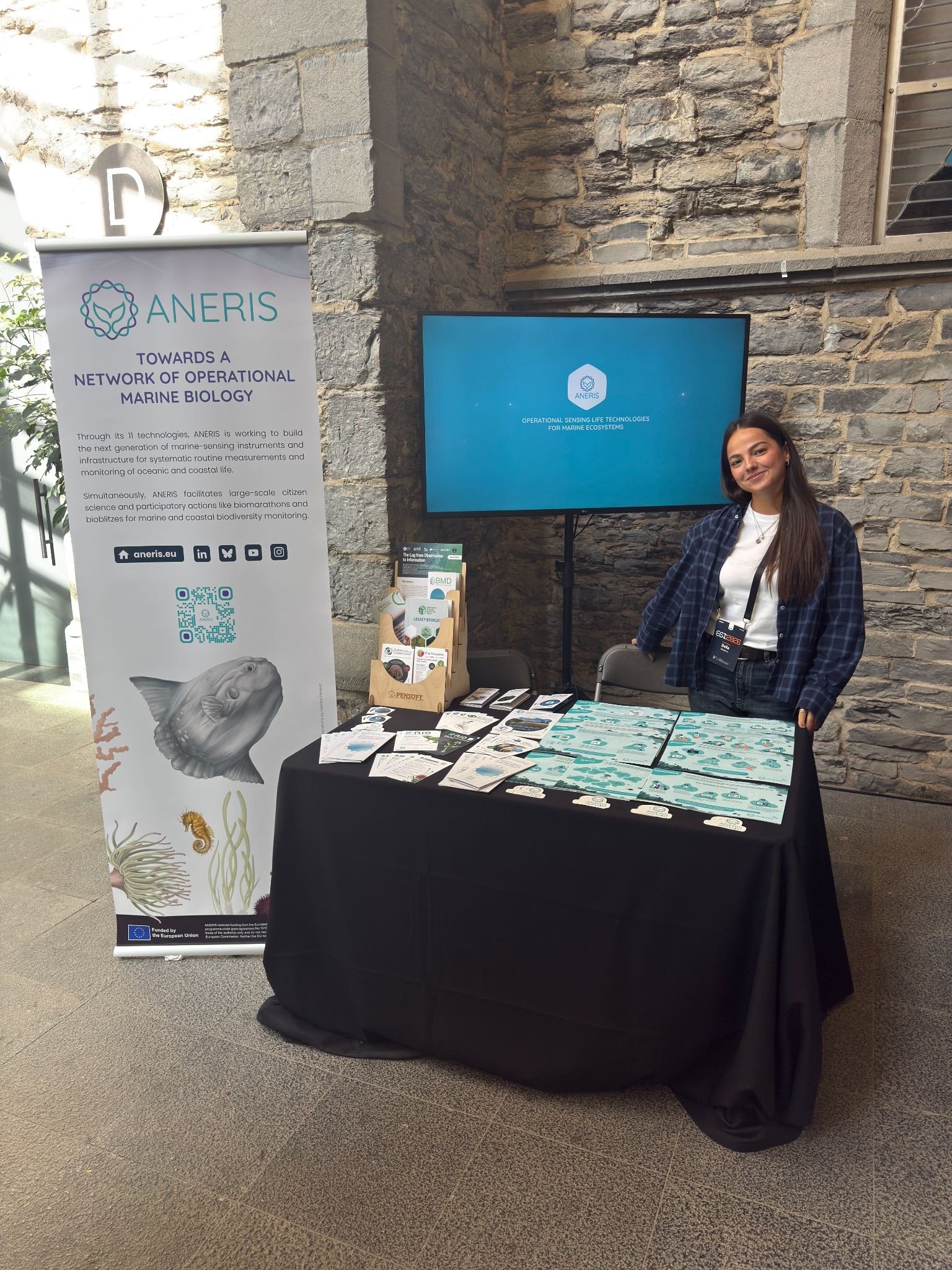
A person behind a stand
ANERIS booth at EGI2026 in Ghent.

During the opening ceremony, all exhibitors were invited to present their projects and initiatives to the audience in short pitches. Pensoft’s Communication Officer Bella Dimitrova used the opportunity to introduce ANERIS and its concept of Operational Marine Biology. Many attendees later came by the booth specifically to learn more about the project.

ANERIS materials
ANERIS materials.

The ANERIS booth welcomed a steady stream of visitors. Although most participants came from engineering and computing backgrounds, the project’s scientific illustrations and sticker sheets quickly became a highlight of the exhibition. The marine species featured on the stickers are among the most frequently observed and photographed during ANERIS citizen science campaigns. This made them a natural starting point for conversations about how volunteers, researchers and new technologies work together to monitor coastal biodiversity. Visitors also showed strong interest in the project’s newly produced case study factsheets and infographics, which made their print debut at the conference.

  • paper materials
  • paper materials
  • paper materials

At the booth, attendees could also learn more about Pensoft’s expertise and experience as a scientific publisher through a selection of journals aligned with the conference themes. They could also find out about Pensoft’s role as an active consortium member in the COAST-SCAPES, B-Cubed and Biodiversity Meets Data projects.   

Funded by the European Union’s Horizon Europe programme and coordinated by the Institute of Marine Sciences (ICM-CSIC), ANERIS brings together 25 partners from 13 countries. Over four years, the consortium has developed 11 technologies for marine life sensing and monitoring. They cover AI-assisted imaging of plankton and macrofauna, genomic and eDNA approaches and citizen science observatories such as MINKA.

As the project nears its end in December 2026, the focus is on making these tools usable beyond the project’s lifetime. This includes integrating them into European research infrastructures, which is why conversations with the EGI community were especially valuable. Combining large-scale imaging data, AI-based identification and citizen observations requires reliable storage, compute and data services. These are exactly the services EGI2026 participants build and operate.

The project’s results will be further showcased at the ANERIS Final Workshop “The future of marine monitoring – imaging, AI, and research infrastructures” on the 16th of November 2026. The hybrid event will be hosted by VLIZ in Oostende, Belgium. Through real-world case studies, partners will present tools including AI-driven underwater image restoration, automated organism identification platforms and integrated citizen science observatories. Shortly after, ANERIS will also take part in the 7th World Conference on Marine Biodiversity in Bruges.

The full plenary recordings and the detailed programme are available on the conference’s official website. 

New Horizon Europe project supports land-coast-sea systems under climate change

“COAST-SCAPES is a collective effort to rethink how we coexist with coastal systems”, explains project coordinator Prof. Manel Grifoll.

COAST-SCAPES: a newly launched project, funded by the European Commission, is to propose a reconsideration of the current coastal ecosystem to enhance resilience and biodiversity protection through nature-based solutions.

Leading maritime engineering specialists, marine ecologists, and biodiversity experts, gathered in Barcelona (Spain) between 7 and 9 October to officially kick start the project’s vision on climate-resilient coastal landscapes. Hosted by the Maritime Engineering Laboratory from the Polytechnic University of Catalonia, the meeting focused on setting the strategic direction of the project, aligning the scientific, technical and communication objectives and establishing synergies between project partners across Europe and beyond. 

In the span of two days, consortium partners were given the opportunity to present their missions with the COAST-SCAPES project, showcasing how each partner institution will contribute to building science-based and community-driven resilience pathways. 

The project coordinator, Prof. Manel Grifoll, navigated the discussions, which centered around key deliverables and milestones, future challenges and plans on work-related activities, highlighting the crucial role of the project’s Core and Replicating Pilots for scalable resilience plans for replication and export. 

A group photo of the COAST-SCAPES consortium at the project’s kick-off (Barcelona, October 2025).

Officially started on 1 September 2025, the COAST-SCAPES project has major ambitions to co-design systemic resilience solutions for coastal landscapes by developing integrated indicators, proactive climate warning systems, as well as knowledge-based strategies for business and maintenance in order to reduce the risks of climate change and improve land-sea interactions. To achieve this, COAST-SCAPES will promote the utilisation of nature-based solutions (NbS), seeking biodiversity gains and reduction of the environmental footprint under scarce natural resources. 

The project brings together a diverse group of partners, including research institutions, universities and technological organisations from Europe, Africa and Latin America. Their shared goal is to restore vulnerable coastal areas and apply resilience through adaptation. Due to human intervention, which drastically altered the evolution of coastal ecosystems, the ecological role of such areas is becoming crucial. By harnessing their low-carbon adaptation potential, coastal ecosystems can mitigate climate-related risks and boost biodiversity.

COAST-SCAPES is a collective effort to rethink how we coexist with coastal systems. By integrating natural processes, technology, and community knowledge, we aim to create adaptive landscapes that safeguard biodiversity and support sustainable livelihoods. Our ambition is to build resilient coasts that can thrive, not just survive, under climate change.

says Prof. Manel Grifoll, project coordinator.

The selected project’s Core Pilots, among which the Mar Menor lagoon in the Iberian Peninsula, will serve as a starting point for leading experts to carry out large-scale resilience plans, while protecting coastal biodiversity and addressing existing infrastructure challenges. 

Supported by social and technical innovation, as well as a governance shift, these plans will connect scientists, citizens, policy-makers, environmental activists, and the industry with administrations responsible for local implementations for an increased cross-sectoral engagement. Contributing to a balanced land-to-sea ecosystem and a sustainable biodiversity protection, COAST-SCAPES reminds us that coastal restoration is vital for our adaptation to climate change.

Pensoft’s contribution to COAST-SCAPES:

Pensoft will lead two tasks within the COAST-SCAPES’ Work Package dedicated to dissemination and communication for practical exploitation. The objectives of these tasks are focused on the identification of key exploitable results of the project. Together with other consortium members, Pensoft will be working on establishing the most suitable exploitation pathways for each result. The experienced communication team at the scholarly publishing and technology providing company will also be actively raising societal and technical awareness necessary to transform governance for systemic resilience through yearly newsletters and policy briefs. In addition, Pensoft takes part in Work Package 6, where it will be responsible for the project’s visual identity and ensuring constant visibility of project results, as well as proper data management. 

List of project consortium members: 

Coordinated by the Polytechnic University of Catalonia, the project brings together 30 partner organisations from 15 countries to develop coastal resilience through nature-based solutions (NbS).

  1. Polytechnic University of Catalonia (UPC) 
  2. EURECAT Technology Centre 
  3. The New Water Culture Foundation (FNCA)
  4. National Research and Development Institute for Marine Geology and Geoecology (GeoEcoMar) 
  5. Consortium for the coordination of research relating to the Venice lagoon system (CORILA) 
  6. National Institute of Oceanography and Experimental Geophysics (OGS) 
  7. Euro-Mediterranean Center on Climate Change (CMCC)
  8. Scottish Association for Marine Science (SAMS)
  9. Royal Melbourne Institute of Technology Spain SL (RMIT Spain)
  10.  University of Aveiro (UA) 
  11.  Pensoft Publishers (Pensoft) 
  12.  Ludwig-Maximilians-Universität München (LMU)
  13.  Lower Saxony State Office for Water Management, Coastal Protection and Nature Conservation (NLWKN) 
  14.  University of Save (USV)
  15.  Northern University Foundation (UNR) 
  16.  Mohammed Premier University (UMP) 
  17.  Assane-Seck University of Ziguinchor (UASZ)  
  18.  Global Climate Forum (GCF) 
  19.  Helmholtz-Zentrum Hereon GMBH 
  20.  Odesa I.I. Mechnykov National University 
  21.  International Center for Coastal Resources Research of Spain 
  22.  Can Tho University 
  23.  Ministry of Infrastructure and of Transport of Italy 
  24.  Spanish National Research Council (CSIC) 
  25.  University of San Francisco de Quito (USFQ) 
  26.  WWF Romania 
  27.  Association for the Defense of Nature/WWF – Spain 
  28.  Royal Melbourne Institute of Technology – RMIT University (RMIT Uni) 
  29.  Ministry for Ecological Transition and the Demographic Challenge of Spain (MITECO) 
  30.  Portuguese Environment Agency (APA)

For more information:

Follow the COAST-SCAPES project on Bluesky and LinkedIn.

Project website coming soon!


Funded by the European Union under grant agreement No. 101213138, COAST-SCAPES (rethinking COASTal landSCAPES with climate-resilient interventions: systemic land-to-sea solutions).

Views and opinions expressed are, however, those of the author(s) only and do not necessarily reflect those of the European Union or the European Research Executive Agency (REA). Neither the EU, nor the REA can be held responsible for them.