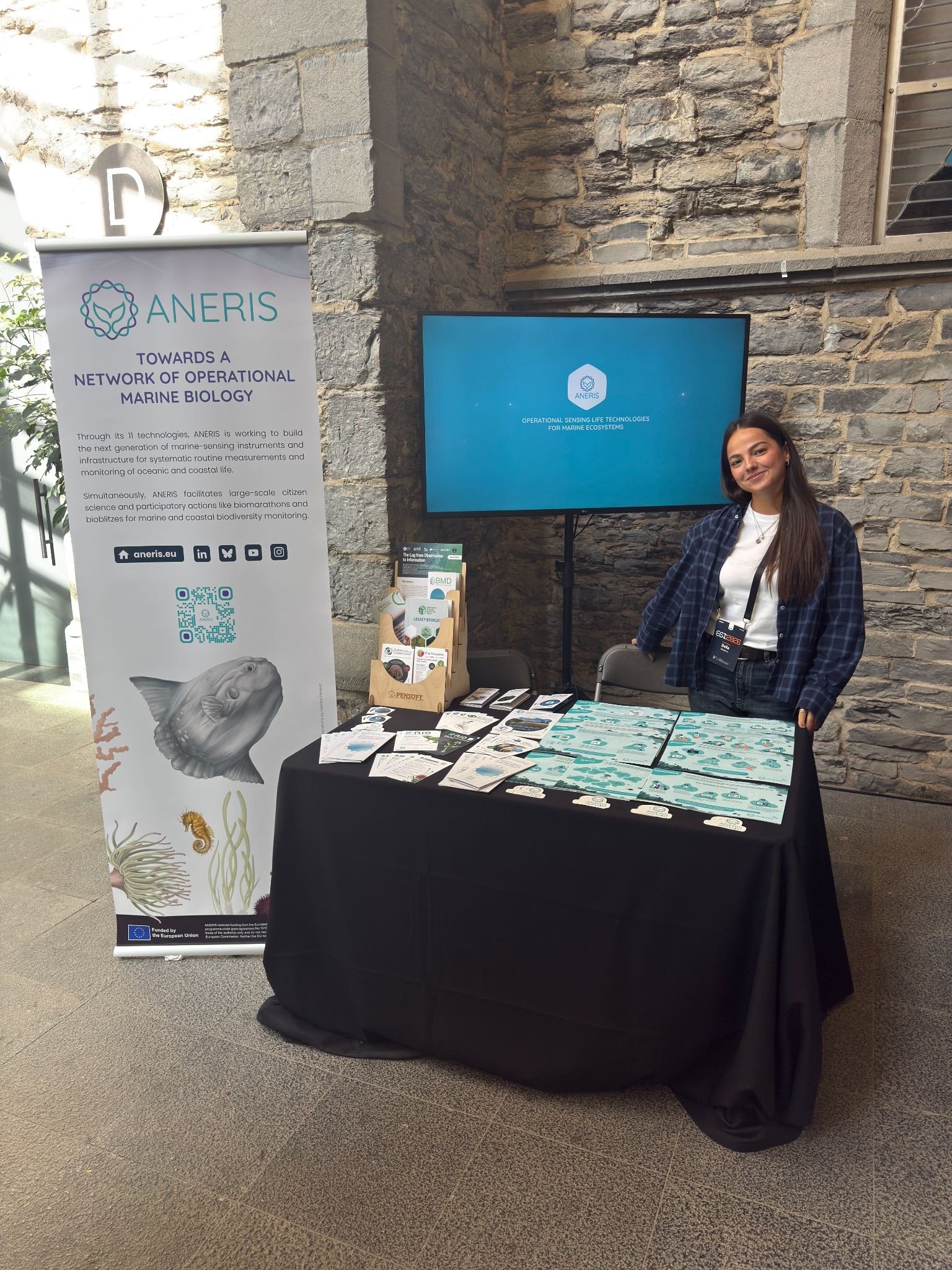
Between the 21st and the 25th of September 2026, the ANERIS project, joined the EGI2026 Conference in Ghent, Belgium, as an exhibitor and conference partner.
Group photo provided by EGI Foundation
Every year, the EGI Conference brings together digital and research infrastructure providers, data scientists and innovators to advance data-intensive science. Organised by the EGI Foundation in collaboration with partners from the EGI Federation, this year’s edition took place at the Bijloke, a former hospital site turned arts and knowledge campus on the banks of the river Lys. The five-day programme covered topics ranging from AI for European science and the European Open Science Cloud (EOSC) to federated compute and data infrastructures for research.
For ANERIS, the conference was a natural fit as the EGI Foundation is one of the project’s 25 partners, and the project’s vision of faster, more reliable and accessible marine life data depends directly on the kind of digital infrastructure discussed in Ghent.
ANERIS booth at EGI2026 in Ghent.
During the opening ceremony, all exhibitors were invited to present their projects and initiatives to the audience in short pitches. Pensoft’s Communication Officer Bella Dimitrova used the opportunity to introduce ANERIS and its concept of Operational Marine Biology. Many attendees later came by the booth specifically to learn more about the project.
ANERIS materials.
The ANERIS booth welcomed a steady stream of visitors. Although most participants came from engineering and computing backgrounds, the project’s scientific illustrations and sticker sheets quickly became a highlight of the exhibition. The marine species featured on the stickers are among the most frequently observed and photographed during ANERIS citizen science campaigns. This made them a natural starting point for conversations about how volunteers, researchers and new technologies work together to monitor coastal biodiversity. Visitors also showed strong interest in the project’s newly produced case study factsheets and infographics, which made their print debut at the conference.
At the booth, attendees could also learn more about Pensoft’s expertise and experience as a scientific publisher through a selection of journals aligned with the conference themes. They could also find out about Pensoft’s role as an active consortium member in the COAST-SCAPES, B-Cubed and Biodiversity Meets Data projects.
Funded by the European Union’s Horizon Europe programme and coordinated by the Institute of Marine Sciences (ICM-CSIC), ANERIS brings together 25 partners from 13 countries. Over four years, the consortium has developed 11 technologies for marine life sensing and monitoring. They cover AI-assisted imaging of plankton and macrofauna, genomic and eDNA approaches and citizen science observatories such as MINKA.
As the project nears its end in December 2026, the focus is on making these tools usable beyond the project’s lifetime. This includes integrating them into European research infrastructures, which is why conversations with the EGI community were especially valuable. Combining large-scale imaging data, AI-based identification and citizen observations requires reliable storage, compute and data services. These are exactly the services EGI2026 participants build and operate.
The project’s results will be further showcased at the ANERIS Final Workshop “The future of marine monitoring – imaging, AI, and research infrastructures” on the 16th of November 2026. The hybrid event will be hosted by VLIZ in Oostende, Belgium. Through real-world case studies, partners will present tools including AI-driven underwater image restoration, automated organism identification platforms and integrated citizen science observatories. Shortly after, ANERIS will also take part in the 7th World Conference on Marine Biodiversity in Bruges.
Last week marked another annual meeting of the Biodiversity Information Standards network, otherwise known as TDWG, with the Norwegian capital Oslo hosting the event between 20 and 25 September.
Last week marked another annual meeting of the Biodiversity Information Standards network, otherwise known as TDWG, with the Norwegian capital Oslo hosting the event between 21 and 25 September.
TDWG is the international, non-profit organisation formerly known as the Taxonomic Databases Working Group, which develops and maintains the standards, such as Darwin Core, that allow biodiversity data to be shared, integrated and understood across institutions worldwide.
The six-day programme was a meeting point for over 300 stakeholders from research, practitioner and corporate circles, with proceedings centred around one central topic – “Research and Robot-Ready Biodiversity Data Standards”. In that sense, the themes of accessibility, responsibility, innovation and collaboration were foremost on the minds of participants as they contemplated how information on the biosphere should be extracted, consolidated and shared in the years to come.
As a long-standing partner of TDWG, Pensoft Publishers served as both a sponsor and an exhibitor for the event. In the latter capacity, the company contributed with a joint booth for three of the EU-funded projects it is leading the outreach efforts for:
BMD – an initiative working towards a Biodiversity Explorer for high-throughput biodiversity monitoring tools, biodiversity data and biodiversity analyses for better conservation across Europe
TETTRIX – a new arrival building a next-generation taxonomic system connecting knowledge, expertise and innovation for all across the Old Continent
ANERIS – a pan-European effort to mobilise a network of operational marine biology via a new technological infrastructure
The Pensoft team at the joint booth of the BMD, TETTRIX and ANERIS projects.
A number of other projects from Pensoft’s communication portfolio also found a place in the display, including BEAGLE, OneSTOP, B-Cubed, MAMBO, OBSGESSION and BioAgora. Furthermore, 14 of the company’s journals were in the spotlight, including Biodiversity Information Science and Standards (BISS), the official journal of the TDWG community (where all of the conference’s abstracts are set to be published).
Crucially, the event also saw the official launch of ORPHO, Pensoft’s new collaborative workspace for scientific writing. Founder and CEO Prof. Lyubomir Penev and CTO Teodor Georgiev conducted live demos of the tool, showcasing how manuscripts crafted within it with full version control for authors become discoverable, interoperable and FAIR-compliant.
In the context of TDWG2026’s agenda, they also presented ORPHO’s integrated semantic annotation and communication instruments as part of the workshop “How Literature Services can Support & Benefit from Biodiversity Publication and Data Standards?” on 24 September. The workspace was received with anticipation and enthusiasm by attendees, with many expressing a desire to test it out for themselves.
They were also treated with a tease of Pensoft’s next large-scale endeavour, as Senior Communications Officer Peter Bozakov pulled the curtain behind the forthcoming communication platform for research projects Scientiana.
Pensoft’s CTO Teodor Georgiev introduces the collaborative scientific workspace ORPHO.
As for other notable contributions to the wider conference agenda by researchers affiliated with Pensoft’s publishing or project activities:
The session “Operationalising Biodiversity Digital Twins within Data Space Ecosystems”, which was co-led by BMD coordinator and long-time author and reviewer across several Pensoft journals, including Biodiversity Data Journal and Research Ideas and Outcomes, Niels Raes, and showcased a number of innovative outputs from the project. As such, it was an important occasion to assess the initiative’s progress towards unifying Europe’s Data Space within a single Biodiversity Explorer.
Niels Raes presenting “Mainstreaming high-throughput biodiversity monitoring using AI” at TDWG 2026.
The symposium “Publishing and Communications Promoting Biodiversity, Natural History Collections, People, Data and Data Standards”, for which Deborah Paul (co-Editor-in-Chief of the Natural History Collections and Museomics (NHCM) journal) had the role of co-organiser. Within it, the TETTRIX project’s vision for the automated tracking of taxonomic research activities was laid out by consortium member David Fichtmüller. Moreover, Shelley James (co-Editor-in-Chief for NHCM) delivered an insightful talk on the creative promotion of biodiversity data and standards for success and recognition.
Co-Editors-in-Chief of NHCM, Shelley James and Deborah Paul, presenting “Hit or miss? Creative promotion of biodiversity data and standards for success and recognition” at TDWG 2026.
Notably, the Biodiversity Information Science and Standards (BISS) journal is the home for TDWG conference abstracts. TDWG 2026 presenters can currently submit their abstracts there and publish them in an extended abstract or mini-paper format completely free of charge. The journal also hosts abstracts from conferences held over the past decade. You can browse the TDWG 2026 collection here.
Last but not least, the company’s sponsorship supported two awards at TDWG2026 (with a free publication in a Pensoft journal as an accompanying prize):
Best Student Oral Presentation – awarded to Yeshan Qui for “Reporting structure and sampling-bias correction in citizen-science bird data across Asian cities”
Best Student Poster – awarded to Claudia Campanini for “Improving marine fieldwork documentation and metadata with Adaptable Standardised Methods Reporting (ASMR)”
Claudia Campanini receiving the Pensoft Best Student Poster Award at TDWG 2026.
Overall, TDWG2026 proved itself a crucial forum for mapping out the future of biodiversity monitoring and the management of the myriad data streams that emerge from it. Pensoft is proud to be an important actor in this process, contributing with innovative tools and solutions at the heart of the interface between research and practice. As summarised by Prof. Penev:
“Given its status as a large-scale conference centred around the future of biodiversity sciences in the age of AI, TDWG2026 was a crucial venue for unveiling Pensoft’s forward-looking vision for academic publishing and science communication. The “pearl” of these pursuits is undoubtedly the ORPHO workspace, a tool that is well-placed to introduce a new standard when it comes to collaborative AI-FAIR research in Europe and beyond.”
The inaugural conference took place in Sofia, Bulgaria, bringing together researchers, conservationists and practitioners to address gaps in small mammal research and monitoring.
The inaugural European Small Mammal Conservation Conference (SMCC 2026) took place in Sofia, Bulgaria, from 21 to 25 September 2026, bringing together researchers, conservationists and practitioners from across Europe and beyond to address gaps in small mammal research and monitoring.
This year’s conference was held jointly with the 33rd Hamster Working Group and the VIII European Ground Squirrel Meeting, making hamsters and sousliks the primary focus, alongside broader topics including renewable energy development, agricultural impacts, reintroductions, predator–prey interactions and innovative methodologies in small mammal research.
We were delighted to participate in SMCC 2026 with an exhibition booth, showcasing the breadth of publishing services we offer to the biodiversity and conservation community. It was a pleasure to present our portfolio of journals dedicated to advancing research across ecology, biodiversity and conservation.
Pensoft’s booth at SMCC 2026.
We were particularly proud to present the following journals:
Individual-based Ecology – exploring the physiological and behavioural mechanisms that shape ecological processes
Biodiversity Data Journal – an open-access venue for publishing primary biodiversity data and datasets
Pensoft’s journal portfolio exhibited at SMCC 2026.
Meeting delegates from across the small mammal research community was tremendously rewarding, and we thoroughly enjoyed discussing how our journals can support and amplify their work.
Beyond our academic offerings, we were particularly excited to showcase beautiful art prints illustrated by our in-house scientific illustrator, Denitsa Peneva. The collection featured stunning depictions of otters, olinguitos and hamsters.
Pensoft’s art prints at SMCC 2026.
Conference Highlights
The scientific programme was exceptional, and we were privileged to attend many outstanding presentations that demonstrated the importance of innovative monitoring approaches and conservation action.
Lessons from Citizen Science for Small Mammal Conservation Monitoring in Great Britain
We were delighted to attend a talk by Matt Larsen-Daw, Chief Executive of the Mammal Society (UK), which presented a portfolio of citizen science programmes designed to address distribution knowledge and population monitoring across Great Britain. The programmes, united by the Mammal Mapper smartphone app, included the National Harvest Mouse Survey, the Searching for Shrews initiative, and the University Mammal Challenge.
The presentation highlighted the value of standardised effort data, the differing trade-offs between structured and opportunistic recording, and the potential for these approaches to be applied across European contexts.
Matt Larsen-Daw presenting “Lessons from citizen science for small mammal conservation monitoring in Great Britain” at SMCC 2026.
Strong Decline of Hamster Populations in Bulgaria
We were equally impressed by Nedko Nedyalkov’s presentation documenting the significant decline in distribution and abundance of both the common hamster (Cricetus cricetus) and the Romanian hamster (Mesocricetus newtoni) across Bulgaria. The research revealed that population reductions, detected through owl pellet analysis and trapping methods, likely began in the 1950s with agricultural intensification and continue today.
Given that both species are strictly protected under the EU Habitats Directive yet lack active conservation projects, the presentation substantiated the urgent need for targeted conservation measures. We are also pleased to note that Nedko serves as a subject editor for two of our open-access journals, ZooKeys and the Biodiversity Data Journal.
Nedko Nedyalkov presenting “Strong decline of the distribution and abundance of Cricetus cricetus and Mesocricetus newtoni (Mammalia: Cricetinae) in Bulgaria” at SMCC 2026.
Reintroduced Saker Falcons and Their Dependence on European Ground Squirrels
Yana Andonova’s presentation on the diet of Bulgaria’s reintroduced saker falcon population provided compelling evidence of the breeding birds’ overwhelming dependence on the European ground squirrel (Spermophilus citellus) as a primary food source.
Through food-remain analysis, visual observations and camera-trap monitoring, the research documented that ground squirrels comprised over 80 per cent of identified prey items, with small rodents accounting for 89 per cent overall! It is also worth mentioning that Andonova is an author in our open-access Biodiversity Data Journal.
Yana Andonova presenting “Reintroduced Saker Falcons (Falco cherrug Gray, 1834) are dependent on European ground squirrels during the breeding period in Bulgaria” at SMCC 2026.
Looking Forward
Attending SMCC 2026 was a genuine pleasure and particularly meaningful given that the conference took place in Sofia, the city in which our company is based. Connecting with researchers and conservationists working at the forefront of small mammal conservation, and sharing our commitment to advancing biodiversity research through open-access publishing, reinforced our dedication to supporting this important field.
We look very much forward to engaging with this community again at future events!
Pensoft Publishers took part in the 14th International Conference on Biological Invasions (NeoBiota 2026) in Brussels, Belgium, between 7-11 September 2026.
Pensoft Publishers took part in the 14th International Conference on Biological Invasions (NeoBiota 2026) in Brussels, Belgium, between 7-11 September 2026. The well-established biennial series brought together researchers, practitioners, policymakers and stakeholders from around the world to share cutting-edge scientific research on biological invasions.
Over five days, the conference covered the full arc of the field, from how alien species arrive and spread to what they do to ecosystems and to people. The conference sessions also tackled how risks are assessed and prioritised, and what management, policy and public engagement can realistically achieve.
Pensoft’s Presence
During the days of the conference, we showcased our journals’ portfolio and project materials from OneSTOP and other projects, which were of interest to the participants.
Pensoft’s stand at the 14th International Conference on Biological Invasions.
More specifically, Pensoft was represented with a booth showcasing the relevant journals such as:
NeoBiota– publishes all disciplines interested in biological invasions, specifically on the ecology, evolution and biogeography of non-indigenous aquatic and terrestrial animals, plants, fungi and micro-organisms
Nature Conservation – publishes all disciplines interested in basic and applied conservation ecology and nature conservation in general at various spatial, temporal and evolutionary scales
Biodiversity Data Journal – publishes biodiversity science containing taxonomic, floristic/faunistic, morphological, genomic, phylogenetic, ecological or environmental data on any taxon of any geological age from any part of the world
One Ecosystem – provides a forum for studies in the field of ecology and sustainability
PhytoKeys– publishes in systematic Botany containing taxonomic/floristic data on any taxon of any geological age from any part of the world
MycoKeys – publishes on the monophyletic kingdom Fungi containing taxonomic or ecological data on any taxon of any geological age from any part of the world
ZooKeys– launched to support free exchange of ideas, data and information in all branches of Zoology
Research Ideas and Outcomes – publishes all outputs of the research cycle, including: project proposals, data, methods, workflows, software, project reports and research articles
Pensoft at the 14th International Conference on Biological Invasions.
During the days of the conference, we met many project partners and journal editors. Indeed, Pensoft’s presence at the conference was significant, with a Pensoft NeoBiota editorial meeting held and the Pensoft Award for the Best Talk given by Ana Novoa to Rajat Rastagi at the closing ceremony of the conference.
The Highlights
Pensoft Editorial Meeting
On Tuesday evening, NeoBiota convened its editorial board to review the journal’s progress. The meeting highlighted significant developments, including increases in article submissions and continued improvement in the journal’s impact and reputation within the field.
NeoBiota Editorial Meeting, 2026.
Visiting Meise Botanic Garden
On Wednesday, meanwhile, we visited Meise Botanic Garden, the home of OneSTOP’s coordinators and the Plant Ecology and Evolution journal. The trip allowed us to meet some editors from the journal and talk to them about their plans and publications. In addition, the project OneSTOP was showcased, and the walk in the garden allowed participants to test OneSTOP’s web app for the identification of invasive species.
Meise Botanic Garden, 2026.
Notable Presentations
While the conference included numerous notable presentations, Joana Vicente’s keynote Prioritisation in the Age of Invasion Science: From Risk Ranking to Adaptive Governance, is especially worth mentioning. Joana represented BIOPOLIS-CIBIO, one of OneSTOP’s partners, and showcased OneSTOP’s work in prioritisation. The key takeaway was as follows:
“Prioritisation should not be a one-off ranking of species but an ongoing, adaptive process built into how invasions are governed”.
Joana Vicente presenting at NeoBiota 2026.
Another important session was one on Friday morning, where Quentin Groom (coordinator of OneSTOP and author, reviewer and subject Editor in Biodiversity Data Journal, NeoBiota, One Ecosystem) presented the importance of developing an early-alert system for invasive alien species in the session – From prototype to infrastructure: building a cross-realm European alert system for invasive alien species.
Quentin Groom presenting at NeoBiota 2026.
During the session, he showcased how such a system would help the management of IAS and highlighted the work that has already been done for its developmentby OneSTOP and its sister project GuardIAS.
The Takeaway
NeoBiota 2026 has closed, but the work of limiting the spread and impact of invasive alien species does not pause between conferences. We met many project partners and editors from journals, and talked about the next steps in the science of biological invasions.
The 10th Symposium of the International Association for Lichenology took place in Trieste, where Pensoft showcased its plant science and mycology journal portfolio.
Held once every four years, the symposium is an important event for the global lichenology community, and this edition proved more popular than ever, drawing over 350 participants from around the world – more than double the number originally expected.
Lichenology is a wonderfully niche field, but IAL10 showed just how far-reaching and collaborative the community is. Delegates travelled from every corner of the globe to discuss taxonomy, lichen-associated microorganisms, biodiversity and conservation, ecophysiology, environmental biomonitoring, and cultural heritage preservation.
Pensoft’s stand at IAL10
Maria Kolesnikova, our Head of Marketing, Sales and Events, at the Pensoft stand at IAL10.
We were pleased to have our own stand at the symposium, where we showcased our journals in plant science and mycology, including:
MycoKeys: publishes papers on the monophyletic kingdom Fungi containing taxonomic or ecological data on any taxon of any geological age from any part of the world with no limit to manuscript size;
IMA Fungus: considers contributions from all areas of mycology expected to be of interest to the wider mycological community, from basic research to applications
PhytoKeys: publishes papers in systematic Botany containing taxonomic/floristic data on any taxon of any geological age from any part of the world
Italian Botanist: publishes original research covering all fields of Botany in its wider sense, including Mycology, ranging from molecular to ecosystem studies
Biodiversity Data Journal: publishes papers in biodiversity science containing taxonomic, floristic/faunistic, morphological, genomic, phylogenetic, ecological or environmental data on any taxon of any geological age from any part of the world
Vegetation Classification and Survey: publishes original papers that develop new vegetation typologies as well as applied studies that use such typologies, for example, in vegetation mapping, ecosystem modelling, nature conservation, land use management or monitoring
Pensoft’s journals in plant science and mycology.
It was a great opportunity to speak directly with researchers and students about publishing their work, and to reconnect with authors and editors already part of our community.
Garima Singh – Subject Editor and Author in MycoKeys.
Muhammad Usman, Author in MycoKeys.
Edyta Mazur – Author in Mycokeys.
Pier Luigi Nimis – Subject Editor and Reviewer in MycoKeys.
Talks that caught our attention
Among the many excellent presentations at IAL10, two in particular stood out to us:
Juri Nascimbene presenting his talk at IAL10 – Historical lichen collections as a time capsule.
Juri Nascimbene at Pensoft’s stand.
Juri Nascimbene, a subject editor and author at MycoKeys and an author for Italian Botanist, Vegetation Classification and Survey, and Biodiversity Data Journal, presented on the historical lichen collections held at the University of Bologna’s herbarium (BOLO). His talk explored how these collections, some dating back to the work of Ulisse Aldrovandi in the sixteenth century, allow researchers to track species distributions across centuries.
Using material such as Antonio Bertoloni’s Hortus Siccus Florae Italicae, which contains 850 georeferenced lichen specimens, Nascimbene’s team has been able to trace the long-term presence of species such as Lobaria pulmonaria in the chestnut groves of the Northern Apennines, and the disappearance of cold-adapted species such as Alectoria ochroleuca from high-altitude sites.
It was a fascinating look at how historical herbaria can inform our understanding of global change today!
Martin Grube presenting his talk at IAL10 – Lichens in motion.
We also attended a talk by Martin Grube, a reviewer and author at MycoKeys, who challenged the common perception of lichens as slow-growing organisms. His presentation examined the hygroscopic movements lichens undergo as they take up and lose water, and the mechanical stresses this creates within their thalli.
Grube introduced tools for measuring these mechanical properties and discussed what they might reveal about the evolution and function of lichen structures, thus offering a compelling primer on comparative thallus mechanics.
A new special issue in MycoKeys
While at IAL10, we were pleased to announce a new special issue in MycoKeys: Proceedings of the 10th International Conference of the International Association for Lichenology (IAL10), edited by Mauro Tretiach, Fabio Candotto Carniel, and Lucia Muggia. The special issue will bring together original research articles and short communications covering the full breadth of lichen symbiosis research. We look forward to seeing the community’s latest work published there.
Announcement of a special issue in MycoKeys at IAL10.
Celebrating the award winners
Congratulations to all of this year’s IAL10 award winners:
Group photograph of the award winners at IAL10.
Best Posters
Honorata Wacławek, “Phylogenetic insights into freshwater Gyalidea (Gomphillaceae, Graphidales) from the high Andes of Bolivia”
Ariel Sebastián Udaeta Sanchez, “First axenic cultures of saxicolous lichens from Tucumán (NW Argentina): growth timelines and representation of under-studied neotropical lineages”
Best Flash Talks
Ciaran Kelly, “Comparative genomic analyses of antimicrobial proteins encoded by lichen-forming fungi”
Anna Pasinato, “The metabolic divide: fungal genomes reveal an unequal distribution of biosynthetic gene clusters”
Best Oral Presentations
Victoria K., “Hidden cohabitants: metagenomic insights into global occurrence patterns of black fungi associated with lichens”
Diego Garfias Gallegos, “Central metabolism and development are rewired in lichenized cyanobacteria”
Until next time
IAL10 was a wonderful opportunity to reconnect with the lichenology community, and we were delighted to meet so many authors from our journals in person. Thank you to everyone who stopped by our stand, attended a talk with us, or simply shared a conversation about lichens.
We look forward to continuing our collaboration with the Italian Lichenological Society and seeing you all again at the next symposium.
Between 26-31 July, Pensoft Publishers joined more than 2,600 ecologists, researchers, and conservation professionals in Salt Lake City for the 111th Annual Meeting of the Ecological Society of America (ESA2026).
Pensoft Publishers joined more than 2,600 ecologists, researchers, and conservation professionals in Salt Lake City for the 111th Annual Meeting of the Ecological Society of America (ESA2026) between 26-31 July.
This year’s conference theme, “Ecology in an Era of Uncertainty,” could not have felt more timely. Uncertainty is nothing new to ecological research – it’s built into measurements, mechanisms, and predictions.
But new sources of uncertainty are now reshaping the field: the rise of artificial intelligence, post-pandemic shifts in career development, and growing instability in research funding. Throughout the week, the ESA community came together not only to share cutting-edge ecological research, but also to think collectively about how to navigate these emerging challenges – trading multidisciplinary, creative solutions to keep the field resilient in the face of what’s next.
The Opening Session
The Grand Ballroom was packed for the opening session, where Conference Chairs Daniel Stover and Andrea Swei welcomed attendees. Despite a challenging year for funding and travel, the 111th annual meeting of ESA 2026 hosted 2,600 registered attendees 330 sessions and 884 posters,
The opening address was delivered by Diane Pitaki, Chief Scientist and Vice President for Science at the National Wildlife Federation, who spoke about ecology standing at a crossroads amid the biodiversity crisis and shifting political headwinds, urging the community to actively “defend conservation science.”
Among the meeting’s standout moments was the plenary from Tanya Berger-Wolf, Professor of Computer Science and Ecology at Ohio State University and a leading figure in AI for ecology and biodiversity.
Notably, Berger-Wolf will be a keynote speaker at TDWG 2026 in Oslo (20-25 September) – where Pensoft Publisherswill once again be exhibiting, so stay tuned for future updates.
Situated right at the entrance of the exhibition hall, Pensoft’s booth revelled in attention from attendees throughout the week.
Pensoft’s team at ESA 2026 in Salt Palace Convention Center.
Pensoft’s busy stand at the 111th Annual Meeting of the Ecological Society of America.
Pensoft’s busy stand at the 111th Annual Meeting of the Ecological Society of America.
The beautiful Denitsa Peneva’s illustrations at ESA 2026.
A particular highlight was our trio of diamond open-access journals – free to publish in and free to read – that drew considerable interest from attendees:
Individual-Based Ecology promotes a distinctive individual-based perspective on ecology, aiming to bridge individual behaviour and broader ecological patterns.
Advances in Pollinator Research is designed as an innovative platform for the full spectrum of pollinator science, from pollination ecology and pollinator-plant interactions to molecular ecology, conservation, and more.
Agricultural and Environmental Modelling (AEM), meanwhile, offers an innovative approach to publishing, dedicated to advancing both the science and practice of modelling across agriculture, food systems, natural resources, and environmental sciences.
Brochure of the diamond open-access Individual Based Ecology Journal.
Close up photo of the Advances in Pollinator Research brochure at ESA 2026.
Nicole Nogoy, managing editor of Agricultural and Environmental Modelling at ESA 2026.
Attendees curious about AEM had the chance to speak directly with its Managing Editor, Nicole Nogoy, who was on site throughout the conference to discuss publishing opportunities and promote the journal’s search for Subject Editors.
We also introduced attendees to our newest addition, the diamond open-accessJournal of Regeneration. For those interested in sharing early-stage research or project outcomes, Research Ideas and Outcomes (RIO) offered another avenue worth exploring, publishing everything from project proposals and data to policy briefs and null results.
Those looking for a new publisher or white-label solutions had the opportunity to exploreARPHA, Pensoft’s own publishing platform, which supports the full journey from manuscript writing and peer review to publication, dissemination, and archiving – all in one seamless workflow.
Combined brochure of EU-Funded project in which Pensoft participates.
Beyond the journals and publishing solutions, the team took the opportunity to spotlight some of Pensoft’s ongoing EU-funded projects, including our pollination initiatives and our continued work with eLTER.
This time around, our team created “Pensoft Species Quiz,” challenging booth visitors to identify the correct Latin name for a series of species beautifully illustrated by Denitsa Peneva. Being more than just a fun activity, it became a natural conversation starter – leading into deeper discussions about Pensoft’s journals, services, and potential collaborations with attendees.
Some of the winners from our quiz at ESA 2026.
Some of the winners from our quiz at ESA 2026.
Happy winners from our interactive quiz game at ESA 2026.
Attendees interacting with our fun quiz.
The Agricultural and Environmental Modelling Poster Award
AEM’s Managing Editor – Nicole Nogoy ran a poster competition at the meeting, and it turned out to be one of the highlights of our week. Three researchers stood out:
Julian Resasco (University of Colorado, Boulder) took home the prize for overall best presentation with a hand-drawn comic-book poster on climate change effects on Basque country thistles;
Gwendolyn Lloyd (Indiana University) impressed us with her research on arthropods and mites in agricultural soils;
Emily Redding (Fort Hays State University, KS) joined in with a poster on fire suppression’s effects on Juniper-dependent bird species, having been inspired to bring modelling into her own research.
We also took part in a raffle organised by ESA, to which each exhibitor contributed a prize.
Kanchana Balasubramanian one of the winners of Pensoft Publishers’ raffle prizes at ESA2026.
Elizabeth Afkhami Searcy received our book “Mapping Ecosystem Services” as part of the Ecological Society of America’s conference raffle.
ESA2026 was a strong reminder of just how much energy – and uncertainty – is currently shaping the ecology community. Between thought-provoking plenaries on AI and conservation science, engaging conversations sparked by our species quiz, and the enthusiasm we saw around the AEM poster competition, it was a week full of meaningful connections for Pensoft.
We’re already looking forward to the next time, and we hope you’re looking forward to it, too!
As a longstanding supporter of vegetation science publishing, and publisher of Vegetation Classification and Survey, Pensoft was proud to sponsor EGC 2026 and attend throughout the week.
From 19 to 23 July 2026, Sofia hosted the 21st Eurasian Grassland Conference (EGC 2026), organised by the Eurasian Dry Grassland Group (EDGG), a working group of the International Association for Vegetation Science (IAVS). EDGG is dedicated to research on, and the conservation of, natural and semi-natural grasslands across the Palaearctic biogeographic realm, spanning any taxonomic group, whether plants and vegetation, animals or fungi.
This year’s conference was held under the theme “Connecting science and conservation for grassland sustainability”, with the aim of highlighting how research into grassland ecosystems connects with management practices and conservation goals on the ground.
Grasslands, particularly species-rich semi-natural grasslands and Eurasian steppes, are among the most threatened habitat types in one of the most heavily urbanised and intensively managed regions in the world, despite providing a wide range of ecosystem services. Bringing scientific knowledge together with conservation practice was therefore a central thread running through the week.
The conference was hosted by the Institute of Biodiversity and Ecosystem Research (IBER) at the Bulgarian Academy of Sciences. IBER conducts research across fundamental and applied ecology, biodiversity, nature conservation and the sustainable use of biological resources. The institute also provides scientific and methodological support to state institutions and NGOs, making it a fitting host for a conference concerned with the practical application of grassland science.
As a longstanding supporter of vegetation science publishing, and publisher of Vegetation Classification and Survey (VCS), one of IAVS’s official journals, Pensoft was proud to sponsor EGC 2026 and attend with an information stand throughout the week.
Pensoft’s stand at the 21st Eurasian Grassland Conference.
A gathering of the grassland community
EGC 2026 brought together around 60 participants, from early-career researchers to established names in vegetation science. Among the attendees were several members of the editorial board of VCS, including Editors-in-Chief Idoia Biurrun and Jürgen Dengler, as well as members of the IAVS council:
We were also delighted to catch up with authors who have published with us across several of our journals, including Biodiversity Data Journal (Naim Berisha), PhytoKeys (Marcin Nobel) and VCS(Arkadiusz Nowak).
Naim Berisha, an author in BDJ, at Pensoft’s stand at EGC 2026.
Marcin Nobis, a subject editors for PhytoKeys, at Pensoft’s stand at EGC 2026.
Arkadiusz Nowak, an author and editorial board member for VCS, at Pensoft’s stand at EGC 2026.
Our stand attracted a steady flow of visitors over the course of the week:
Conference participants visiting Pensoft’s stand at the 21st Eurasian Grassland Conference.
Pensoft’s journal portfolio in vegetation science.
Throughout the event, we shared our vegetation science portfolio, including VCSand Vegetation, Ecology and Diversity (VED), with strong additional interest in our following open-access journals:
Biodiversity Data Journal (BDJ) – a community peer-reviewed journal, designed to accelerate publishing, dissemination and sharing of biodiversity-related data of any kind.
MycoKeys– dedicated to the taxonomy, phylogeny, biogeography, evolution and ecology of the fungal kingdom, including lichens, and publishing everything from new species descriptions to checklists, monographs and methodology papers.
Nature Conservation – a rapid, peer-reviewed journal spanning all aspects of nature conservation, from populations to whole ecosystems, and from microorganisms and fungi to higher plants and animals.
A new special feature on the way
We were pleased to learn, just ahead of the conference, of a forthcoming VCS special feature tied to the event: “Vegetation of the Balkan Peninsula”, edited by Jürgen Dengler, Erwin Bergmeier and Urban Šilc.
The special feature welcomes contributions on any vegetation type from the Balkan Peninsula, including syntaxon revisions at national or supranational level, regional vegetation monographs, synthetic overviews of a country’s or region’s syntaxa, nomenclatural proposals, habitat typologies and applications, and long and short database reports.
VCS offers Gold Open Access publishing, holds a Journal Impact Factor of 2.7, and provides reduced article processing charges for IAVS members, with the option of complete waivers. Further details on the special feature will be announced soon on the VegSciBlog and across Vegetation Classification and Survey’s channels.
Scientific highlights
The five-day scientific programme was organised around five sessions: patterns, classification and biogeography of Palaearctic grasslands; grasslands of the Balkan Peninsula; animals in Palaearctic grasslands; innovative methods, experimental approaches and open science in grassland research; and global change, conservation, restoration and management of Palaearctic grasslands.
Participants at the 21st Eurasian Grassland Conference.
Jürgen Dengler – Global change in European grasslands: insights from local to continental studies.
Anna Kuzemko – Impact ofmilitary actions on the steppe ecosystems of Ukraine.
One of the highlights of the week was our own Head of Journal Development and PR, Iva Boyadzhieva, presenting on how Pensoft supports FAIR publishing for biodiversity and conservation research. Her talk set out how, as biodiversity and sustainability research gains momentum through greater international and interdisciplinary collaboration and the pressures of an unfolding environmental crisis, bridging scientific knowledge and conservation practice has become ever more critical.
Iva Boyadzhieva presenting – “At the forefront of FAIR publishing for biodiversity and conservation research”.
We also enjoyed Editor-in-Chief of VCS Jürgen Dengler’s talk on global change in European grasslands, which drew on regional resurveys of historic vegetation plots, combined analyses of multiple resurvey datasets, and decades of plot data from the European Vegetation Archive (EVA).
Anna Kuzemko’s talk on the impact of military actions on the steppe ecosystems of Ukraine was another highlight of the week. Her research offered a valuable basis for prioritising and planning the restoration of Ukraine’s damaged steppe habitats going forward.
Anna Kuzemko – Impact of military actions on the steppe ecosystems of Ukraine.
Awards
Pensoft also sponsored a best presentation and poster competition at the conference. Best Presentation was awarded to Sara Nigro for her talk “Climate and management changes drive semi-natural grassland community assembly over twenty years”, based on the resurvey of 49 vegetation plots in central Italy over two decades, revealing how climatic warming and shifting management practices are reshaping mountain semi-natural grasslands.
Best Poster went to Nadiia Skobel for “Drivers of vascular plant diversity in cultural heritage sites: a case study of old cemeteries (southern Ukraine)”, which showcased how old cemeteries in the grass steppe zone of southern Ukraine act as important refuges for native and steppe specific flora amid widespread habitat loss elsewhere in the region.
Looking ahead
EGC 2026 offered a valuable opportunity to connect with the authors, editors and researchers who make up the vegetation science community, and to see first hand how grassland research is being put to work for conservation across the Palaearctic. The next Eurasian Grassland Conference will take place in 2027 in Dilijan, Armenia – stay tuned for further updates!
Closing ceremony of the 21st EurasianGrassland Conference.
Between 6-10 July, more than 850 participants from 25 countries gathered in Leiden, the Netherlands, for the 8th European Congress of Conservation Biology (ECCB) 2026.
The congress was organised by the Society for Conservation Biology (SCB) and hosted at Leiden University (FWN/CML), in partnership with Hortus botanicus, Wageningen University & Research (WUR), and NIOO-KNAW, with support from the Leiden Biodiversity Network.
Opening ceremony of ECCB 2026
Head of PR and Journal Development representing Pensoft at ECCB 2026.
Exhibitor and poster hall at ECCB 2026.
Effective Biodiversity Conservation
Under the theme “Effective Biodiversity Conservation,” the congress brought together researchers, policymakers, and practitioners to explore how biodiversity can be safeguarded over the long term. Its core message was that effective conservation cannot rest on the efforts of conservationists alone. It requires coordinated, multidisciplinary, science-based action across society.
Opening ceremony of ECCB 2026.
Prof. Dr. Geert de Snoo and his “1% of GDP for safeguarding nature!” presentation
Dr. Laura Bosco, President of SCB Europe, opened the congress and set the scene for the week ahead. Prof. Dr. Geert de Snoo, one of the congress’s co-organisers, followed with the presentation: “1% of GDP for safeguarding nature!” – a call to set aside 1% of global GDP to help close the biodiversity funding gap, given that half of the world’s GDP depends on natural ecosystem services, and to protect 30% of the Earth’s land and oceans by 2030.
From there, the programme ran packed with symposia, roundtables, and workshops covering policymaking and effectiveness, conservation planning, new methods for measuring and quantifying biodiversity, eDNA for conservation, citizen science, and remote sensing, alongside a poster session held each day.
Pensoft at he 8th European Congress of Conservation Biology (ECCB) 2026.
Our stand stood out with professionally designed booth walls and enjoyed a strong flow of visitors throughout the congress. Delegates met Pensoft’s Head of Journal Development and PR, Iva Boyadzhieva, who answered questions about publishing opportunities and scholarly resources, including Advanced Books, Pensoft’s platform for publishing open-access monographs, edited volumes, and other book-length scholarly works.
People spinning Pensoft’s Fortune Wheel to win prizes.
People signing up to Pensoft’s newsletter and spinning the wheel.
For the first time, our booth also ran an interactive game, where visitors could spin a wheel to win some prizes. The game rules were simple: visitors filled out a subscription form for one or more journals, spun a wheel featuring the names of journals relevant to the congress, and won a sticker matching the journal they landed on.
Visitor at Pensoft’s booth at the 8th European Congress of Conservation Biology, interacting with the wheel.
Curiously, the illustrations on the vivid stickers are not coincidental: each features a scientific illustration by Denitsa Peneva of a species discussed in a publication from across Pensoft’s scholarly portfolio – a nod to the authors who chose one of our journals to share their research.
Individual-Based Ecology and Agricultural and Environmental Modelling on focus at ECCB 2026.
A particular highlight was our trio of diamond open-access journals, free to publish in and free to read, that drew considerable interest from attendees:
Individual-Based Ecologypromotes a distinctive individual-based perspective on ecology, aiming to bridge individual behaviour and broader ecological patterns.
Advances in Pollinator Research covers the full spectrum of pollinator science, from pollination ecology to conservation, designed as an innovative platform for the full spectrum of pollinator science, from pollination ecology and pollinator-plant interactions to molecular ecology, conservation and more.
Agricultural and Environmental Modelling, meanwhile, offers an innovative approach to publishing, dedicated to advancing both the science and practice of modelling across Agriculture, Food Systems, Natural Resources, and Environmental Sciences.
Familiar faces at the stand
Deputy Editor-in-Chief of Nature Conservation, Dr. Annegret Grimm-Seyfarth, at Pensoft’s booth at ECCB 2026.
Prof. Davy McCracken, Subject Editor at Nature Conservation.
Dr. Niels Raes, project coordinator of Biodiversity Meets Data at ECCB 2026.
Martina Viti and Annika Zuleger, authors that have published across Pensoft’s journal at ECCB 2026.
Our booth was visited by Nature Conservation’s Deputy Editor-in-Chief Annegret Grimm-Seyfarth. Earlier that week, she also co-organised a symposium, “How can Wildlife Detection Dogs contribute to effective biodiversity conservation in Europe?” As well as one of Nature Conservation’s Subject Editor, Prof. Davy McCracken and Dr. Niels Raes, the project coordinator of Biodiversity Meets Data.
We also met one of our authors, Andra Neagu, in person. We recently ran a PR campaign on her and her team’s research analysing more than 1,100 media reports from 2007 to 2024 to uncover patterns in wildlife poaching across Romania, which you can read here.
Andra Neagu, an author at Nature Conservation at Pensoft’s booth at ECCB 2026.
Andra Neagu next to her scientific poster at ECCB 2026.
Looking ahead
Closing ceremony of ECCB 2026.
Closing ceremony of ECCB 2026.
It was a pleasure to be part of ECCB 2026 and to connect with so many researchers, policymakers, and practitioners working toward effective biodiversity conservation.
Save the date: SCB’s 33rd International Congress for Conservation Biology (ICCB 2027) will be held in Puebla, Mexico, at the end of June or beginning of July 2027.
Held from 22-26 June 2026, the symposium brought together researchers working across the full spectrum of the field, from Earth Observation and vegetation databases to plant community interactions, seed regeneration, and long-term vegetation dynamics. From opening keynotes to the closing ceremony, the energy, curiosity, and collegiality of our community made this one for the books.
A Packed Scientific Programme
The opening ceremony of the 68th IAVS Annual Symposium.
Pensoft’s stand at the 68th Annual Symposium.
Pensoft’s stand at the 68th IAVS Annual Symposium.
Alongside the core symposium topics, this year’s programme featured seven special sessions on some of the field’s most pressing questions, including bringing different vegetation classification approaches together, plant biogeography and macroecology, scaling laws in vegetation ecology, belowground functional ecology and more.
Moreover, the session themed “Bringing the different vegetation classification approaches together”, sponsored by the IAVS Vegetation Classification Working Group, will be used as a basis for assembling a Special Collection in the open-access journal Vegetation Classification and Survey (VCS).
Two of VCS’ Editors-in-Chief also took the stage this year: Prof. Jürgen Dengler shared a presentation called “Plant invasions in grasslands of Switzerland: invaders, spatial patterns and effects on biodiversity”.
While Dr. Idoia Biurrun presented “The power of scale: uncovering biodiversity patterns and environmental drivers in riparian forests”.
Spotlight On Our Vegetation Science Journals
Speaking of that journal, we’ve been proud collaborators with IAVS since 2020, when we launched Vegetation Classification and Survey (VCS) together as the association’s newest journal. At this year’s symposium, we had the chance to showcase both VCS and our other flagship vegetation title, Vegetation Ecology and Diversity (VED), to the community.
Vegetation Classification and Survey promotional materials from the 68th IAVS Annual Symposium.
Vegetation Classification and Survey (VCS) is an international, peer-reviewed, online journal on plant community ecology, published on behalf of IAVS. It is devoted to vegetation survey and classification at any organisational and spatial scale, welcoming original papers that develop new vegetation typologies as well as applied studies, from vegetation mapping and ecosystem modelling to nature conservation and land-use management.
Five years after launch, VCS is boasting a2025 Scopus CiteScore of 4.7(up from 3.6 the year before), and the journal is now ranked Q1 across all the categories in which it is indexed.
Vegetation Ecology and Diversity promotional materials from the 68th IAVS Annual Symposium.
Vegetation Ecology and Diversity (VED) is a peer-reviewed, open-access journal owned by the Italian Society of Vegetation Science (SISV). It publishes original research covering all aspects of vegetation, from plant communities to landscapes, with a particular focus on plant community ecology and vegetation surveys used to advance ecological models, classify vegetation, map ecosystems, and monitor and conserve European habitats.
A Productive Conversation About VCS’s Future
Pensoft’s team presenting during the Editorial Meeting at the 68th IAVS Annual Symposium.
Editorial meeting at the 68th IAVS Symposium.
Editorial Meeting at IAVS 2026.
For Pensoft, one of the standout moments of the symposium was the VCS editorial meeting, where we had the chance to sit down with members of the journal’s editorial board for a candid and productive discussion about Vegetation Classification and Survey‘s current position and its prospects for future growth. It was a valuable opportunity to hear directly from the people shaping the journal’s direction and to plan the next steps together.
Pensoft’s Head of Marketing, Sales and Events with Susan WiserP resident of IAVS during the 68th Annual Symposium.
During the symposium, Pensoft’s stand was visited by Susan Wiser, President of IAVS, giving our on-site team the chance to discuss our ongoing publishing collaboration.
Celebrating The Next Generation Of Vegetation Scientists
Celia González-López receiving the Young Scientist Award at the 68th IAVS Annual Symposium.
Оne of the many highlights that week was seeing the Young Scientist Award go to Celia González-López, recognising her outstanding early-career contributions to the field. Curiously, González-López is among the co-authors of a recent paper in Natural History Collections and Museomics, describing a workflow for creating 3D-printed insect replicas to make museum collections more accessible for education and outreach.
Looking Ahead
Group photo at the end of the conference. Credit to IAVS.
It was a great pleasure to become part of the IAVS community, and we look forward to an even stronger collaboration and many productive achievements together in the years to come.
Save the date: the 69th IAVS Annual Symposium will be held in Kumasi, Ashanti Region, Ghana, from 12-16 July 2027.
You can follow Pensoft on Bluesky, Facebook, X and LinkedIn to keep up all the latest updates and the events we are attending.
Pensoft participated in this year’s 9th European Conference on Tropical Ecology (ECTE 2026) and signed a Memorandum of Understanding with the Society for Tropical Ecology (gtö).
Under the theme ‘Species-Ecosystems-People,’ the conference offered a multidisciplinary perspective through 175 oral presentations and 42 posters across 17 thematic sessions, bridging the gap between fundamental ecological research and the sustainable restoration of vital ecosystems.
From the very first day and throughout the week, the Pensoft booth was buzzing with people and activities. Attendees had the chance to explore our diverse portfolio of journals, many of which align seamlessly with the ‘Species-Ecosystems-People’ theme, including:
Editors of existing or yet-to-be-launched Diamond and Gold Open Access journals were also invited to visit the Pensoft stand to learn more about the process and benefits of migrating to or launching a journal on the ARPHA Platform.
Developed by Pensoft to power its own well-renowned scientific journals, ARPHA is now a globally recognised end-to-end solution for innovative, technologically advanced scientific publishing that comes with multiple in-house human-provided services.
Beyond browsing journals and discussing publishing opportunities, visitors engaged with our interactive “Pin Your Favourite Species” board and took promotional materials and stickers featuring the stunning artwork of Pensoft’s in-house scientific illustrator Denitsa Peneva, which proved to be a major visual draw.
A milestone partnership
Dr. Katarina Sam, president of the Society for Tropical Ecology (gtö) at Pensoft’s booth.
On 24th of February, Dr. Katerina Sam (gtö) signed the partnership. This MoU aims to promote research activities and optimise the dissemination of scientific knowledge within the tropical ecology community to ensure that important research findings reach a global audience through robust publication support.
One major highlight of this year’s conference was the signing of a Memorandum of Understanding (MoU) between the Society for Tropical Ecology (gtö) and Pensoft during the general assembly.
Keynote speakers
Our team on-site was delighted to meet several Pensoft authors who took the stage as keynote speakers to share their expertise.
On February 24th, Prof. Alexandre Antonelli of the Royal Botanic Gardens, Kew delivered a compelling lecture on “Illuminating Biodiversity Darkspots,” reminding us that over 90% of fungi remain unknown and 45% of plants are at risk of extinction.
Prof. Antonelli during his keynote talk at ECTE 2026.
Prof. Antonelli during his keynote talk at ECTE 2026.
That same day, Dr. Maria Fungomeli of the National Museums of Kenya presented her keynote on “Biodiversity Patterns in the Kenyan Coastal Forests,” highlighting the vital links between coastal ecosystems, culture, and community.
A valued author and reviewer for VCS, Dr. Fungomeli has also contributed to several journals powered by ARPHA Platform, including Pensoft’s Biodiversity Data Journal and ZooKeys, as well as Senckenberg’s Contributions to Entomology.
Dr. Fungomeli during her keynote talk.
Dr. Fungomeli at Pensoft’s booth.
On February 25th, Prof. Rob Marchant of the University of York, an author in our open-access journal African Invertebrates, delivered his talk, “Embedding the Past for Balanced Future Tropical Mountain Social Ecological Systems.”
He explored how shifts in human-nature interactions over the last 6,000 years can help researchers understand the complex transitions from original forest extents to our modern landscapes. See Prof. Marchant’s paper in African Invertebrates here.
Her presentation, “Aromatic delight: Revealing diversity and function of fruit microbiome in seed dispersal,” proposed a fascinating shift in ecological understanding.
During her talk, she suggested the potential that microbes co-evolved with animals and plants to support scent-driven seed dispersal effectively transforming a traditional bipartite interaction (plant-animal seed dispersal) into a tripartite one.
Dr. Chronopoulou received a waiver for a free publication in any open-access journal within the Pensoft portfolio.
After a fantastic week in Passau at ECTE 2026, Pensoft is now looking forward to the 10th European Conference on Tropical Ecology, which will take place in Aarhus, Denmark. There, Pensoft plans to establish further partnerships and continue its support for open science in insect research. See you there!