Pensoft joined the 9th European Conference of Tropical Ecology (ECTE 2026)

Pensoft participated in this year’s 9th European Conference on Tropical Ecology (ECTE 2026) and signed a Memorandum of Understanding with the Society for Tropical Ecology (gtö).

From February 23 to 27, the picturesque city of Passau hosted the 9th European Conference on Tropical Ecology (ECTE 2026). Organized by the Society for Tropical Ecology (gtö) and held at the University of Passau, the event brought together around 250 participants from 31 countries to share the latest breakthroughs in tropical research.

Under the theme ‘Species-Ecosystems-People,’ the conference offered a multidisciplinary perspective through 175 oral presentations and 42 posters across 17 thematic sessions, bridging the gap between fundamental ecological research and the sustainable restoration of vital ecosystems.

A buzzing stand

From the very first day and throughout the week, the Pensoft booth was buzzing with people and activities. Attendees had the chance to explore our diverse portfolio of journals, many of which align seamlessly with the ‘Species-Ecosystems-People’ theme, including:

Editors of existing or yet-to-be-launched Diamond and Gold Open Access journals were also invited to visit the Pensoft stand to learn more about the process and benefits of migrating to or launching a journal on the ARPHA Platform.

Developed by Pensoft to power its own well-renowned scientific journals, ARPHA is now a globally recognised end-to-end solution for innovative, technologically advanced scientific publishing that comes with multiple in-house human-provided services.

Beyond browsing journals and discussing publishing opportunities, visitors engaged with our interactive “Pin Your Favourite Species” board and took promotional materials and stickers featuring the stunning artwork of Pensoft’s in-house scientific illustrator Denitsa Peneva, which proved to be a major visual draw.

A milestone partnership

Dr. Katarina Sam, president of the Society for Tropical Ecology (gtö) at Pensoft's booth.
Dr. Katarina Sam, president of the Society for Tropical Ecology (gtö) at Pensoft’s booth.

On 24th of February, Dr. Katerina Sam (gtö) signed the partnership. This MoU aims to promote research activities and optimise the dissemination of scientific knowledge within the tropical ecology community to ensure that important research findings reach a global audience through robust publication support.

One major highlight of this year’s conference was the signing of a Memorandum of Understanding (MoU) between the Society for Tropical Ecology (gtö) and Pensoft during the general assembly.

Keynote speakers

Our team on-site was delighted to meet several Pensoft authors who took the stage as keynote speakers to share their expertise.

On February 24th, Prof. Alexandre Antonelli of the Royal Botanic Gardens, Kew delivered a compelling lecture on “Illuminating Biodiversity Darkspots,” reminding us that over 90% of fungi remain unknown and 45% of plants are at risk of extinction.

Prof. Antonelli frequently contributes to our journals, including IMA Fungus, Frontiers of Biogeography, and Check List.

That same day, Dr. Maria Fungomeli of the National Museums of Kenya presented her keynote on “Biodiversity Patterns in the Kenyan Coastal Forests,” highlighting the vital links between coastal ecosystems, culture, and community.

During her talk, she featured her paper, ‘A new Vegetation-Plot Database for the Coastal Forests of Kenya,’ which was published in Vegetation Classification and Survey (VCS).

A valued author and reviewer for VCS, Dr. Fungomeli has also contributed to several journals powered by ARPHA Platform, including Pensoft’s Biodiversity Data Journal and ZooKeys, as well as Senckenberg’s Contributions to Entomology.

On February 25th, Prof. Rob Marchant of the University of York, an author in our open-access journal African Invertebrates, delivered his talk, “Embedding the Past for Balanced Future Tropical Mountain Social Ecological Systems.”

He explored how shifts in human-nature interactions over the last 6,000 years can help researchers understand the complex transitions from original forest extents to our modern landscapes. See Prof. Marchant’s paper in African Invertebrates here.

Recognizing scientific excellence

As one of the sponsors at ECTE 2026, Pensoft was delighted to present the Best Talk Award to Dr. Evangelia Linda Chronopoulou from the German Centre for Integrative Biodiversity Research (iDiv).

Her presentation, “Aromatic delight: Revealing diversity and function of fruit microbiome in seed dispersal,” proposed a fascinating shift in ecological understanding.

During her talk, she suggested the potential that microbes co-evolved with animals and plants to support scent-driven seed dispersal effectively transforming a traditional bipartite interaction (plant-animal seed dispersal) into a tripartite one.

Dr. Chronopoulou received a waiver for a free publication in any open-access journal within the Pensoft portfolio.


After a fantastic week in Passau at ECTE 2026, Pensoft is now looking forward to the 10th European Conference on Tropical Ecology, which will take place in Aarhus, Denmark. There, Pensoft plans to establish further partnerships and continue its support for open science in insect research. See you there!

Group photo of attendees at the 9th European Conference of Tropical Ecology (ECTE 2026). Credit to: © Ina Voshage

Keep up with us by following Pensoft on Linkedin, Bluesky, Facebook, X,  Instagram & TikTok.

Making the most of conferences with modern publishing and indexing practices

Given scientific conferences present academics with the fantastic opportunity to meet up and discuss their latest work, as well as share their vision for the future of their field, it’s no wonder that, historically, the majority of ground-breaking science can easily be traced back to a particular event.

This said, don’t you think that we need to do everything within our powers to ensure the visibility, dissemination and long-term accessibility of research presented and linked to these wonderful drivers of scientific progress that conferences are? Similarly to the care conference organisers take to make sure the event runs smoothly and the attendants are happy with the programme and enjoy themselves, the organisational committee should also be thinking how to preserve all those promising pieces of research well after the event is over.

Here at Pensoft, an open-access scholarly publisher, founded by scientists, we’ve been contemplating for a while now how to encourage and support the community to efficiently open up the valuable outputs to researchers and readers well beyond the publication of abstracts in an abstract book of the conference. 

As a result, we came up with several simple, yet efficient publishing solutions for scientific conferences to collect and contextualise various research outputs either presented at or resulting from the event.

Bear in mind that with any solution, all publications enjoy the benefits seen in conventional research papers, such as:

  • Crossref registration and individual DOI to ensure preservation;
  • Publication in PDF, semantically enhanced HTML and data-minable XML formats to improve readability, accessibility and findability;
  • Indexing and archiving at multiple, industry leading databases to increase visibility;
  • PR and social media promotion to boost outreach to various audiences.

Collections of conference abstracts, posters and presentations

Conference (video) abstracts, posters and presentations are easily the first to fall victims of the ephemerality of an event, yet these are too often the stepping stones to major scientific discoveries. This is why a few years back we launched ARPHA Conference Abstracts (ACA), where conference organisers can open their own collection and provide the participants with submission, review and publication of their abstracts ahead of the conference.

Furthermore, these abstracts can be handled editorially in sub-collections, e.g. the convenors of symposia or working groups within a conference will take care of the abstracts submitted to them, thus spreading the editorial workload across larger teams of editors and organisers.

Not only will conference organisers spare themselves the worries about providing a special platform for abstracts submissions, but this will also facilitate presenting authors, who will be able to easily point to their contribution before, during or after their presentations. On the contrary, the abstracts are assigned with DOIs, published in human-readable PDF and HTML and machine-actionable JATS XML, permanently preserved on ARPHA and Zenodo, and easy to find, access and cite, just like a conventional research paper, providing authors with full credit for their work early on.

Further, with ACA, the conference abstracts can be enhanced into what we call “extended abstracts”, meaning they can also include data, images, videos and multimedia. After the conferences, we can add video recordings of the presentations or graphic files of posters, so that these are visualised on the page of each abstract.

For example, take a look at the conference abstract collection of the Vth International Congress on Biodiversity: “Taxonomy, Speciation and Euro-Mediterranean Biodiversity”.

Conference proceedings

About the time we launched ACA, we also created ARPHA Proceedings, in order to also find a place for full-text conference papers. Similarly, the platform supports dedicated collections, where conference attendants are invited to submit and publish dynamically articles under the imprint of the event.

Conference papers in ARPHA Proceedings can also include data, figures and citations, and can also be updated with video recordings, posters and presentations following the conference.

Check out an example by the VI International Forum on Teacher Education.

Article topical collections and special issues resulting from conferences

Naturally, papers resulting from a particular conference are contextually linked, so a one-stop place to discover topical studies sharing one and the same topic would be greatly appreciated by readers and future researchers. In turn, this would lead to better viewership and citability of the papers in the collection.

With our user-friendly, dedicated workflow for special issues and permanent topical article collections, we’ve made it easy for guest editors across our journals to pitch and manage article collections, in order to bring together valuable and related studies. Using such a collection under the theme of your conference in a suitable journal, you can invite your conference’s participants or, better yet, all scientists working within the field, to submit their work in a nice package of topical science. We’d be happy to assist you with the identification of the most suitable journal for your conference, authors and goals.

See an example from One Ecosystem and the collection “Mapping and assessment of ecosystem condition and ecosystem services across different scales and domains in Europe”, the result from the “Mapping and assessment of ecosystem services – Science in action” conference, held in 2017.

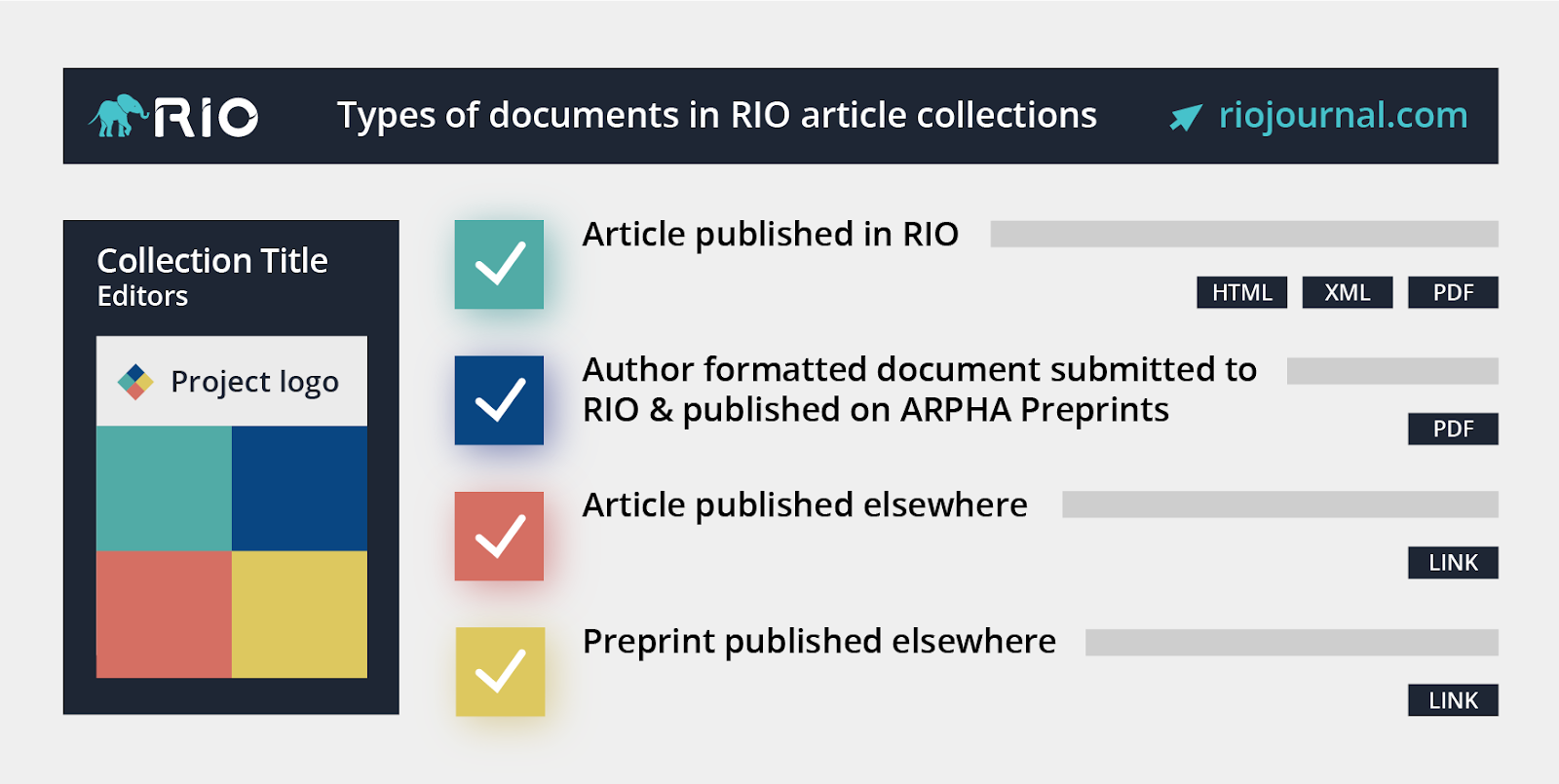
Bringing together traditional and non-conventional research outputs, (e.g. research ideas, grant proposals, conference materials or workshop reports) with RIO Journal’s article collections

Undoubtedly, valuable research outcomes come in many shapes and sizes well beyond research papers, conference abstracts, posters and proceedings. We are firm supporters that every research item, even early and interim outputs, could be of value to the scientist next in line within a particular study.

This is why we launched the award-winning journal Research Ideas and Outcomes (RIO), where your collections can include both conventional and non-traditional research outputs, such as research ideas, posters, workshop reports, forum papers, policy briefs, software and data management plans to name a few. Furthermore, in RIO, you can even link articles or preprints published elsewhere to your collection via their metadata. Similarly to other Pensoft journals, in RIO, you will have the full control to whom you are opening your collection for submissions, allowing you to either limit it to the outcomes coming from your conference or welcome submissions from other researchers as well.

A permanent topical collection in RIO Journal may include a diverse range of both traditional and unconventional research outputs, as well as links to publications from outside the journal (see What can I publish on the journal’s website). 

See the Brainhack 2016 Project Reports, whose aim is to collate reports from the 2016 Brainhack events. Also, check out the collection of the European Biodiversity Observation Network (EU BON) Project, providing a nice example for a wide range of publication types.

***

Don’t hesitate to get in touch to discuss your own case and select the best option for your conference – we’ll be happy to hear from you!

***

Follow Penoft on Twitter and Facebook and subscribe for Pensoft’s blog.