New research is dismantling the long-standing myth of the “pristine” Amazon. A reconstruction of 10,000 years of Amazonian pyrogeography, based on 1,361 radiocarbon (¹⁴C) dates across 303 sites – including soil charcoal and burned archaeological material – shows that fire in the rainforest is almost exclusively a human-driven phenomenon, not a natural one.
Over the last two millennia, human-ignited fire has driven vegetation change on a scale comparable to major climatic shifts, such as deglaciation or the extinction of Pleistocene megafauna.
Amazonian fires rarely, if ever, ignite without human input. In the pre-human evolutionary history of these wet forests, fire was an exceptional rarity.
Forest fire in the Brazilian Amazon. Credit to J Brarymi via Getty images.
Glacial-aged paleoecological reconstructions from sites like the Hill of Six Lakes in Brazil and the Serra Sul dos Carajás reveal that charcoal was either entirely absent or present in only minuscule amounts before human arrival. Even more striking, the Campo Libre sediment core on the Andean slopes of Ecuador showed a total absence of fire for 30,000 years, ending only when humans appeared on the landscape around 4,500 years ago.
Lead author Crystal N. H. McMichael of the University of Amsterdam describes the arrival of humans as the introduction of fire to a “naïve landscape.” Because Amazonian plants are evolutionarily fire-sensitive, the introduction of regular burning by a fire-using species fundamentally altered a system that had been stable since the late Pleistocene.
The ignition timeline
By compiling and analysing 1,361 (¹⁴C) radiocarbon-dated charcoal fragments and archaeological materials, researchers mapped a history of human-driven fire across Amazonia that unfolded over three phases of the Holocene.
Map of Amazonian sites with 1329 14C AMS dated charcoal fragments or burned archaeological material used in the summed probability analyses. Sites are color coded by geographic region: central (CA), eastern (EA), northwestern (WAN), southwestern (WAS), southern (SA) Amazonia, and Guiana Shield (GS). Symbols denote new 14C dates from this study (squares inside dashed boxes), and previously published 14C dates from soil charcoal surveys (circles) and archaeological surveys (triangles). Symbol size indicates the number of 14C dates at each site. Tree cover is shown as the fractional tree cover in proportions ranging from 0 to 1 for the year 2020 (Liu et al. 2024); b. Frequencies of 14C dates over the last 12,000 years for this study (left), previously published dated soil charcoal fragments from paleoecological surveys (center), or previously published dated material from archaeological sites (right). Credit to McMichael et al., 2026.
Between 10,000 and 6,000 years ago, fires were highly restricted, occurring primarily within the basin’s peripheral areas and along the main channel of the Amazon River. This localised footprint shifted dramatically between 6,000 and 4,000 years ago, as the geographic spread of fire and occupation sites accelerated sharply across most regions – a development that coincided with the onset of early maize cultivation in northwestern and southwestern Amazonia.
Finally, between 3,000 and 2,000 years ago, fire reached the deep interior of the basin: though central Amazonia had remained a relatively fire-free refuge for thousands of years while the periphery burned, it was ultimately transformed as expanding human influence and fire-use reached the very heart of the forest.
The dying fire
This human-driven fire history is marked by a dramatic, two-phase decline over the last 700 years.
Summed probability distribution of 14C AMS dated charcoal fragments and burned archaeological material (N = 1329 dates over 303 sites) for the last 10,000 years (a) and a zoom-in of the last 2000 years (b). Panels (c) and (d) show the composite kernel density estimates based on 1000 iterations of randomly sampled ages for the last 10,000 years and 2000 years. The black dashed line in (c) and (d) is the mean probability of all 1000 iterations, and the green shaded areas are confidence intervals. Ship icon and vertical dashed line in (b) and (d) indicate the timing of the first expedition down the Amazon River in A.D. 1541. Credit to McMichael et al., 2026.
First, an initial decrease in fire frequency 600 to 700 years ago which supports the “early abandonment” of lands several centuries before European arrival. Physical evidence from lake sediments shows a significant “pollen surge” during this window, signaling massive reforestation and a major pre-Columbian shift in land use or site abandonment.
The second and larger decline followed the “Great Dying” after A.D. 1541, when disease, warfare, and enslavement killed an estimated 90-95% of Indigenous peoples in the Americas. As ignitions vanished with the population, the forest entered a second, more extensive phase of recovery.
The ecological legacy of 10 000 years of fire
Burning fire. Credit to Keith Lowery via Pexels.
These changing fire patterns – particularly over the last two millennia – led to an increase in human-caused fires, which spread across all regions and accelerated changes in vegetation. Ultimately, this left a profound ecological imprint that has strongly shaped today’s plant communities by selectively favoring fire-tolerant species, such as palms, over fire-sensitive vegetation.
The restructuring of Amazonian pyrogeography over the last 2,000 years has likely played a large role in shaping modern forests. The intensification of fire during this period induced rates and magnitudes of vegetation change that are comparable to major climatic shifts. The impact was subtle, favoring species that were already there but showed the most fire tolerance, such as some palms, but this pressure has undoubtedly changed the configuration of Amazonian plant communities.
the team explained in their research article
Citation:
McMichael CNH, Heijink BM, Witteveen NH, Zwarts A, Bush MB (2026) The pyrogeography of Amazonia: a Holocene perspective. Frontiers of Biogeography 19: e169863. https://doi.org/10.21425/fob.19.169863
Researchers at the University of Idaho have identified a new species of spider in the mountains of northern Idaho and given it a name that pays tribute to the university itself: Hexura vandal.
Researchers at the University of Idaho have identified a new species of spider in the mountains of northern Idaho and given it a name that pays tribute to the university itself: Hexura vandal.
The spider belongs to a small group of funnel-web spiders related to tarantulas. Until now, only two species in this genus were known, both living hundreds of miles away in the coastal forests and mountains of Oregon and Washington.
Finding a third species so far inland, in the Rocky Mountains near the town of Kooskia, came as a surprise to the research team, led by Arnau Calatayud-Mascarell, Ethan J. Briggs and Chris A. Hamilton. It extends the known range of the genus by roughly 500 kilometres and is the first new taxonomic work done on this group of spiders in almost fifty years.
Distribution and habitat of Hexura spiders including new records, records from iNaturalist, Gertsch and Platnick (1979), and The Burke Museum of Natural History in Seattle, Washington. Blue = H. picea, Pink = H. rothi, Yellow = H. vandal.
Associate Professor Dr. Chris A. Hamilton stated:
“It’s always exciting when you realize the samples you’ve been looking at are an undescribed new species. This is one of the main reasons we do this job – to document Earth’s incredible biodiversity and expand our foundational biological knowledge of our planet. It just makes it even more exciting when that undescribed diversity can be found in your backyard (figuratively speaking).”
The name is where the story becomes especially local. Rather than a Latin descriptor, the researchers chose “vandal”, which is a direct nod to the university’s own mascot. The nickname dates back to 1917, when student journalist Harry Lloyd McCarty described the men’s basketball team’s fierce style of play as “vandalizing” their opponents. The name stuck, and the University of Idaho remains the only Division I university in the United States with the Vandals as its mascot.
Hexura vandal sp. nov. female (L) and male (R). Credit: Arnau Calatayud-Mascarell et al., (2026).
When discussing how the name was picked, Hamilton said:
“It didn’t take very long for the lab to sit down and decide what to name the new species. It was basically, this is really unique because it’s only found in Idaho and it’s not very far (relative) from campus. It’s black (sorry that it’s not black and gold like the school colors!). It’s a predator that attacks. It’s a Vandal.”
The discovery comes with a note of caution. Hexura vandal has so far only been found in a handful of sites within a very small area of forest in Idaho, despite repeated searches nearby. The region faces pressure from logging, and wildfires, which are becoming more frequent, and tend to strike during the spiders’ breeding season. Taken together, these factors have led the researchers to consider the micro-endemic species likely endangered, and they hope the discovery will help build the case for protecting its habitat.
University of Idaho, home of the Vandals, is Idaho’s land-grant university and the state’s first Carnegie R1 research institution — a ranking reserved for the top 4% of U.S. universities. From its residential campus in Moscow, U of I serves the state through centers in Boise, Coeur d’Alene, Idaho Falls and McCall, nine research and Extension centers, and Extension offices in 42 counties. With more than 12,000 students, U of I is a leader in student-centered experiential learning, interdisciplinary research, business and community service and global outreach. The Vandals compete as a founding member of the Big Sky Conference and as an affiliate in the Big West and Mountain Pacific Sports Federation.
Pensoft is an independent, open-access scholarly publisher and technology provider, best known for its 30+ biodiversity journals, including ZooKeys, Biodiversity Data Journal, PhytoKeys, MycoKeys, One Ecosystem, and Metabarcoding and Metagenomics. Ever since becoming the first to introduce semantic enrichments and hyperlinks within a scientific article in the field of biodiversity in 2010, Pensoft has been working on various tools and workflows designed to facilitate data findability, accessibility, discoverability and interoperability.
Cover image:
Top: US Highway 12, near Hexura vandal sp. nov. type locality, Apgar Campgrounds, Lowell, Idaho.; Bottom: Mixed conifer forest logs, Hexura vandal sp. nov. type locality, Apgar Campgrounds, Lowell, Idaho
Original source:
Calatayud-Mascarell A, Briggs EJ, Hamilton CA (2026) Hidden in the woods: A new species of Hexura (Araneae, Mygalomorphae, Antrodiaetidae) from a highly restricted range in Idaho. ZooKeys 1290: 339–355. https://doi.org/10.3897/zookeys.1290.200898
A researcher from the University of North Carolina Asheville has drawn on 20 years of collaborative fieldwork to create a single illustrated reference for scientists, conservationists and nature enthusiasts.
A researcher from the University of North Carolina Asheville has published the first comprehensive checklist of the native terrestrial reptiles of the Turks and Caicos Islands (TCI), drawing on 20 years of collaborative fieldwork to create a single illustrated reference for scientists, conservationists and nature enthusiasts.
The study, led by Professor R. Graham Reynolds of UNC Asheville’s Department of Biology, is published in the open-access journal ZooKeys. It documents the 11 native reptile species across the archipelago’s Turks and Caicos Banks, eight of which are found nowhere else on Earth.
Two further species are represented in the islands by their own endemic subspecies. The checklist combines published research through 2026 with original field data collected by Dr Reynolds between 2006 and 2025, and includes original photographs, distribution information and conservation assessments for every species.
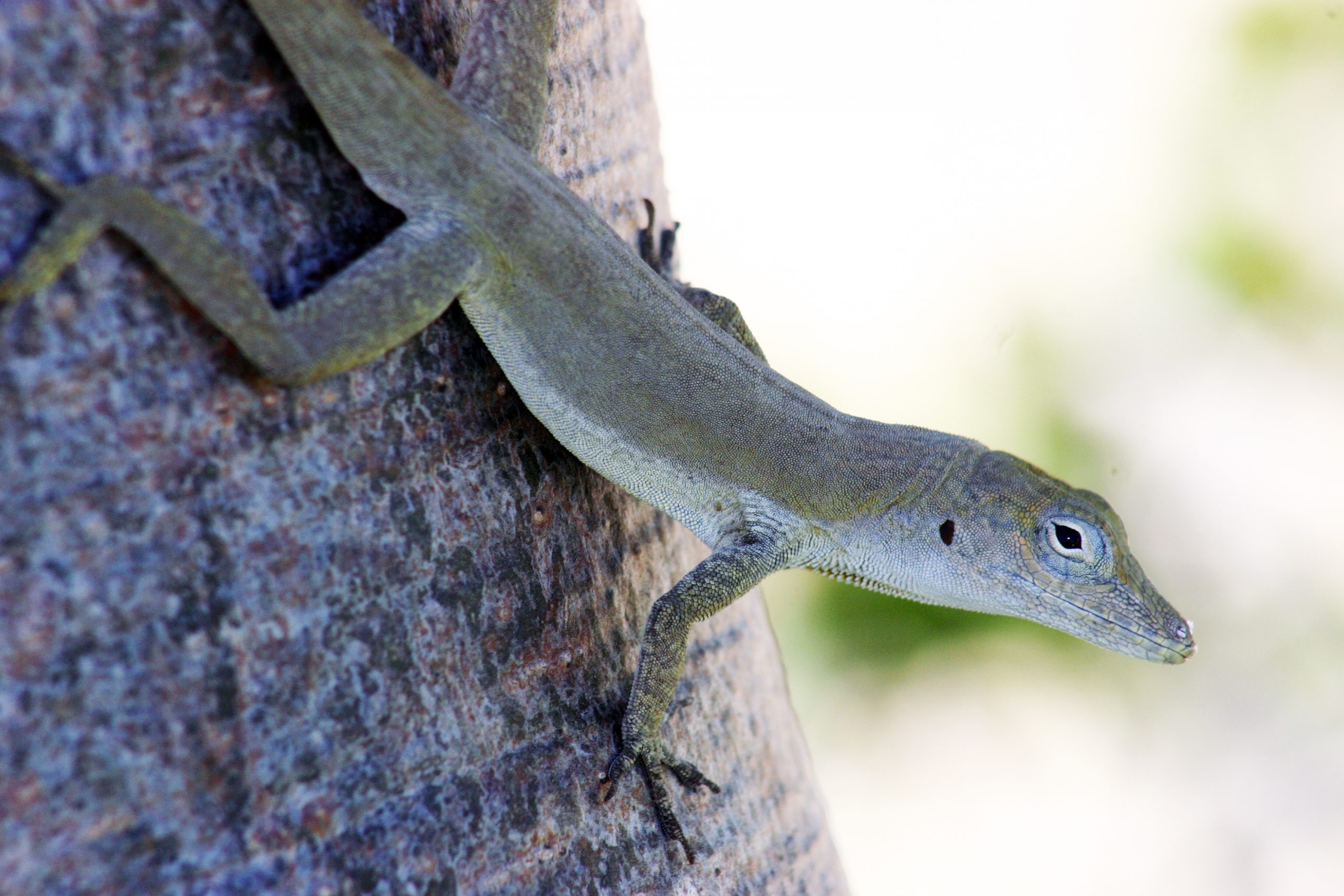
An adult male Turks and Caicos Anole (Anolis scriptus scriptus) watching his territory from the trunk of a tree. Big Ambergris Cay, Turks and Caicos Islands. Photograph by R. Graham Reynolds, UNC Asheville.
Dr Reynolds began studying the islands’ reptiles in 2006, in his first year of graduate school, working alongside Dr Glenn Gerber of the San Diego Zoo Wildlife Alliance:
“This quickly turned into a passion, and I have made studying these animals the focus of my career.
I conduct fieldwork several times a year on the islands, and this year is the 20th year of this work. In that time, I have published dozens of papers on the reptiles of the region and collected a huge amount of data, and I felt that, after two decades, it was time to produce something to showcase everything we’ve learned about these animals.”
Although information on the islands’ reptiles has existed scattered across books, online databases and journal articles, no single resource has previously combined photographs, distribution maps, natural history and conservation status for every species.
“Somewhat surprisingly, there has never been a comprehensive checklist for the terrestrial reptiles of the region.
“Portions of this are available elsewhere, such as distribution maps and some photographs on the online database CaribHerp, or island checklists and natural history information in a book chapter. But this is the first time that all of this information has been brought together to fully describe and illustrate the amazing terrestrial reptiles of the Turks and Caicos.”
Dr Reynolds
Seven of the 11 native species are of conservation concern. The Turks Island Skink is Critically Endangered and may now survive as a single protected population, while the Turks and Caicos Iguana, classified as Endangered, has been lost from around 90% of its historical range. Introduced predators, particularly feral cats and rats, are identified as the main cause of these declines, alongside habitat loss and road mortality.
An adult male Turks and Caicos Curlytail (Leiocephalus psammodromus apocrinus) perches on top of a Turks cap Cactus (Melocactus intortus). Big Ambergris Cay, Turks and Caicos Islands. Photograph by R. Graham Reynolds, UNC Asheville.
The study also revises the taxonomy of the Curly-tailed Lizard, recommending that six previously recognised subspecies be reduced to two, reflecting recent genetic evidence.
Original source
Reynolds RG (2026) An annotated checklist and species accounts of the native terrestrial reptiles of the Turks and Caicos Islands. ZooKeys 1290: 1-33. https://doi.org/10.3897/zookeys.1290.198843
For more articles on zoology, visit the ZooKeys website and follow the journal on BlueSky and Facebook.
When I arrived in the Galápagos in 1996, I never imagined that one of the most meaningful conservation projects of my career would begin inside an herbarium cabinet. At the Charles Darwin Research Station, I spent many hours working with herbarium collections assembled over more than a century by botanists who had explored the archipelago. Each specimen preserved a moment in time – a record of where a species had lived and the landscapes it once inhabited. Together, they formed a living archive of the Galápagos flora.
Two years later, in 1998, one specimen began to capture my attention. Collected near Caleta Tagus on northern Isabela Island in 1962, it belonged to Galvezia leucantha subsp. leucantha, a small shrub found nowhere else on Earth.
Every time I opened that cabinet, I found myself asking the same question: Does this plant still survive?
Herbarium specimen of Galvezia leucantha subsp. leucantha, collected near Caleta Tagus in 1962. More than six decades later, this historical record helped inspire and guide the restoration of one of the Galápagos’ rarest endemic plants. Courtesy of Patricia Jaramillo Díaz, CDS Herbarium.
At first, it was simply curiosity. Over the years, however, that question grew into something much larger. It inspired field expeditions, nursery experiments, ecological restoration and scientific research spanning almost three decades.
Historical herbarium records and botanical surveys led us to Playa Tortuga Negra, on the remote northern coast of Isabela Island, where the species had last been documented. In 2017, the Galápagos Verde 2050 (GV2050) restoration program began working to prevent the disappearance of this critically endangered population.
Reaching the site was never easy. After travelling by boat along the rugged coastline, we crossed extensive young lava flows under the equatorial sun, carrying equipment and supplies. When we finally located the plants, our excitement quickly gave way to concern. Only a handful of wild individuals remained, some growing from narrow cracks in the lava. Their resilience was extraordinary, but so was their vulnerability.
Standing beside those plants, it became clear that we were looking at much more than a rare shrub. These were the last representatives of a unique evolutionary lineage found nowhere else on Earth. Losing them would mean losing an irreplaceable part of the Galápagos’ botanical heritage.
Our question changed: instead of asking whether Galvezia leucantha still survived, we began asking how we could help ensure that it would continue to survive.
That question became the foundation of a long-term restoration program developed through collaboration among the Charles Darwin Foundation, the Galápagos National Park Directorate, researchers, park rangers, field assistants, students and volunteers.
Researchers and a Galápagos National Park ranger collecting and preparing Galvezia leucantha subsp. leucantha specimens for the CDS Herbarium at Playa Tortuga Negra, Isabela Island, during a collaborative field expedition across several islands of the Galápagos Archipelago in 2012. Photo: Rubén Heleno.
Before restoring the species, however, we first had to learn how to propagate it. Very little information existed. There were no established protocols or published studies describing how to cultivate the species. Germination was inconsistent, seedlings were delicate and survival varied depending on growing conditions.
Through observation, experimentation and patience, we gradually refined propagation techniques, tested different substrates and identified conditions that improved germination and seedling development. The nursery became a living laboratory where research and practical conservation came together. Every healthy seedling represented months of work, from collecting seeds in the field to monitoring germination and growth.
Equally important was documenting what we learned. Developing a propagation protocol strengthened our restoration program while providing practical guidance for future conservation projects involving threatened island plants.
Producing healthy seedlings was only the beginning. Returning them to one of the youngest volcanic landscapes in the Galápagos presented an entirely different challenge. Every restoration campaign required months of preparation. Seedlings were gradually acclimated before transport, while strict biosecurity protocols ensured that no invasive organisms accompanied them into one of the world’s most protected ecosystems.
Moving hundreds of young plants across rough seas and unstable lava fields required close coordination between the Charles Darwin Foundation and the Galápagos National Park Directorate. Once on site, every planting location was carefully selected to maximize the seedlings’ chances of survival.
Collection, sorting, disinfection, and laboratory germination trials of Galvezia leucantha subsp. leucantha seeds. Photos: Paúl Mayorga and Patricia Jaramillo Díaz.
Because northern Isabela experiences prolonged dry seasons and shallow volcanic soils retain very little moisture, we also evaluated techniques to improve plant establishment.
During the first restoration campaigns, hydrogel and the Groasis Waterboxx® were tested to reduce water stress during the most vulnerable stage of seedling development. Planting a seedling takes only a few minutes. Helping it become part of a self-sustaining population takes years. That is why restoration never ends when the last plant is placed in the ground.
Researchers Anna Calle-Loor and Nicolás Velasco surveying the restoration site at Tagus Cove, Isabela Island, before planting Galvezia leucantha subsp. leucantha. Photo: Carlos Espinoza/FCD.
Every year, our team returned to Playa Tortuga Negra to monitor the restored plants. We recorded their survival, growth, flowering and fruit production, always asking the same question: Could the population eventually recover on its own?
For several years, the answer remained uncertain. Although the restored plants survived, flowered and set seed, the clearest sign of recovery had yet to appear. Then, three years after the first reintroductions, during a monitoring expedition in 2021, everything changed.
While surveying the restoration site, Galápagos National Park rangers and researchers from the Galápagos Verde 2050 program noticed a tiny seedling emerging from a narrow crack in the lava. Only a few centimeters tall, it was easy to overlook. A closer look revealed something extraordinary: it was not one of the seedlings we had planted.
Galvezia leucantha in the lava crack. Photo credit to Jefreys Galápagos Verde 2050 team (GV2050).
Detailed images of Galvezia leucantha subsp. leucantha. Credit to Jaramillo Díaz, 2026.
It had germinated naturally from seeds produced by the restored population. After years of restoration efforts, we were witnessing the first evidence that Galvezia leucantha was once again reproducing in the wild. The discovery filled us with excitement, but also with scientific caution. One naturally established seedling was encouraging, yet we needed to know whether it represented the beginning of broader recovery.
Galvezia leucantha subsp. leucantha seedlings. Left: Monitoring and data collection. Right: Seedlings growing under protective mesh. Photos: Carlos Espinoza.
Subsequent monitoring confirmed that it was not an isolated event. By the end of the monitoring period, our team had recorded four naturally established seedlings, all resulting from natural recruitment rather than nursery-grown plants. They demonstrated that restored individuals were flowering, producing viable seeds and giving rise to a new generation without direct human intervention. They also provided the first clear evidence that restoration was rebuilding not only the population, but the ecological processes need for the species to persist over time.
Seedling of Galvezia leucantha. Credit to Díaz et al., 2026
Flowering Galvezia leucantha. Credit to Galápagos Verde 2050 team (GV2050).
Flowering Galvezia leucantha. Credit to Galápagos Verde 2050 team (GV2050).
True restoration begins when nature no longer depends on us.
As the project continued, another chapter brought me back to where everything had begun.
The herbarium specimen that inspired my original question once again became central to our work. Historical collections showed that Galvezia leucantha had once occurred near Caleta Tagus, where it had last been collected more than sixty years earlier. Those specimens, together with field observations and ecological assessments, helped identify suitable sites for restoring part of the species’ historical range.
In 2024, the restoration program expanded to Caleta Tagus, helping re-establish the species in part of its historical range for the first time in more than sixty years. Returning plants there felt like completing a circle.
Decades earlier, botanists had carefully preserved specimens documenting a disappearing population. Without knowing it, they had also preserved information that would later help guide its recovery. For me, this reinforced the extraordinary value of herbaria. They are far more than collections of dried plants; they are archives of biodiversity that connect the past with the future, helping us understand species distributions, identify restoration opportunities and guide conservation decisions.
The restoration of Galvezia leucantha also taught us that conservation does not end in the field. Sharing what we learn is just as important. In 2025, nearly three decades of experience came together in a scientific paper, a restoration plan and a propagation guide, ensuring that these lessons could support future restoration efforts.
Looking back today, I do not think first about the number of seedlings we planted or the kilometers we walked across lava fields. I think about the people: the park rangers who protected restoration sites, field assistants who carried plants across difficult terrain, nursery staff who cared for thousands of seedlings, researchers who designed experiments, and students and volunteers whose enthusiasm sustained this project over the years.
Although this story is written from my perspective, the recovery of Galvezia leucantha has always been the result of teamwork. When I first opened that herbarium cabinet nearly three decades ago, I could never have imagined where one preserved specimen would lead.
Today, nearly thirty years later, that question finally has an answer. Yes. Galvezia leucantha still survives.
Our work continues in the field and laboratory to support the recovery of this species and, we hope, keep sharing good news through 2050. Photos: Patricia Jaramillo Díaz, Paúl Mayorga, and Carlos Espinoza.
More importantly, it is no longer represented only by a few isolated shrubs growing from cracks in lava. Restored plants are flowering, producing seeds and giving rise to a new generation in the wild. The species still faces challenges, but its future is far brighter than it once seemed.
For us, that is the greatest lesson of this journey. Conservation begins with curiosity, advances through science and succeeds through collaboration. Sometimes, a single herbarium specimen is enough to inspire a question.
Sometimes, answering that question takes nearly thirty years, but the journey is worth every step.
Original source:
Jaramillo Díaz P, Charette C, Calle-Loor A, Espinosa-Ortega N, Mayorga P, Zambrano D, Chango R, Velasco N (2026) Advances in the recovery of Galvezia leucantha subsp. leucantha (Plantaginaceae): restoring a critically endangered species on northern Isabela Island, Galápagos. Nature Conservation 64: 111-133. https://doi.org/10.3897/natureconservation.64.177895
A new, reproducible R workflow that enables ecologists to standardise the measurement of individual differences in habitat use based on GPS data, demonstrated using data on 13 lapwings, has been published in Individual-Based Ecology.
The ecological niche concept describes the set of environmental conditions a species needs to survive and reproduce, but it has traditionally been applied at the species or population level – even though individual animals are known to vary widely in behavior, diet, and habitat choice.
Individuals belonging to the same species do not necessarily use or respond to their environment in the same way. This variation has been traditionally treated as statistical noise but now we know that it has important implications for the long-term survival of a species.
said Dr. Takola
Despite this, few tools exist to translate modern tracking data and space use patterns into practical, comparable measures of individual habitat specialisation. This new workflow aims to address this gap.
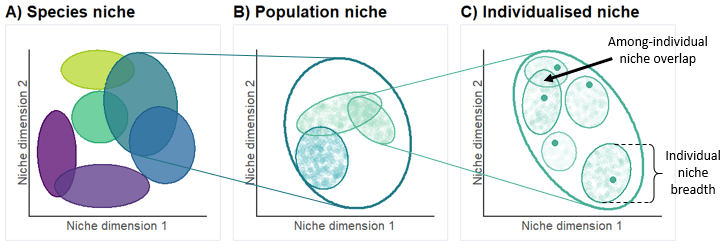
Heuristic representation of the different niche levels. A) A community can be represented as a set of species in which each occupies a different niche. B) A species can be represented as a set of metapopulations with different niches. C) A population consists of multiple individuals with different individualised niches (the potential niche is shown with transparent dots, and the realised niche is shown with bold dots). Adapted from Takola and Schielzeth (2022).
Working at the individual level, it treats each animal’s personal range of habitat conditions as its own ‘individualised niche’, distinguishing for each individual between the conditions it actually uses (its realised niche) and the conditions available to it but not necessarily used (its potential niche).
These concepts were defined in a previous study by E. Takola and H. Schielzeth. Takola has now taken these concepts a step further, translating them into a practical workflow for studying individual animals in the wild.
To achieve this, it uses combined mixed-effects resource selection functions such as statistical models that estimate both average habitat preferences and how much individuals deviate from that average with hypervolume exploration methods, a way of mapping all the environmental conditions an individual could occupy as a multidimensional space.
Graphical abstract of the workflow. Generated by Dr. Takola using ChatGPT.
Implemented entirely in R, the workflow draws on tools from ecological niche modeling, behavioral ecology, and spatial ecology. Further, the workflow is divided into three stages: data preparation, analysis, and output generation.
Throughout, it distinguishes between the environmental conditions available to an individual and the conditions it actually uses, allowing researchers to quantify niche breadth or how broad or narrow an individual’s habitat use is; niche overlap or how much individuals’ habitat use overlaps with one another; and repeatability – how consistent an individual’s habitat use is over time.
The lapwing case study puts this into practice. By using publicly available GPS tracking data from 13 northern lapwings, the study shows how the workflow integrates multiple environmental layers such as earthworm abundance, human presence, pesticides, management, soil variables, and vegetation.
Why Individual Variation Matters And Future Outlook
Individual organisms differ in genotype, morphology, life strategy, diet, and behavior. Individual-based approaches capture how animals adapt locally and respond to environmental stress in ways population-level averages can obscure.
This has real implications for conservation. Individual-based models, ones that account for energy costs, demographic trends, habitat-selection patterns, and life-history traits, offer a more accurate, mechanistic picture of wild population dynamics, and a better basis for predicting how populations will fare as conditions change.
Although demonstrated on the northern lapwing, the workflow is designed to be transferable to other mobile species with GPS tracking data, giving ecologists a general-purpose tool for incorporating individual variation into habitat and conservation models.
explains Takola
The data and code underpinning the workflow are available on GitHub.
By making individual specialisation measurable and comparable across taxa and datasets, the workflow can help researchers study niche specialisation and population-level heterogeneity across ecological scales, linking individual-level variation back to population- and species-level patterns, and giving conservationists a tool to move beyond population averages toward more targeted conservation methods.
Original source:
Takola E (2026) The individualized niche in motion: Quantifying individual specialisation with movement data. Individual-based Ecology 2: e203247. https://doi.org/10.3897/ibe.2.203247
Study introduces a new way to measure pollinator “effectiveness,” not just presence, revealing that climate change could shrink suitable habitat for key mango pollinators by more than 40% in coming decades
Some of the most important pollinators for South Africa’s mango industry aren’t bees at all – they’re houseflies and blowflies, according to a recently published study in Frontiers of Biogeography by scientists at University College London (UCL).
The study, led by Matthew Phillips Sánchez and Richard Pearson of UCL’s Centre for Biodiversity and Environment Research, set out to find not just which insects visit mango flowers, but which ones actually pollinate them effectively.
Visiting vs. pollinating species of mango in South Africa. Insect visitors of mango in South Africa (61), composed of five orders and 15 families (‘Visitors’). Compiled from global studies describing visitors to mango flowers, which are also present in South Africa with at least 20 occurrence records on GBIF. Thirty-eight of these are pollinators (pollen deposition effectiveness > 0), belonging to two orders and eight families (‘Pollinators’). Credit to Sánchez and Pearson, 2026.
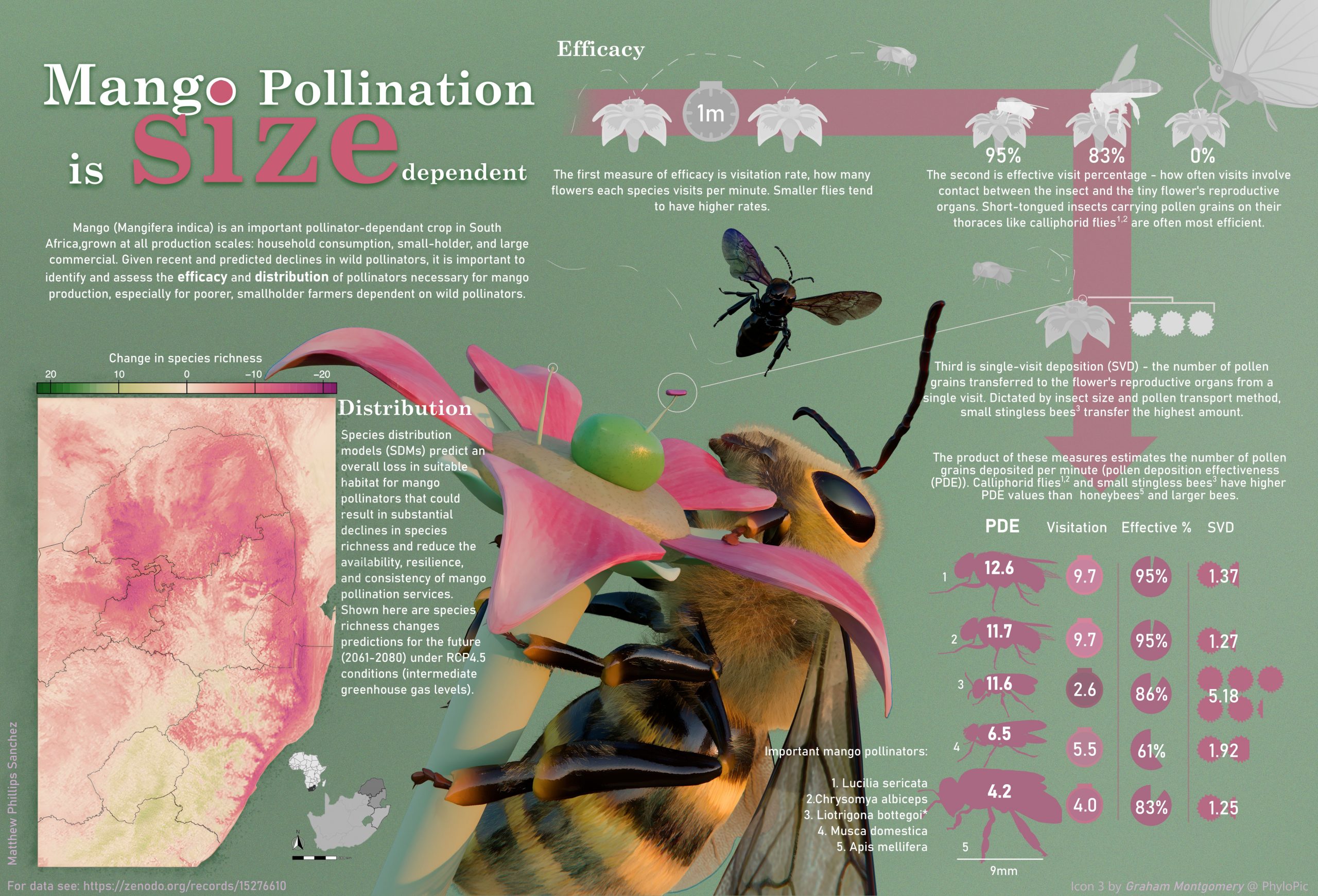
Mango flowers attract a huge range of insect visitors, but many never touch the flower’s reproductive parts and so transfer no pollen at all. To separate the true pollinators from the freeloaders, the researchers used a Pollen Deposition Effectiveness (PDE) metric, which combines how often a species visits mango flowers, how often those visits make contact with the flower’s reproductive organs, and how much pollen is deposited per visit.
Graphic credit to Matthew Phillips Sánchez, 2026.
Applying this method to 61 known mango-visiting insect species found in South Africa, the team identified 38 true pollinators – and found that flies, not bees, were the amongst the more effective pollinators. Blowflies (family Calliphoridae), the housefly (Musca domestica), and a tiny stingless bee species, Liotrigona bottegoi, ranked as the most effective pollinators identified in the study. Larger insects such as honeybees and carpenter bees (Xylocopa) were generally less effective per visit, likely because their bigger bodies make less consistent contact with the small mango flower’s reproductive structures.
Insects from the orders Lepidoptera (butterflies and moths), Coleoptera (beetles) and Hemiptera (true bugs) were found not to contribute meaningfully to pollination, either because they don’t make contact with the flower’s reproductive parts or because there wasn’t enough data to assess them.
A shrinking future for mango pollinators
The researchers combined their pollinator effectiveness data with species distribution models, statistical tools that predict where a species can survive based on climate, to project how pollinator habitat in South Africa’s main mango-growing provinces (Limpopo, Mpumalanga and KwaZulu-Natal) might change under future climate scenarios.
The results point to widespread declines. On average, pollinator species are projected to lose 42% (under a moderate-emissions scenario) to 43% (under a high-emissions scenario) of their currently suitable habitat by 2061-2080 or 66,663 km2 and 73,608 km2 respectively.
Mango pollinator species richness and potential pollination provision. Species richness and potential pollinator provision under present-day climate (left column) and SDM-predicted changes under two climate change scenarios (right columns). Credit to Sánchez and Pearson, 2026.
Flies were projected to be hit hardest, while some bee species were projected to gain ground in parts of the region. The study also found that pollinator communities are likely to undergo substantial species turnover, with many current pollinators potentially shifting toward the country’s south as the climate changes.
Encouragingly, the researchers found that potential pollination service didn’t decline much faster than pollinator numbers overall – a sign of what ecologists call “functional redundancy,” where many species contribute moderate pollination value rather than the community depending on one or two irreplaceable species. This suggests the loss of some species is less likely to cause a sudden pollination collapse, provided enough functionally similar species remain.
The mango industry
Tomy mangoes by alexanruiz via Envato.
Mango is a significant industry in South Africa, valued at more than US$25 million annually and supporting over 13,000 jobs in processing and related trades, in addition to many smallholder and subsistence growers who rely heavily on wild, unmanaged pollinators.
The authors stress that their study is intended primarily as a proof-of-concept for this new modeling approach, rather than a definitive forecast of mango production. The models estimate climatically suitable habitat, not realised populations, and do not account for land use, habitat availability, or the timing of mango flowering relative to pollinator activity.
Practical steps for growers
Pile of Fresh Mangoes by elxeneize via Envato.
The researchers highlight several low-cost conservation measures that could help support wild pollinator populations in mango orchards, including reducing pesticide and herbicide use, setting up low-cost “stink stations” to attract pollinating blowflies, planting native flowering plants or allowing wildflowers to grow between orchard rows to provide food and nesting sites for pollinators, and increasing overall plant diversity within orchards.
Original source:
Sánchez MP, Pearson R (2026) Biogeography of pollination under climate change: integrating pollinator effectiveness into species distribution models for mango in South Africa. Frontiers of Biogeography 19: e180771. https://doi.org/10.21425/fob.19.180771
Our in-house indexing team works tirelessly to maintain the highest standards and to secure indexing for Pensoft-published journals across a growing range of indexing services. Our team works closely with journal editors and leverages the automated and manual workflows of the ARPHA Publishing Platform to export rich XML metadata, submit content to global databases, and maintain long-term digital preservation.
As of August 2026, these four Pensoft-published, open-access, peer-reviewed journals are now indexed in CABI.
Frontiers of Biogeography publishes research on the geographic distribution of organisms and the processes shaping biodiversity patterns across space and time.
Phytologia Balcanica focuses on the flora, vegetation, and plant diversity of the Balkan Peninsula and surrounding regions.
Vegetation Ecology and Diversity publishes studies on plant community ecology, vegetation classification, and biodiversity patterns worldwide.
Indexing will begin with the latest volume, covering articles published from the start of 2026.
CABI’s full-text repository, as of May 2026, spans over 1,003,300 documents and continues to grow, fully integrated into CABI’s databases – including CAB Abstracts, Global Health, Subject Collections, and Database Subsets. Furthermore, readers with a CABI subscription gain instant, automatic access to all corresponding full-text material.
This marks a step forward in ensuring that research published in these journals reaches an even wider audience of researchers, policymakers, and practitioners worldwide.
Guest blog post by Jürgen Dengler, Iwona Dembicz & Łukasz Kozub
This post refers to the article Translation of the Braun-Blanquet scale to percent in TURBOVEG can bias diversity metrics in Vegetation Classification and Survey (https://doi.org/10.3897/VCS.198373)
Visualisation of different ways of back-transforming 7-step Braun-Blanquet scales to percent for numerical analyses. It is evident that for cover values below 3% (0.5 on the log10 scale), the back-translation of TURBOVEG (yellow) yields systematically too high values, while the two mid-point translations partly over- and partly underestimate the true values (Image taken from Dengler et al. 2026, https://doi.org/10.3897/VCS.198373)
The most widespread approach to vegetation sampling is the use of vegetation plots, i.e., defined areas in which all species present are recorded together with their cover. Cover refers to the percentage of the plot area occupied by the superficial parts of a given species. Still, many vegetation ecologists prefer recording cover on ordinal scales, such as variants of the Braun-Blanquet scale, rather than recording it directly as a percentage. Estimating cover always comes with errors, but using an ordinal scale increases this error as it involves a double transformation, first in the field from the fractional cover to a category of the ordinal scale, and then back from the ordinal scale to a metric scale for all kinds of analyses (Dengler and Dembicz 2023; Dembicz and Dengler 2025). Typically, the arithmetic or geometric midpoint of the class boundaries of the respective ordinal scale is recommended when back-translating the data. However, the most widely used software for storing and handling vegetation-plot databases, TURBOVEG (Hennekens and Schaminée 2001), has an inbuilt back-translation deviating from this principle (see Figure 1). We thus asked whether and how the mid-point translation and the TURBOVEG translation might bias a set of widely used biodiversity metrics, namely Shannon diversity, Shannon evenness and Simpson diversity.
In our case study using three different datasets covering a wide array of vegetation types, we found that the two mid-point translations had partly significant, partly non-significant, but in all cases small effects on the biodiversity metrics. By contrast, the inbuilt translation of TURBOVEG had severe distorting effects on all three metrics (see Figure 2). The average increases were about 0.7 units for Shannon diversity and 0.2 units for Shannon evenness, which corresponds to an approximately 30% difference in both cases. For Simpson diversity, the increase on average was smaller, with about 0.1 unit, corresponding to roughly 10%, which is due to the fact that the true Simpson diversity values in our datasets were above 0.8 and thus already close to the theoretical maximum of 1.0.
These differences due to the TURBOVEG settings were way higher than differences in biodiversity metrics often reported as statistically significant and ecologically meaningful. This means that using the TURBOVEG default translations can lead to wrong conclusions in studies using datasets that partly have been recorded on the Braun-Blanquet scale and partly directly in percent. For example, in a temporal comparison where a larger fraction of the older plots has been recorded on the Braun-Blanquet scale than in the newer plots, this methodological artifact could erroneously suggest a biodiversity decline. Likewise, spatial biodiversity patterns can be biased when the fraction of plots recorded with variants of the Braun-Blanquet scale varies between different geographic entities (e.g., countries). It is self-evident that the TURBOVEG default translations will also bias any other response variable that relies on species cover, namely other cover-based biodiversity metrics or community-weighted means of functional traits, albeit we did not quantify the effect sizes in these cases.
Effect of using ordinal scales on three biodiversity metrics in three exemplary datasets when using the conventional back-translation to the arithmetic mid-point of class borders compared to the default back-translation from TURBOVEG (yellow) (Image taken from Dengler et al. 2026, https://doi.org/10.3897/VCS.198373)
We thus recommend that researchers using TURBOVEG should not use the default back-translations of this program but set their own back-translations. This is particularly important when receiving data from the two largest vegetation-plot databases in the world, EVA in Europe (Chytrý et al. 2016) and sPlot globally (Bruelheide et al. 2019), as these databases are run under TURBOVEG 3. However, with an adequate export of the requested data, users can overwrite the TURBOVEG default percent values with more proper values that cause less distortion. It is to be hoped that in a future release of TURBOVEG these mistakes rooted in the early days of the program will be corrected.
For decades, butterfly enthusiasts and lepidopterists across Italy have wondered: could the lost southern populations of the Southern Swallowtail still be out there?
Historical records of Papilio alexanor in Southern Italy were sparse and dated, often dismissed as stray individuals blown in by strong winds from Greece or the Balkans. But for many lepidopterists, alexanor represents a true holy grail – a majestic, bright-yellow species that is strictly protected.
Our research didn’t start in a lab, but with a smartphone screen.
Male Papilio alexanor on C. ruber. Picture by Stefano Meraglia.
In May 2023, a marine biologist kayaking along the rugged cliffs of Basilicata uploaded a brief video to iNaturalist. It captured an unmistakable female Papilio alexanorfluttering around a giant fennel (Ferula) stalk.
A year later, a second record appeared on iNaturalist: a pristine, freshly emerged female photographed by a German tourist in Campania. Together, these two sightings hinted that the species might be more than a mere vagrant here.
Papilio alexanor. Picture by Paolo Mazzei.
This is where the power of modern biodiversity platforms like iNaturalist, Observation.org, and the eBMS (European Butterfly Monitoring Scheme) shines: they act as distributed networks of eyes on the ground, catching subtle shifts in nature that a single research team could easily miss. Inspired by these community sightings, our team from the Italian Lepidopterological Association (ALI), in collaboration with the University of Turin, decided it was time to step in.
A 1,400 km Journey into the Wild
Obtaining research permits for a strictly protected species under EU law takes time, ethics, and rigor. With support from the University of Turin, we secured formal authorization from the Italian Ministry of Environment in early 2026.
Driven by passion, our team funded the expedition ourselves, driving over 1,400 km round trip to systematically survey the steep coastal cliffs and dry habitats along the Campania–Basilicata border.
Pupa of Papilio alexanor. Photo by Paolo Mazzei.
5th instar Papilio alexanor caterpillar. Picture by Stefano Meraglia,
Papilio alexanor caterpillars feeding F. glauca. Picture by Paolo Mazzei.
Papilio alexanor caterpillars of different instars, feeding on seeds of F. glauca. Picture by Stefano Meraglia.
Papilio alexanor on C. ruber. Picture by Andrea Baruzzi,
The thrill of discovery was immediate. Standing at a cliffside turnout, we watched the first bright-yellow male soar up from the ravine. Soon we spotted courting pairs feeding on red valerian (Centranthus ruber) and females in the act of ovipositing.
Encouraged, we started scouting similar spots nearby, and the hunch paid off. About 15 to 20 km away, we found a second active breeding colony.
Surprising Ecology: A New Host Plant for Italy
Female Papilio alexanor laying eggs on the flowers of F. glauca. Picture by Luciano Valeri.
First, the Northern Italian populations rely on host plants such as Ptychotis saxifraga or Opopanax chironium, but the southern caterpillars feed exclusively on Ferula glauca. This host-plant association was previously documented in Greece and the Balkans, but never before in Italy.
Second, the flight begins significantly earlier here than in northern populations, reflecting local adaptation to the semi-arid, thermo-Mediterranean climate.
Protecting the Future: Simple Actions for Big Impact
Finding a “lost” population is cause for celebration, but it also brings responsibility. These isolated coastal colonies remain vulnerable to habitat fragmentation, fire, climate extremes, and road infrastructure development.
Female Papilioalexanor on C. ruber. Picture by Andrea Baruzzi, 2026,
To help Papilio alexanor keep thriving here, effective conservation management should prioritise targeted monitoring, integrating structured transects through schemes like eBMS to track population trends over time; habitat protection, preserving coastal slope vegetation and preventing over-mowing or destruction of Ferula glauca stands during roadside maintenance; and responsible citizen engagement, encouraging nature lovers, hikers, and photographers to submit observations with precise geolocation, while ensuring that delicate breeding sites remain respected and undisturbed.
This story is a reminder that remarkable biological discoveries are still waiting to be made right under our noses. All it takes is a curious eye, a smartphone upload, and a community of passionate researchers ready to follow the trail.
Original source:
Meraglia S, Baruzzi A, Mazzei P, Valeri L, Zerunian Z (2026) First documented record of a reproducing population of Papilio alexanor Esper, 1800 (Lepidoptera, Papilionidae) in Southern Italy, with ecological notes. Nota Lepidopterologica 49: 157-170. https://doi.org/10.3897/nl.49.206084
New research expands the knowledge on chalcid wasps in Cyprus, with five new species described from the island. One was named after the Greek goddess Aphrodite.
Scientists have described five new species of parasitoid wasp from Cyprus, more than doubling the number of chalcid wasps known to be found nowhere else on the island. The wasps, all belonging to the family Pteromalidae, are small insects that play an important role as natural pest controllers, yet remain poorly studied across much of Southeastern Europe and the Middle East.
“Before the start of this study, our knowledge regarding the chalcid wasp fauna of the Akrotiri Sovereign Base Area (SBA) and the rest of the island of Cyprus was extremely limited,” said Koutsoukos.
Chalcid wasps comprise a hyperdiverse group of insects that serve as biological controllers both in natural and manmade ecosystems, and as such it is crucial to enrich our knowledge, towards understanding their true extend of biodiversity, ecology, and their role in the various trophic webs they participate across different ecosystems.
Ablaxia makrisi, photo credit to Evangelos Koutsoukos.
Erythromalus makrisi, photo credit to Evangelos Koutsoukos.
“Each of the five new species was named with a story behind it. Two of the species [Ablaxia makrisi and Erythromalus makrisi] were named after Mr. Christodoulos Makris, prominent Cypriot entomologist, for his contributions on the Cypriot biodiversity, and for collecting the holotypes of these two species,” Koutsoukos explained.
Hemitrichusakrotiriensis. Photo credit to Evangelos Koutsoukos.
Hemitrichus akrotiriensis takes its name from the Akrotiri peninsula, described by Koutsoukos as “a protected area and one the greatest biodiversity hotspots in Cyprus, where the holotype was also collected from.” Another species, Ablaxia toxeftrae, was named after Toxeftra beach in the Akamas peninsula, where its holotype was found.
The final species carries perhaps the most evocative name of all:
Janssoniella aphrodite was named after the Greek Ancient Goddess Aphroditi, since the holotype of this species was collected in Yeroskipou area of Paphos, where the Goddess was worshipped during ancient times.
said Koutsoukos
Janssoniella aphrodite. Photo credit to Mircea-Dan Mitroiu.
Janssoniella aphrodite, Head, frontal view. Photo credit to Mircea-Dan Mitroiu.
Janssoniella aphrodite, fore wing. Photo credit to Mircea-Dan Mitroiu.
Before this study, only three chalcid wasp species were known to be unique to Cyprus. “Our collecting efforts yielded many more interesting specimens, which might represent new species as well,” said Koutsoukos, “and as such it is evident that these numbers are an underestimation of the true biodiversity of the island.”
“The outcomes of this project will contribute towards the enrichment of our knowledge of the biodiversity, not only of the island of Cyprus and the U.K. SBAs, but the whole region’s as well,” Koutsoukos said.
Original study:
Koutsoukos E, Mitroiu M-D (2026) Enriching inventories of rare genera: five new species of Pteromalidae (Hymenoptera, Chalcidoidea) from Cyprus. ZooKeys 1286: 1-16. https://doi.org/10.3897/zookeys.1286.196157