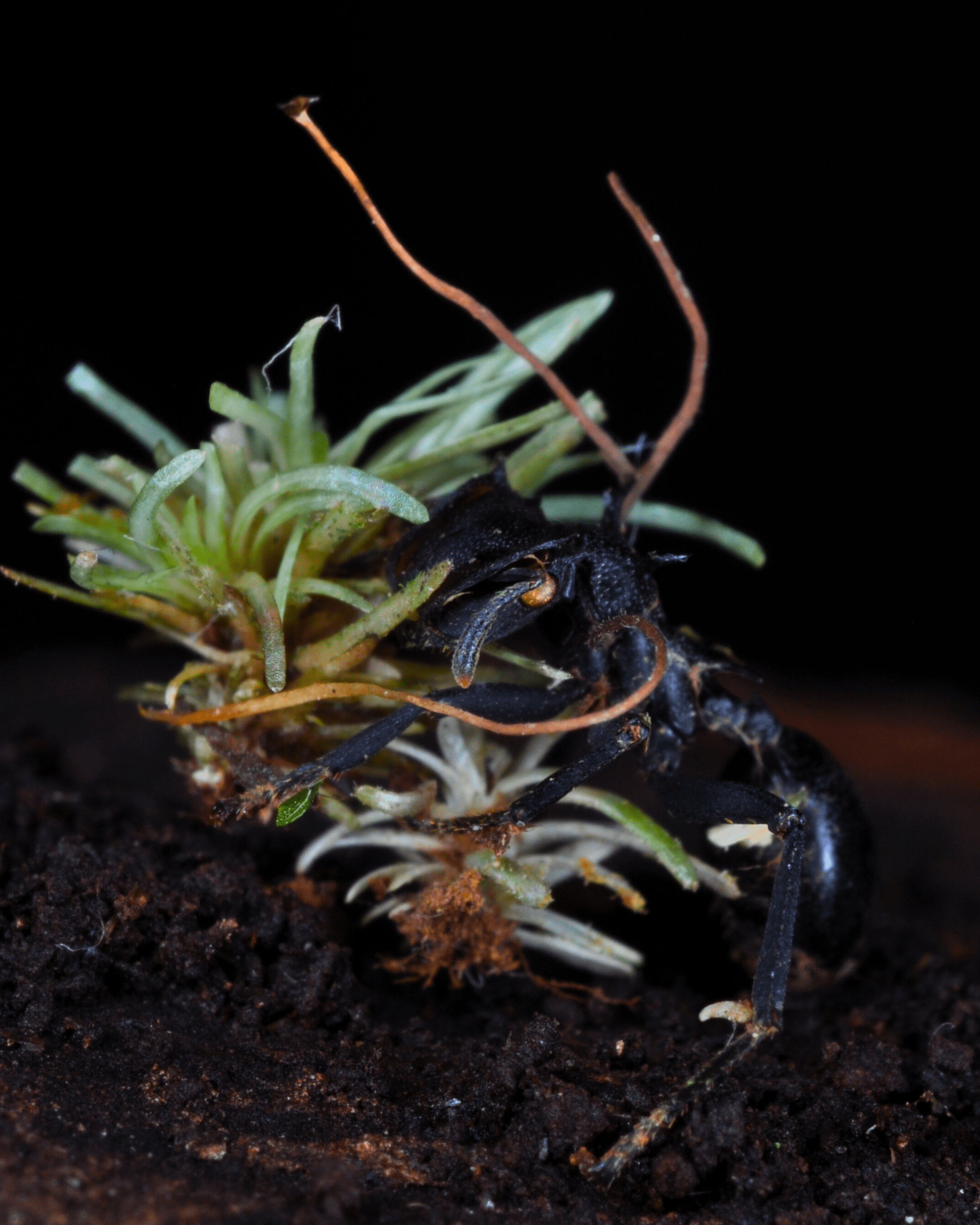
Amazonian ‘zombie’ fungus harbours a hidden stage inside forest mosses, new study reveals

Research led by INPA scientists reveals that the parasite, famous for altering ant behavior, also shelters within vegetation, suggesting a dual ecological journey never before observed in manipulating lineages of the genus.

A team led by researchers at the National Institute for Amazonian Research (INPA), in Manaus, has found evidence that the “zombie-ant” fungus (genus Ophiocordyceps), globally known for controlling ant behavior and forcing infected ants to bite onto plants before dying, also lives hidden inside mosses in the Amazon rainforest.

By analysing the DNA of mosses collected at the Ducke Reserve in Manaus, the scientists detected the same parasitic fungus present not only in infected and manipulated insects, but also in the mosses where the infected insect is manipulated to bite. This indicates that the fungus has one life stage as an insect parasite and another, endophytic (living inside the plant) stage that had gone unnoticed until now.

The genus Ophiocordyceps comprises more than 350 species of fungi known for infecting a wide range of insects. Some of these species are famous for a behaviour that sounds like science fiction: after infecting an ant, the fungus alters its behaviour and forces it to leave the colony, climb the vegetation, and clamp its mandibles onto a specific spot, the so-called “death grip,” shortly before dying and releasing its spores.

In 2020, studies in China had already shown that a species from the same genus, known as “Himalayan gold” (O. sinensis), lived endophytically in plants in alpine regions. The major breakthrough of this new INPA study is demonstrating this same dual lifestyle in fungi that manipulate the insect to specifically and consistently bite plants that harbor the endophytic stage of the “zombie fungus.”

This suggests that the behavioral manipulation goes beyond the fungus-ant association, and that the plant harbouring the fungus’ endophytic phase may also possibly influence the manipulation itself.

The research, published in the open-access journal IMA Fungus, was carried out at the Adolpho Ducke Forest Reserve, north of Manaus, and relied on metabarcoding, a technique that allows researchers to read the DNA of all fungi present in an environmental sample at once.

Ophiocordyceps-infected insects found attached to bryophytes. Camponotus renggeri ant infected by O. camponoti-renggeri (TAJ32) biting into a Plagiochila liverwort while gripping an Octoblepharum moss with its tarsal claws. Image credit: Tales Alves-Júnior et al.

The results revealed that the fungus was present not only in infected ants but also consistently in the surrounding mosses, including in plants located more than 10 metres away from any ant infected by the parasite.

In the Amazon, researchers had already noticed that some manipulated ant species predominantly seek out mosses to bite for the “death grip,” but little was known about a possible prior colonisation of the moss by the same insect-parasitising fungus.

DNA analyses showed that even highly host-specialised fungal lineages, such as O. camponoti-nidulantis (infecting Camponotus nidulans) and O. kniphofioides (infecting Cephalotes atratus), were sheltered within bryophytes in the surrounding vegetation.

Ophiocordyceps kniphofioides in a turtle ant (Cephalotes sp.), found attached to an Octoblepharum moss. Image credit: Tales Alves-Júnior.

The discovery reshapes our understanding of the life cycle of these fungi and how these organisms evolve and survive. The ability to associate with plants may help the fungus persist through periods when insect hosts are scarce, and could also help explain the intriguing fidelity of certain fungal lineages to specific moss types.

“We have always thought of this fungus (Ophiocordyceps) as a parasite exclusive to insects, especially the ones it manipulates. What our data suggest is that the story is much larger: the same fungus appears to be ubiquitous in the surrounding moss communities. Our results illustrate a far closer link between the lifecycles of the plants and fungi involved in the behavioral manipulation of Amazonian ants.

Tales Alves Jr., biologist, Master’s in Botany from INPA and lead author of the study.

“The well-known behavioral manipulation caused by Ophiocordyceps may not result solely from the interaction between fungus and ant, but from a complex relationship among the fungus, its host, and the plant where the same fungus lives silently as an endophyte.”

João Paulo Machado de Araújo, co-author and researcher at the Natural History Museum of Denmark (University of Copenhagen).

Original source

Alves-Júnior T, Araújo JPM, Góes-Neto A, Mendes-Pereira T, Zartman CE (2026) Metabarcoding reveals a hidden endophytic stage of the ‘zombie-ant’ fungus in Amazonian mosses. IMA Fungus 17: e196998. https://doi.org/10.3897/imafungus.17.196998

Two new bird species from the Amazon Basin described based on bioacoustics and morphological data

Two new antbird species discovered in the Amazon Basin and described in the open-access journal Vertebrate Zoology.

Scientists have discovered that a widely recognized Amazonian antbird is not one, but five distinct species – including two completely new to science. This revelation of hidden biodiversity was achieved by integrating artificial intelligence, vocal analysis, and traditional museum work, demonstrating how cutting-edge technology can transform our understanding of life in Earth’s richest ecosystems.

The study was conducted by Vagner Cavarzere and his master’s student Enrico L. Breviglieri from São Paulo State University (UNESP), Brazil, together with curator Luis F. Silveira of the University of São Paulo Museum of Zoology, and was published in the open-access journal Vertebrate Zoology.

The research focused on the Cercomacra cinerascens antbird species complex, a group of small, insect-eating birds widespread across the Amazon Basin. While these birds appear nearly identical in plumage, they produce strikingly different songs.

Birds rely heavily on vocal communication, which are important for species recognition. Their songs act as acoustic signatures, providing a powerful key to unlocking hidden diversity.

the researchers explain

The team named one of the new species (Cercomacra mura) in honor of the Mura people, Indigenous inhabitants of the western Amazon where this bird occurs.

One of the new antbird species, Cercomacra mura perched on a branch.
One of the new antbird species, Cercomacra mura, perched on a branch. Credit to Tomaz Melo.

The second new species takes its name from its most diagnostic trait: a song composed solely of two‑note, raspy phrases. From the Latin raucus (hoarse, raspy) and sonus (sound), the scientific name Cercomacra raucisona directly reflects its unique vocal signature.

One of the new antbird species, Cercomacra raucisona perched on a tree branch
One of the new antbird species, Cercomacra raucisona. Photo credit to: Fernando Zurdo

To decode these signatures, the team employed BirdNET, an artificial intelligence tool developed by the Cornell Lab of Ornithology. This machine-learning algorithm converts sound into numerical data, allowing for the automated comparison of bird recordings collected across the Amazon. The vocal patterns it revealed were then cross-referenced with meticulous analyses of vocalizations, plumage patterns and morphology.

This multidisciplinary approach confirmed that populations separated by major Amazonian rivers, such as the Amazonas, Ucayali, Madeira, and Tapajós, have evolved into distinct species. “These rivers function as long-term natural barriers”, says lead author Cavarzere.

Populations diverged independently over millennia into the unique species we describe today, which are kept isolated by these major rivers.

the researchers explain

The discovery underscores the vast amount of cryptic biodiversity still awaiting discovery in the Amazon, even among seemingly well-known birds. It also highlights a new paradigm for taxonomy, where AI-powered tools work in concert with traditional bioacoustics and specimen-based research.

By merging artificial intelligence with the foundational science of bioacoustics and museum collections, we can uncover diversity that would otherwise remain invisible. Recognizing these species is the first and most critical step toward ensuring their protection in a rapidly changing world.

the researchers conclude

Original study:

Cavarzere V, Breviglieri EL, Silveira LF (2026) Integrative taxonomy of the Cercomacra cinerascens species complex with description of two new species (Aves: Thamnophilidae). Vertebrate Zoology 76: 73-91. https://doi.org/10.3897/vz.76.e171834

Cute but deadly: a new velvet worm species from Ecuador

The so-called “living fossil” shoots a sticky substance from a pair of glands to trap its prey.

Researchers have described a remarkable new species of velvet worm from the Ecuadorian Amazon.

Take a look below:

Oroperipatus tiputini.
Credit: Roberto J. León, Archive Universidad San Francisco de Quito USFQ.

While the Tiputini velvet worm (Oroperipatus tiputini) may look friendly, it is an accomplished hunter that shoots a sticky substance from a pair of glands to trap its prey.

However, lead author Jorge Montalvo from the USFQ Museum of Zoology, notes that the species also has a softer side, with the mother taking care of her considerably lighter-coloured young after they are born.

Adult female velvet worm with her offspring on a leaf.
Adult female with her offspring.

Velvet worms, also known as onychophorans or peripatus, are rare and unique invertebrates often referred to as “living fossils” because they evolved over 500 million years ago, long before the appearance of dinosaurs.

Currently, only about 240 velvet worm species are known, inhabiting tropical regions in the Americas, southern Chile, Africa, Southeast Asia, Oceania, and New Zealand.

Adult velvet worm on a leaf.
Oroperipatus tiputini.
Pedro Peñaherrera-R., Archive Universidad San Francisco de Quito USFQ

Published in the open-access journal Zoosystematics and Evolution, the discovery was more than 20 years in the making. It also represented the first study of Ecuadorian velvet worms for over 100 years.

“The research on this new species took several decades. I discovered the first individual of this new species in 2001, and we finally managed to describe it as part of Jorge Montalvo’s graduation thesis, who is now my colleague at the Museum of Zoology at USFQ. To complete the description, we used not only macromorphological descriptions but also high-magnification images obtained with a scanning electron microscope.”

Diego F. Cisneros-Heredia, one of the authors and director of the USFQ Museum of Zoology, Ecuador.

The researchers named the species after the Tiputini Biodiversity Station (TBS), part of the Yasuní Biosphere Reserve. The name recognises the hard work of the station’s management, research, and field team in protecting biodiversity.

Map of Ecuador showing the location of the Tiputini Biodiversity Station.
Map of Ecuador showing the location of the Tiputini Biodiversity Station (white square), type locality of Oroperipatus tiputini sp. nov., in the Amazonian lowlands.

The description of the Tiputini velvet worm raises the total number of described velvet worm species in Ecuador to seven. This species is the first from the Ecuadorian Amazon lowlands and the third in the western Amazon.

Original source

Montalvo-Salazar JL, Bejarano ML, Valarezo A, Cisneros-Heredia DF (2024) A new species of velvet worm of the genus Oroperipatus (Onychophora, Peripatidae) from western Amazonia. Zoosystematics and Evolution 100(3): 779-789. https://doi.org/10.3897/zse.100.117952

Follow Zoosystematics and Evolution on X and Facebook for more!

A new “groins of fire” frog, from the Peruvian Amazon

“When we found this new species in the Amazon lowlands of central Peru, we were quite surprised and kind of speechless.”

Guest blog post by Germán Chávez

As a South American herpetologist, it is inevitable to be absolutely buzzed every time I hear “Germán, you have to go to the Amazon jungle”. Going to the Amazon forest in Peru is perhaps the most joyful way to do your work. The chances to find so many frogs, lizards, snakes, turtles, and even caimans are really high, so one can’t help but get excited.

The Agua Blanca forest. Photo by Germán Chávez

The thing is, to someone like me who focuses their work on describing new species, the expectations shouldn’t be that high. The Amazon has always been a place full of mysteries, so many explorers, seduced by its enigmatic atmosphere, have gone deeper and deeper into the Amazonia. This has resulted in the description of so many species and very few unexplored places left.

So, when Wilmar Aznaran and I found this new species in the Amazon lowlands of central Peru, a well-visited area, we were quite surprised and kind of speechless. I have to confess that my reaction was “Bloody hell!” Externally, the frog is clearly different from any other similar species, and that was evident for us at the very moment we caught it. Indeed, the first option for the title of our new paper in Evolutionary Systematics was “Expect the unexpected: a new treefrog from the Amazon lowlands of Peru.” We could not believe that a medium-sized arboreal frog had passed in front of other researchers’ eyes, and remained unseen.

Scinax pyroinguinis. Photo by Germán Chávez

Soon we found out that it is not a common species in the area: after catching two individuals, we were unable to find more. Not ready to give up, we went once more time to that site a few months later and our efforts to find it were unsuccessful, so we suggest it is not a common frog.

At that point, we knew that we had a new species on hands, but describing it with only two specimens was challenging. Luis A. García-Ayachi went to the area and his efforts were also unsuccessful. That is when Alessandro Catenazzi joined us, so we decided to add an integrative approach to our work, basing our research on morphological and genetic differences. I can only say thanks to all our co-authors: from then on, everything started to work out.

Scinax pyroinguinis. Photo by Germán Chávez

We noticed there were wildfires in the area, are a serious threat to the frog’s habitat. So it is really curious that the orange pattern on the groins, thighs and shanks of the new species, resembles flames, like those threatening its habitat. No better name for our frog than Scinax pyroinguinis, which literally means “groins of fire”.

We hope that this discovery encourages people  and institutions to protect these remnant forests in central Peru, because they may yet harbour unknown species. If these forests disappear, we will probably lose a diversity that we do not even know now yet, and may never will. It is sort of a race against deforestation and habitat loss, but this doesn’t mean there’s nothing we can do. Research like ours is really important to help put the focus on this place, at least in the short term, and try to attract people to join forces in the conservation of Scinax pyroinguinis and its habitat.

Research article:

Chávez G, Aznaran W, García-Ayachi LA, Catenazzi A (2023) Rising from the ashes: A new treefrog (Anura, Hylidae, Scinax) from a wildfire-threatened area in the Amazon lowlands of central Peru. Evolutionary Systematics 7(1): 183-194. https://doi.org/10.3897/evolsyst.7.102425

Frog with tapir-like nose found in Amazon rainforest

The people of Peru’s Comunidad Nativa Tres Esquinas have long known about a tiny, burrowing frog with a characteristically long snout. Yet, until now, this species has remained elusive to biologists.

The people of Peru’s ​​Comunidad Nativa Tres Esquinas have long known about a tiny, burrowing frog with a long snout; one local name for it is rana danta, “tapir frog” for its resemblance to the large-nosed Amazonian mammal. But until now, this frog has remained elusive to biologists. Thanks to the help of local guides, an international team of researchers was able to find the frog and give it an official scientific name and description.

It’s an example of the Amazon’s hidden diversity, and it’s important to document it to understand how important the ecosystem functions.

Michelle Thompson, researcher in the Keller Science Action Center at Chicago’s Field Museum

“These frogs are really hard to find, and that leads to them being understudied,” says Michelle Thompson, a researcher in the Keller Science Action Center at Chicago’s Field Museum and one of the authors of a study describing the frog in Evolutionary Systematics. “It’s an example of the Amazon’s hidden diversity, and it’s important to document it to understand how important the ecosystem functions.”

“Frogs of this genus are spread throughout the Amazon, but since they live underground and can’t get very far by digging, the ranges each species is distributed in are fairly small. Since we found this new species in Amazon peatland, it wouldn’t be strange for it to be restricted to this environment. Its body shape and general look seems to be adapted to the soft soil of the peatland, rather than the robust and wider shape of species in other environments,”says Germán Chávez, a researcher at Peru’s Instituto Peruano de Herpetología and the study’s first author.

Synapturanus danta. Photo provided by Field Museum

The tapir frog’s appearance is striking. “It looks like a caricature of a tapir, because it has a big blobby body with this tiny little pointy head,” says Thompson. But despite its goofy appearance, it was very difficult to find. “The frogs are tiny, about the size of a quarter, they’re like brown, they’re underground, and they’re quick,” she says. “You know these little frogs are somewhere underground, but you just don’t see them hopping around.”

But while the frogs are hard to see, they’re not hard to hear. “We just kept hearing this beep-beep-beep coming from underground, and we suspected it could be a new species of burrowing frog because there had recently been other species in its genus described,” says Thompson. “But how do we get to it?”

Local guides who were familiar with the frogs led the researchers to peatland areas– wetlands carpeted with nutrient-rich turf made of decaying plant matter. The team searched by night, when the frogs were most active. 

“After 15 to 20 minutes of digging and looking for them, I heard Michelle screaming, and to me that could only mean that she and David had found the first adult,” says Chavez.

“We could hear them underground, going beep-beep-beep, and we’d stop, turn off our lights, and dig around, and then listen for it again,” says Thompson. “After a few hours, one hopped out of his little burrow, and we were screaming, ‘Somebody grab it!’”

Synapturanus danta. Photo by Germán Chávez

In addition to finally finding adult specimens of the frogs, the team recorded their calls. “I am obsessed with recording frog calls, so I decided to record the call first and then continue digging,” says Chávez.

The researchers used the physical specimens of the frogs, along with the recordings of their calls and an analysis of the frogs’ DNA, to confirm that they were a new species. They named them Synapturanus danta– Synapturanus is the name of the genus they belong to, and danta is the local word for “tapir.”

The frogs’ burrowing behavior that made them hard to find likely makes them an important part of their peatland home. “They’re part of the underground ecosystem,” says Thompson. “They’re moving down there, they’re eating down there, they’re laying their eggs down there. They contribute to nutrient cycling and changing the soil structure.”

“Beside the important role of this new species in the food chain of its habitat, we believe that it could be an indicator of healthy peatlands,” says Chávez. “First, we have to confirm whether it’s restricted to this habitat, but its body adaptations seem to point in that direction. For instance, if the habitat is too dry, the soil would become too hard for a non-robust frog like this one to dig. This would leave our frog with far fewer chances to find a shelter and eventually, it would be hunted by a bigger predator. So I think possibilities that this frog would be a wetlands specialist are high, but still need to go further in this research to confirm it.”

Panoramic view of the type locality. Photo by Alvaro del Campo

And the study’s implications go beyond the description of one little frog. S. danta was found during a rapid inventory led by Field Museum scientists, a program in which biologists and social scientists spend a few weeks in a patch of the Amazon to learn what species live there, how the people in the area manage the land, and how they can help make a case for the area to be protected. “Even though it’s called a rapid inventory, it could take a year or more to plan these things, and then it could take a year or a decade to do the conservation follow-up,” says Thompson. “The rapid part is where you spend a month in the field. And it’s a total whirlwind.”

A view of the landscape in the Amazonian Peatlands inhabited by Synapturanus danta. Photo by Luis Montenegro

Peru’s Putumayo Basin, where this rapid inventory took place, is part of a larger conservation scheme by the Keller Science Action Center and its partners. “The Putumayo Corridor spans from Ecuador, Colombia, Peru, and down to Brazil, following the Putumayo River,” says Thompson. “There’s very little deforestation, and it’s also one of the last free flowing rivers that has no current dams. There’s like a huge conservation opportunity to conserve the whole corridor, watershed and surrounding areas. This tapir frog is another piece of evidence of why scientists and local people need to work together to protect this region.”

Research article:

Chávez G, Thompson ME, Sánchez DA, Chávez-Arribasplata JC, Catenazzi A (2022) A needle in a haystack: Integrative taxonomy reveals the existence of a new small species of fossorial frog (Anura, Microhylidae, Synapturanus) from the vast lower Putumayo basin, Peru. Evolutionary Systematics 6(1): 9-20. https://doi.org/10.3897/evolsyst.6.80281

Learning more about vampire fish: first report of candiru attached to an Amazonian thorny catfish

For the first time, scientists report a vampire fish attached to the body of an Amazonian thorny catfish. Very unusually, the candirus were attached close to the lateral bone plates, rather than the gills, where they are normally found. Since the hosts were not badly harmed, and the candirus apparently derived no food benefit, scientists believe this association is commensalistic rather than parasitic. The research is published in the open-access journal Acta Ichthyologica et Piscatoria.

Guest blog post by Chiara C. F. Lubich, André R. Martins, Carlos E. C. Freitas, Lawrence E. Hurd and Flávia K. Siqueira-Souza

The Amazon River Basin is home to about 15% of all freshwater fish species known to science, and an estimated 40% yet to be named. These include some of the most bizarre fishes: the vampire fishes, locally known as candiru, members of the catfish subfamily Vandelliinae.). They survive by attaching themselves to the bodies of other fish and sucking on their blood, hence their common name. Yet, it was only recently that we found out that one candiru species, belonging to the genus Paracanthopoma, seems to be making use of its host in quite a different way.

During a sampling study of freshwater fish fauna in a lake of the Demeni River Basin, a left bank tributary of the Negro River, we found candirus attached to the surface of the body of an Amazonian species of a thorny catfish. By the end of the survey, we had observed a total of twenty candirus attached to the outside of the bodies of nine larger Doras phlyzakion, one or two per host. Very unusually, the candirus were attached close to the lateral bone plates, rather than the gills, where these fish are normally found.

Location of the study: Demeni River, left bank tributary of Negro River, Amazonas State, Brazil.

As a result of these observations, we recently published the first record of a candiru attached to the body surface of an Amazonian thorny catfish in an article in the open-access scholarly journal Acta Ichthyologica et Piscatoria.

Vampire fish have long and robust snouts, with strong dentary teeth that help them stay attached to the epidermis of their host and feed on its blood. However, when we performed a macroscopic analysis of the stomach contents of the preserved Paracanthopoma specimens, we were surprised to find no coagulated blood, nor flesh, skin or mucus. This might indicate an interaction between parasite and host that is more benign than usually attributed to vampire fish. 

Doras phlyzakion with vampire fish (Paracanthopoma sp.)  fixed into its epidermis close to the bony plates of the lateral line. Arrows: areas with reddish wounds.

We believe the association between candiru and host in this case might be commensalistic (where one organism benefits from another without harming it), rather than parasitic, because the hosts were not badly harmed, and the candiru apparently derived no food benefit. 

But what else would they seek on the back of Amazonian thorny catfish? One explanation could be that, since candirus are tiny and nearly transparent, they might be avoiding getting noticed by visual predators by riding on larger fish. Another hypothesis is that they could be using their big cousins to transport them over longer distances that they wouldn’t be able to cover themselves, eventually making it to safety or new food sources.

Research article:

Lubich CCF, Martins AR, Freitas CEC, Hurd LE, Siqueira-Souza FK (2021) A candiru, Paracanthopoma sp. (Siluriformes: Trichomycteridae), associated with a thorny catfish, Doras phlyzakion (Siluriformes: Doradidae), in a tributary of the middle Rio Negro, Brazilian Amazon. Acta Ichthyologica et Piscatoria 51(3): 241-244. https://doi.org/10.3897/aiep.51.e64324

Online sales of threatened cacti point to the Internet as an open door for illegal trade

International trade of wildlife on the Internet is highly unregulated and has become a threat for species survival. Threatened cacti are available on websites and shipped across countries without any legal documents to certify their trade is not a menace to population viability in the wild. Is this ignorance or unwillingness to comply with regulations? Study published in the open access journal Nature Conservation reports on the activity and discusses assessment methods and solutions.

In present days, trade of species is possible without any real human interaction, and distance is no longer an obstacle. Although conventional trade routes are maintained through shipping of goods, the widespread use and the unregulated nature of the Internet make e-commerce a great concern to the Convention on International Trade in Endangered Species of Wild Fauna and Flora (CITES).

This convention regulates international trade through issuing and control of permits, which aim to guarantee that the trade of individuals is not a threat to the survival of a species in the wild. Due to the magnitude of the international trade, the entire cacti family is under CITES.

In their study, scientists Vania Olmos-Lau and Dr María C. Mandujano, both affiliated with the Universidad Nacional Autónoma de México (UNAM), México, present a quick and easy method to assess the online availability of a highly collectible Mexican threatened cactus, commonly known as disc cactus. The method can be readily used to assess other species.

Because of its threatened status, no commercial trade of wild specimens is allowed and a collection permit is needed for harvest of seeds and individuals. Plants and seeds were found available in major online markets like eBay and Amazon, and were also offered via online stores based in the USA, France, Germany, Australia, the Czech Republic, the UK, and others. Researchers point out that the Asian market was underestimated due to language constraints.

Only a minority of these online stores openly stated that they would provide CITES documentation, or that plants were obtained from nurseries that grew cacti themselves. Results also indicate that the country home to this species, Mexico, plays no important role in the legal international trade of the species.

“This method is easily transferable to estimate the illegal market for any species and offers an understanding of the real magnitude and main targets of this new form of threat,” note the authors. “Compliance or other regulation mechanisms are needed in order to promote species conservation.”

For major online stores like eBay, Mercado Libre and Amazon, the researchers propose a policy based on filtering the publications which contain the name of CITES species.

For example, there could be downloadable forms for the sellers to sign and prove that they assume responsibility for the legal origin of the product. Also, a pop up window could let buyers know what a CITES species is and what its acquisition involves. After all, most times the lack of compliance with regulations for wildlife trade is a matter of ignorance rather than disobedience.

“We need to open our eyes to the demand for wildlife and how it can be satisfied through fair trade schemes that benefit local landowners,” point out the researchers.

###

Original source:

Olmos-Lau VR, Mandujano MC (2016) An open door for illegal trade: online sale of Strombocactus disciformis (Cactaceae). Nature Conservation 15: 1-9. doi: 10.3897/natureconservation.15.8259

Rare Amazonian butterfly named after British national treasure Sir David Attenborough

A beautiful new Black-eyed Satyr species has become the first butterfly named in honour of the popular naturalist and TV presenter Sir David Attenborough. Although not the first animal to be named after the British national treasure, the butterfly is so rare that it is known only from lowland tropical forests of the upper Amazon basin in Venezuela, Colombia, and Brazil. The study, conducted by an international team of researchers, led by Andrew F. E. Neild, Natural History Museum, London, and Shinichi Nakahara, McGuire Center for Lepidoptera and Biodiversity and Entomology & Nematology Department, University of Florida, is published in the open-access journal ZooKeys.

The presently described Attenborough’s Black-eyed Satyr, scientifically called Euptychia attenboroughi, has such a restricted distribution that all of its known sites lie within 500 kilometres from each other in the north-west of the upper Amazon basin.

Best known for scripting and presenting the BBC Natural History’s ‘Life’ series, Sir David Attenborough is also a multiple winner of the BAFTA award and a president of Butterfly Conservation.

“Other animals and plants have previously been dedicated to Sir David, but it makes us happy and proud to be the first to dedicate a butterfly species in his name,” says Andrew Neild. “Although we are a large team from several countries from across four continents and speaking different languages, we have all been deeply influenced and inspired by Sir David’s fascinating and informative documentaries.”

The butterfly’s atypical wings in comparison to its relatives, have been the reason the scientists took to plenty of diagnostic characters to define its taxonomic placement. The peculiar patterns and morphology initially led the researchers to think the species could be even a new genus.

“It was a surprise for us that DNA data supported inclusion of this new species in the existing genus Euptychia, since this species lacked a distinctive structural character which was considered to be shared by all members of the genus” explains Shinichi Nakahara.

###

Original Source:

Neild AFE, Nakahara S, Zacca T, Fratello S, Lamas G, Le Crom J-F, Dolibaina DR, Dias FMS, Casagrande MM, Mielke OHH, Espeland M (2015) Two new species of Euptychia Hübner, 1818 from the upper Amazon basin (Lepidoptera, Nymphalidae, Satyrinae). ZooKeys 541: 87-108. doi: 10.3897/zookeys.541.6297