Two new bird species from the Amazon Basin described based on bioacoustics and morphological data

Two new antbird species discovered in the Amazon Basin and described in the open-access journal Vertebrate Zoology.

Scientists have discovered that a widely recognized Amazonian antbird is not one, but five distinct species – including two completely new to science. This revelation of hidden biodiversity was achieved by integrating artificial intelligence, vocal analysis, and traditional museum work, demonstrating how cutting-edge technology can transform our understanding of life in Earth’s richest ecosystems.

The study was conducted by Vagner Cavarzere and his master’s student Enrico L. Breviglieri from São Paulo State University (UNESP), Brazil, together with curator Luis F. Silveira of the University of São Paulo Museum of Zoology, and was published in the open-access journal Vertebrate Zoology.

The research focused on the Cercomacra cinerascens antbird species complex, a group of small, insect-eating birds widespread across the Amazon Basin. While these birds appear nearly identical in plumage, they produce strikingly different songs.

Birds rely heavily on vocal communication, which are important for species recognition. Their songs act as acoustic signatures, providing a powerful key to unlocking hidden diversity.

the researchers explain

The team named one of the new species (Cercomacra mura) in honor of the Mura people, Indigenous inhabitants of the western Amazon where this bird occurs.

One of the new antbird species, Cercomacra mura perched on a branch.
One of the new antbird species, Cercomacra mura, perched on a branch. Credit to Tomaz Melo.

The second new species takes its name from its most diagnostic trait: a song composed solely of two‑note, raspy phrases. From the Latin raucus (hoarse, raspy) and sonus (sound), the scientific name Cercomacra raucisona directly reflects its unique vocal signature.

One of the new antbird species, Cercomacra raucisona perched on a tree branch
One of the new antbird species, Cercomacra raucisona. Photo credit to: Fernando Zurdo

To decode these signatures, the team employed BirdNET, an artificial intelligence tool developed by the Cornell Lab of Ornithology. This machine-learning algorithm converts sound into numerical data, allowing for the automated comparison of bird recordings collected across the Amazon. The vocal patterns it revealed were then cross-referenced with meticulous analyses of vocalizations, plumage patterns and morphology.

This multidisciplinary approach confirmed that populations separated by major Amazonian rivers, such as the Amazonas, Ucayali, Madeira, and Tapajós, have evolved into distinct species. “These rivers function as long-term natural barriers”, says lead author Cavarzere.

Populations diverged independently over millennia into the unique species we describe today, which are kept isolated by these major rivers.

the researchers explain

The discovery underscores the vast amount of cryptic biodiversity still awaiting discovery in the Amazon, even among seemingly well-known birds. It also highlights a new paradigm for taxonomy, where AI-powered tools work in concert with traditional bioacoustics and specimen-based research.

By merging artificial intelligence with the foundational science of bioacoustics and museum collections, we can uncover diversity that would otherwise remain invisible. Recognizing these species is the first and most critical step toward ensuring their protection in a rapidly changing world.

the researchers conclude

Original study:

Cavarzere V, Breviglieri EL, Silveira LF (2026) Integrative taxonomy of the Cercomacra cinerascens species complex with description of two new species (Aves: Thamnophilidae). Vertebrate Zoology 76: 73-91. https://doi.org/10.3897/vz.76.e171834

New Special Issue in Nature Conservation offers an interdisciplinary resource for wetland ecosystem restoration

New Special Issue in Nature Conservation offers an interdisciplinary resource from over 100 European experts for the better restoration of wetlands, coasts and floodplains

Wetlands are key environmental sentinels. These systems offer a plethora of ecosystem services, acting as biodiversity hotspots and carbon sinks while providing natural buffers against the impacts of climate change.

They also benefit our society by ensuring food security, providing clean water, and protecting coastal communities. In fact, they support more than one billion livelihoods worldwide, as well as 40% of all known plant and animal species.

However, in our rapidly changing world, we face a series of complex, overlapping challenges. To address the ongoing loss of wetlands, new, interdisciplinary solutions are needed that match the scale of the problem.

A Special interdisciplinary resource

In response to these challenges, a new special issue in Nature Conservation titled ‘Wetlands in a Changing Climate: Restoring Coasts and Floodplains,’ aims to bridge critical knowledge gaps, highlight the vital importance of wetland ecosystems, and identify ways to upscale restoration action under the EU Nature Restoration Regulation.

Wetlands in a Changing Climate: Restoring Coasts and Floodplains special issue in the open-access journal Nature Conservation published by pensoft

Edited by Ute Susanne Kaden, Sophia Schmid, Simone Wulf, Katrina Marsden, Carla Klusmann, Aletta Bonn, Klement Tockner and Mathias Scholz, the Special Issue includes 15 peer-reviewed articles with contributions from over 100 European experts across 18 countries. You can read the full editorial here.

Adopting a ‘source-to-sea’ approach, the collection bridges the gap between riverine and coastal research to foster integrated responses to environmental pressures. Its findings are organized into four key thematic sections:

  • Section I: Wetland biodiversity in a changing climate: Understanding their vulnerability
  • Section II: Wetland ecosystem services and nature-based solutions for climate change mitigation and adaptation
  • Section III: Wetland restoration in practice: Opportunities, overcoming barriers and scaling up implementation
  • Section IV: Wetland policy: Enabling a transition towards a resilient future

By synthesizing perspectives from science, policy, and practice across Europe, this collection serves as a transdisciplinary “guide for anyone seeking an integrated understanding of the unique role of European riverine and coastal wetlands in the context of climate change and biodiversity,”. 

While the primary scope is from Europe, these findings offer vital insights applicable to restoration efforts worldwide.

For me, riverine and coastal wetlands are vivid examples of how biodiversity, climate, and human well-being depend on one another, yet they often remain out of the spotlight – making their protection and restoration all the more important. This Special Issue brings together accessible science, practical experience, and policy perspectives, and we hope it will help spark real – and urgently needed – progress in restoring Europe’s coasts and floodplains.

comments Dr. Ute Kaden, one of the lead authors of this Special Issue.

This Special Issue builds on the 5th European Conference on Biodiversity and Climate Change (Bonn, 2023), a collaborative effort organized by the German Federal Agency for Nature Conservation (BfN), the European Network of Heads of Nature Conservation Agencies (ENCA), the Helmholtz Centre for Environmental Research (UFZ), the German Centre for Integrative Biodiversity Research (iDiv), and adel-phi.

Connecting the research and people

Beyond the Special Issue itself, the lead editors organised a free online launch event to present the valuable collection of research publications. On Thursday, 26 February, over 300 participants gained insights into the vulnerability and resilience of riverine and coastal wetlands.

The discussion centered on evaluating the multifunctional benefits of nature-based solutions, sharing restoration lessons from across Europe, and identifying key opportunities аnd challenges in scaling up wetland restoration actions.

Addressing biodiversity climate nexus is important – biodiversity loss and climate change are interconnected and we must strengthen their relationship to develop effective responses to both challenges.

Dr. Kim Grutzmacher, Head of Division International Nature Conservation, BfN

During the launch event, Dr. Flore Lafaye de Micheaux, European Senior Advisor at the Ramsar Convention on Wetlands, reflected on how the importance of wetlands extends beyond their ecosystem value.

Wetlands have been part of human existence since the dawn of time, not only because they have provided for our basic needs, but also because they are places of meaning, culture and spirituality. Our message is that it’s time to invest in wetlands as this means investing in future.

Dr. Flore Lafaye de Micheaux, Ramsar Convention on Wetlands

Research from four major projects, BioAgora, Respin, SpongeBoost, and Rest-Coast, was showcased during the launch event. As an active consortium member in these projects, Pensoft contributes essential expertise in science communication, dissemination, stakeholder engagement, and technological development.

Notably, the lead authors Dr. Kaden (UFZ) and Dr. Scholz (who also serves as the coordinator of SpongeBoost) presented insights from Sections I and II of the new Special Issue. Comprising eight papers from the SpongeBoost consortium, the research tackles pressing ecological challenges, ranging from nutrient retention and floodplain services to the socio-economic valuation of nature-based solutions and the intricacies of EU policy.

Wetland restoration involves human-nature relationships, and wetlands should be treated treated as a social ecological system.

Dr. Mathias Scholz, Helmholtz Centre for Environmental Research

In this Special Issue, you will find in-depth analyses such as the work of Ibáñez et al., 2026, which asks ‘To what extent is coastal wetland biodiversity endangered by climate change? How can we boost the resilience of coastal ecosystems?’ Their research highlights the dual threat of “coastal squeeze” and climate change on Mediterranean wetlands. 

Shifting the focus to inland waters, the issue also features ‘Building blocks for upscaling freshwater ecosystem restoration: Place-based strategies for a transdisciplinary challenge’ by Birk et al. (2026). Drawing on 18 European case studies from the MERLIN project, this research identifies five essential ‘building blocks’ necessary to successfully upscale freshwater restoration efforts.”


Full list of the articles in the Special Issue:

To follow the latest publications, news and highlights from Nature Conservation, we invite you to subscribe for the journal’s newsletter by using the Email alert field on this website’s homepage, and follow the journal on Bluesky and Facebook.


The development of the issue was supported by the Federal Agency for Nature Conservation (BfN) with funds from the Federal Ministry for the Environment, Climate Action, Nature Conservation and Nuclear Safety(BMUKN) (Project No. 3521830200).

5000 Students run ‘bee hotels’ across Canada – DNA reveals who’s checking in

Students at the forefront of conservation or how community science helps gather data on cavity-nesting bees and wasps, enhancing our understanding of ecosystem interactions.

Can students be the front lines of conservation? A new Canada-wide study, published in Metabarcoding and Metagenomics, suggests they can. The efforts of some 5000 students produced data detailed enough to reveal complex ecological networks hidden inside a small PVC and cardboard tube home.

A trap nest installed at a Bees@Schools community science location. Multiple tubes nested in are visible.
A trap nest installed at a Bees@Schools community science location. Multiple tubes nested in are visible. Photo credit to Sage Handler.

They invited schools to volunteer across Canada to install standardised ‘trap nests’ – simple PVC pipe and cardboard tube homes that mimic natural cavities where bees and wasps build nests.

Cavity-nesting bees and wasps play key roles in pollination and pest control, yet their distributions and feeding relationships are often poorly known because they can be small, secretive and difficult to observe directly.

As part of the Bees@Schools community science program, researchers Sage Handler (University of Guelph), Nigel Raine (University of Guelph), and Dirk Steinke (University of Guelph) aimed to address this.

Nesting tubes gathered from one trap nest, ready to be cut open and processed.
Photo credit to Sage Handler.

Instead of relying only on traditional identification under a microscope, the researchers used DNA metabarcoding – a method that reads DNA from mixed samples and can detect many species at once.

This allowed the team to identify not only which bee or wasp species built each nest, but also which plant pollen or insect prey were brought back as food. The result was a rich, detailed view of both where cavity-nesting bee and wasp species live and how they interact with plants and other insects.

A key outcome of the study was the creation of tripartite networks: maps linking (1) the nesting bee or wasp, (2) its food (pollen or insect prey) and (3) parasites. This kind of network is extremely difficult to build through observation alone, but trap nests can act like tiny ecological time capsules.

Every brood cell contains biological traces and metabarcoding can recover them. Students weren’t just collecting insects, they were collecting entire ecological interaction datasets: the raw material needed to build food-web maps across a whole country!

A lot of people want to contribute to conservation or learn more about biodiversity, but don’t know how. This shows that a small, practical action, like hosting a trap nest, can contribute real data that researchers can use. Community and citizen science is becoming more common, so keep an eye out for research happening in your neighbourhood.

says Handler, the lead author of the study

Original resource:

Handler S, Coveny K, Braukmann TWA, Raine NE, Steinke D (2026) Welcome to Hotel Hymenoptera: monitoring cavity-nesting bee and wasp distribution and their trophic interactions using community science and metabarcoding. Metabarcoding and Metagenomics 10: e139674. https://doi.org/10.3897/mbmg.10.139674

Call Me Invasive: New Evidence Confirms the Status of the Giant Asian Mantis in Europe

These mantises are increasingly threatening local biodiversity through aggressive predation and reproductive competition.

In the realm of entomology, few creatures command as much fascination as the mantis. Throughout history, these striking insects have been deeply woven into local myths and legends, sometimes respected as mystical soothsayers that can guide lost travelers home, and other times feared as little devils. 

Today they remain captivating animals, serving as excellent bioindicators of biodiversity, and helping us identify rich and diverse ecosystems when present as native species. 

However, a new study published in the open-access Journal of Orthoptera Research reports that two mantis species identified in Europe – Hierodula tenuidentata and Hierodula patellifera – have been formally recognised as Invasive Alien Species (IAS). This shift in status highlights a growing threat to the biodiversity that native mantises typically help us protect. Led by Roberto Battiston of the Museum of Archaeology and Natural Sciences “G. Zannato”, a team of researchers investigated the impacts of these native to Asia species on European ecosystems which, until now, were largely unknown.

According to Battiston, these mantises have been present in Europe for about a decade, but their numbers have recently exploded in the Mediterranean and continental regions. 

“They are pushing increasingly further north, thanks to climate change,” Battiston explains, noting that viable populations are now frequently spotted by the public in local parks and gardens. Because they are large and fascinating, they often inspire more curiosity than concern, with members of the public frequently wondering if these striking insects are a positive sign for their local environment.

“This study was born to give people those answers and to develop strategies to contain them.”

Hierodula tenuidentata and Hierodula patellifera are large and adaptable tree-dwelling predators, characterised by their high reproductive potential. They are capable of hatching an average of around 200 nymphs per egg case, which is almost double that of the native European mantis (Mantis religiosa). Coupled with their low rate of cannibalism among young nymphs, they are able to grow very rapidly. 

These species are considered particularly dangerous to local biodiversity because they fatally lure native males into mating attempts that end in the males being eaten, potentially depressing native populations. They additionally consume a wide range of other native species, including essential pollinators like honeybees, and small protected vertebrates such as lizards and tree frogs. These negative interactions demonstrate the need for urgent assessments, particularly in Mediterranean islands with endemic species of invertebrates and vertebrates.

Interestingly, domestic cats have emerged as the primary vertebrate predator of the invasive Asian mantises, accounting for 45% of recorded positive predation events. Battiston notes that while cats serve as an effective means of containment for these invaders, they are unable to distinguish between alien and native species. Consequently, roaming cats also prey on native species like the European mantis, which already suffer competition from their exotic cousins in peri-urban environments and are in decline. 

Human-modified environments, particularly in urban and suburban areas, significantly facilitate the expansion of Hierodula mantises. These insects utilise artificial structures, such as insect hotels, as concentrated hunting grounds, and leverage urban heat islands to survive longer into colder months. Thus, by exploiting human infrastructure and localised warming, these mantises are successfully extending their range and survival beyond natural limits.

To mitigate the spread of Hierodula, Battiston mentions the following initiative:

“My colleagues William di Pietro and Antonio Fasano (GRIO) have managed to set up a huge citizen science project and collect over 2,300 reports from enthusiasts and citizens. Citizen science is a fundamental tool not only for monitoring but also for raising awareness and informing people in an active and participatory way about these issues.”

Hierodula patellifera. (Video credit: Roberto Battiston).

Beyond reporting sightings, the public can also take direct action by intervening during the winter months when trees and shrubs are leafless. During this time, the oothecae – brownish, spongy egg cases about 2-3 cm in size – are well-exposed and easily recognisable on branches. While these cases are easy to remove and their destruction is painless, Battiston cautions that the public should always consult a specialist before removal to ensure that they are not accidentally targeting native mantises.

Hierodula patellifera eating a wasp and a bee at the same time. (Video credit: Roberto Battiston).

The expansion of the Asian mantis is a powerful reminder of how human activity shifts natural boundaries and makes active community-led conservation more important than ever. As these adaptable invaders continue to reshape European ecosystems, our collective vigilance and participation in citizen science are effective tools for protecting Europe’s native biodiversity.

Original source:

Battiston R, Di Pietro W, Boscato F, Fasano A (2026) Call me invasive: Testing the first impacts of the alien mantises Hierodula patellifera and Hierodula tenuidentata on European biodiversity. Journal of Orthoptera Research 35(1): 179-190. https://doi.org/10.3897/jor.35.165233

For more interesting articles on orthoptera, visit the Journal of Orthoptera Research website and follow us on Bluesky and Facebook.

Year of the Horse 2026: A selection of equine-related species to celebrate the Lunar New Year

Pensoft celebrates the Year of the Horse by showcasing scientific discoveries of equine-adjacent species.

Lunar New Year is a celebration of the arrival of spring and the beginning of a new year on the lunar calendar. As the most important holiday in China, it is also widely celebrated across Korea, Vietnam, and other countries with a substantial Chinese diaspora.

In celebration of 2026 as the Year of the Horse, we reviewed our journals for horse-related studies. While our recent publications do not focus on horses themselves, we have highlighted several fascinating species that share an equine connection in their names.

2026 may be the Year of the Fire Horse, but we start our series with a creature of the opposite element: the seahorse!

Hippocampus japapigu in situ, Hejie, Kenting, Taiwan. (Photo credit: Chao-Tsung Chen).

Monitoring tiny, cryptic pygmy seahorses can be costly and logistically challenging. To overcome this, researchers from Taiwan turned to citizen science, gathering photographs from divers and underwater photographers via social media. Five species were identified, including two never before recorded in the region.

Among them is the charismatic “Japan pig” seahorse, Hippocampus japapigu, originally described from Japan in the open-access journal ZooKeys.

At the time, only seven pygmy seahorses had been identified globally. Documenting five of them in Taiwan established the region among the world’s biodiversity hotspots for these miniature fish.

Read more: ZooKeys 883: 83–90. https://doi.org/10.3897/zookeys.883.39662

But seven did not remain the final count for long. In Chinese tradition, eight is considered an auspicious number, associated with prosperity and good fortune.

Enter Hippocampus nalu – the eighth recognized pygmy seahorse species!

Hippocampus nalu in situ, Sodwana Bay, South Africa at 14 m depth. (Photo credit: Richard Smith, oceanrealmimages.com).

It is also the first confirmed true pygmy seahorse recorded from Africa. Measuring just 20 mm, this tiny species was discovered at depths of 17 m on a sandy coral reef in Sodwana Bay, South Africa.

Read more: ZooKeys 934: 141–156. https://doi.org/10.3897/zookeys.934.50924

Seahorses also feature in a remarkable Mediterranean story…

A study published in Acta Ichthyologica et Piscatoria documented a stable and conspicuous population of the long-snouted seahorse, Hippocampus guttulatus, in a highly polluted coastal lagoon in the Ionian Sea.

Hippocampus guttulatus observed during the diving visual census carried out in the Mar
Piccolo of Taranto (Ionian Sea), 2011-2013. (Photo credit: Francesco Tiralongo and Rossella Baldacconi).

Through three years of diving surveys, amounting to 69 hours underwater, researchers recorded 196 sightings. The seahorses showed a clear preference for artificial hard substrates, while only a few individuals were found in algal meadows. 

Despite environmental fluctuations and pollution, the population persists. In the Year of the Horse, we wish you the same resilience and strength!

Read more: Acta Ichthyologica et Piscatoria 44(2): 99–104. https://doi.org/10.3750/AIP2014.44.2.02

Fish is a traditional Lunar New Year dish, symbolising abundance and good fortune. While you won’t find a horsefish at the markets of Hainan, China, you can certainly spot a ponyfish.

Researchers have reported the first confirmed record of Aurigequula striata in Chinese waters, based on specimens collected at a fish market in Sanya, Hainan Island.

Aurigequula striata, left lateral view. (Photo credit: Jia-Jie Chen).

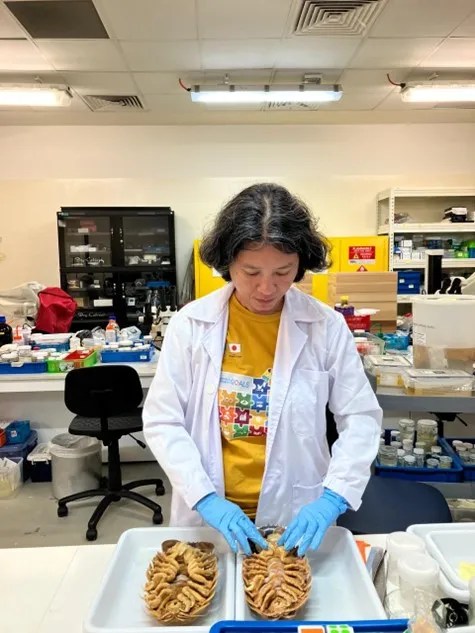
Live seafood markets have long proven to be unexpected hotspots for scientific discovery – just like the remarkable giant isopod Bathynomus vaderi described from market-purchased material in Vietnam.

As fresh as the seafood on display, this discovery was published in late January 2026 in ZooKeys. Newly collected specimens of Aurigequula fasciata enabled detailed morphological and genomic analyses, including the first complete mitochondrial genomes for both species and new phylogenetic insights into the family Leiognathidae.

Aurigequula fasciata, left lateral view. (Photo credit: Jia-Jie Chen).

Read more: ZooKeys 1267: 31–49. https://doi.org/10.3897/zookeys.1267.174380

Fittingly, we close with a horseshoe bat once feared lost. Its name bridges our equine theme with a traditional Chinese symbol: the word for bat (fú, 蝠) is a homophone for blessing (fú, 福), representing happiness and prosperity.

Hill’s horseshoe bat (Rhinolophus hilli), listed as Critically Endangered and unseen since 1981, was rediscovered in Nyungwe National Park, Rwanda, after 40 years.

Rhinolophus hilli, first observation of this species since 1981 in Nyungwe National Park. (Photo credit: Flanders, et al.).

Through cave surveys, forest capture efforts, and long-term acoustic monitoring, researchers confirmed the survival of this elusive species, bringing renewed hope for its conservation. 

Read more: Biodiversity Data Journal 10: e83546 https://doi.org/10.3897/BDJ.10.e83546

As we gallop into 2026, may the Year of the Horse bring you strength, endurance, and a stable path toward success. On behalf of Pensoft, we wish you a happy, healthy and prosperous New Year!

Original sources:

Chen J-J, Zhong J-S, Zeng S, Yang D-Y, Liu P, Wang X-D, Zhang H-Y, Ye J-Q (2026) A new leiognathid record from China with complete mitogenomes and phylogenetic insights of two Aurigequula (Teleostei, Leiognathidae) species. ZooKeys 1267: 31-49. https://doi.org/10.3897/zookeys.1267.174380

Flanders J, Frick WF, Nziza J, Nsengimana O, Kaleme P, Dusabe MC, Ndikubwimana I, Twizeyimana I, Kibiwot S, Ntihemuka P, Cheng TL, Muvunyi R, Webala P (2022) Rediscovery of the critically endangered Hill`s horseshoe bat (Rhinolophus hilli) and other new records of bat species in Rwanda. Biodiversity Data Journal 10: e83546. https://doi.org/10.3897/BDJ.10.e83546

Heard J, Chen J-P, Wen CKC (2019) Citizen science yields first records of Hippocampus japapigu and Hippocampus denise (Syngnathidae) from Taiwan: A hotspot for pygmy seahorse diversity. ZooKeys 883: 83-90. https://doi.org/10.3897/zookeys.883.39662

Short G, Claassens L, Smith R, De Brauwer M, Hamilton H, Stat M, Harasti D (2020) Hippocampus nalu, a new species of pygmy seahorse from South Africa, and the first record of a pygmy seahorse from the Indian Ocean (Teleostei, Syngnathidae). ZooKeys 934: 141-156. https://doi.org/10.3897/zookeys.934.50924

Tiralongo F, Baldacconi R (2014) A conspicuous population of the long-snouted seahorse, Hippocampus guttulatus (Actinopterygii: Syngnathiformes: Syngnathidae), in a highly polluted Mediterranean coastal lagoon. Acta Ichthyologica et Piscatoria 44(2): 99-104. https://doi.org/10.3750/AIP2014.44.2.02

Otters as ocean doctors: how a 40-year watch on Brazil’s coasts reveals hidden threats to estuaries

Neotropical otters are key for estuarine health, providing insights into ecosystem integrity and pollution impacts.

Guest blog post by Dr. Oldemar de Oliveira Carvalho Junior

For four decades, we’ve been quietly watching otters along the southern coast of Brazil. Not just because they’re charismatic and playful, but because they are among nature’s most honest diagnosticians. Just like a doctor checks your pulse, blood, and behavior to assess your health, scientists can use otters to monitor the condition of estuaries, those vital transition zones where rivers meet the sea.

Published in Estuarine Management and Technologies, our new study, ‘Otters as Bioindicators of Estuarine Health,’ synthesizes 40 years of field data from from Projeto Lontra in Brazil’s Peri Lagoon, along with global ecological research. The findings reinforce the role of semi-aquatic mammals as “living sensors” of ecosystem integrity.

This study is part of the topical collection: Otters as Bioindicators of Estuarine Health: Innovations in Monitoring and Management from Tropical Coastal Brazil

Why otters and not another animal?

Neotropical otter (Lontra longicaudis). Photo credit to: Projeto Lontra / Instituto Ekko Brasil

Otters sit at the top of the food chain in estuaries. They need clean water, healthy fish populations, connected habitats, and safe denning sites. If any of these elements falter, otters are among the first to respond, with fewer sightings, changes in their diet, or markers of disease.

While a water sample offers only a fleeting snapshot, otters aggregate environmental signals across time and space.

Neotropical otter with a cub. Photo credit to Projeto Lontra / Instituto Ekko Brasil

In fact, their very presence, or absence, tells a story. In regions where Atlantic Forest fragmentation has severed the connection between land and water, otter sightings have plummeted by 30% in just a decade.

This isn’t just a loss of biodiversity; it’s a warning for everyone downstream. Fewer otters mean degraded waterways, disrupted food webs, and weakened natural buffers against floods and erosion.

A “living record” of pollution

Neotropical otter (Lontra longicaudis) feeding on fish. Video credit to: Projeto Lontra / Instituto Ekko Brasil

The diet of otters consists of 70-80% fish, as well as crabs and other aquatic animals. As they consume prey, they also accumulate pollutants, like heavy metals, microplastics, and industrial chemicals, that have built up in those animals. Their bodies effectively become archives of contamination.

Think of an otter as a biological hard drive: by analyzing its scat (feces), we can reconstruct what pollutants are moving through the estuary, even if they’re invisible to the naked eye.

For instance, in Brazil, we’ve found microplastic fibers in otter droppings from protected lagoons, proof that no coastal system is truly isolated from human impact.

The tropical knowledge gap

Neotropical otter. Photo credit to: Projeto Lontra / Instituto Ekko Brasil

Globally, over 70% of otter research focuses on temperate species like the Eurasian or sea otter. Meanwhile, the Neotropical otter (Lontra longicaudis) receives less than 4% of scientific attention, despite inhabiting the world’s most biodiverse and threatened estuaries.

This imbalance in the research poses a great conservation risk. Tropical estuaries face unique pressures: rapid urbanization, mangrove deforestation, and climate-driven sea-level rise. Without focused research, we risk managing these ecosystems with tools designed for entirely different environments.

Our work aims to close this divide, establishing the Neotropical otter as a key indicator to drive evidence-based conservation across the Global South.

Land-based diseases in aquatic sentinels

Video from trap camera of two Neotropical otters in a shelter. Video credit to: Projeto Lontra / Instituto Ekko Brasil

One of our most striking findings showed that 66% of otters tested positive for Toxoplasma gondii – a parasite shed only by domestic cats. How does a land-based pathogen end up in an aquatic mammal? The answer is through runoff.

The rain washes cat feces from the streets, gardens, and informal settlements into rivers and lagoons. This reveals a sobering truth: even within protected areas, otters are exposed to threats originating far inland. To protect these sentinels of ecosystem health, we must implement integrated management strategies that address sewage overflow, urban runoff, and domestic animal impact.

What comes next?

Neotropical otter inside a shelter. Video credit to: Projeto Lontra / Instituto Ekko Brasil

We’re finalizing the Otter Health Index (OHI), a low-cost toolkit for municipalities, NGOs, and community groups to monitor estuaries using simple metrics: spraint frequency, habitat connectivity, contaminant screening, and local knowledge. It’s designed for places with limited labs but rich ecological insight.

After 40 years of observing otters, we’ve learned this: protecting them isn’t just about saving a species. It’s about safeguarding the intricate web of processes that sustain clean water, fisheries, flood resilience, and human well-being.

Otters aren’t just inhabitants of our estuaries; they are their guardians. If we listen to what they’re telling us, we’ll know exactly what these ecosystems need to survive and thrive.

Original sources:

Carvalho Junior, O., Bez Birolo, A., Tosatti, M., Haddout, S., Ljubenkov, I. and Jayachandran, P.R. eds., (n.d.). Otters as Bioindicators of Estuarine Health: Innovations in Monitoring and Management from Tropical Coastal Brazil. PEstuarine Management and Technologies. doi:https://doi.org/10.3897/emt.coll.317


Birolo, A.B., Tosatti, M., Junior and Assiya Haddout (2026). Otters as bioindicators of estuarine health: Scientific gaps, field-based insights, and a framework for future research. Estuarine Management and Technologies., 3, pp.65–78. doi:https://doi.org/10.3897/emt.3.185117.

Great white sharks in Spain: new record sparks a 160-year review

A juvenile great white shark was caught off Spain, prompting further research confirming its elusive presence in the Spanish Mediterranean.

On April 20, 2023, a juvenile great white shark (Carcharodon carcharias) measuring approximately 210 cm and weighing between 80-90 kg was incidentally caught by local fishermen off the coast of eastern peninsula. This rare encounter, prompted the researchers to dive deep into past records spanning from 1862 to 2023 compiling an extensive review that is now published in the open-access journal Acta Ichthyologica et Piscatoria.

The accidentally caught juvenile great white shark. Photo credit to Báez et al., 2026

The accidental capture – contextualized within a review of records spanning 160 years – revealed that while the Mediterranean great white shark remains as an elusive “ghost” population, it maintains a continued presence in these waters. Currently, the species is listed as Vulnerable on the IUCN Red List, with a declining population trend.

“Determining the presence of juvenile individuals is of particular importance,” says Dr. José Carlos Báez, the study’s lead researcher. “The occurrence of juvenile specimens raises the question whether active reproduction may be occurring in the region.” He further hypothesized. 

The fear of Great White Sharks

Through the examination of records, this study confirms the continued, though sporadic, presence of white sharks in Spanish Mediterranean waters. This research highlights a persistent but infrequent occurrence, with sightings remaining an exceptional event.

Citing H.P. Lovecraft’s famous observation that “the oldest and strongest emotion of mankind is fear, and the oldest and strongest kind of fear is fear of the unknown.” He emphasizes that scientific clarity is the best remedy. “By shedding light on the biology and ecology of the great white shark, research can help replace unfounded myths with genuine understanding.”

Dismantling the Stigma, One Myth at a Time

Video of the accidentally caught great white shark. Credit to Báez et al., 2026

With Great White Shark populations in decline, researchers emphasize that long-term observation programs are vital to understanding the species’ biology in the Mediterranean. By pairing direct sightings with advanced tracking methods, evidence-based strategies can be developed for the conservation of this iconic apex predator.

“The main idea I want to convey to the public is that these large marine animals have a fundamental role in marine ecosystems. As highly migratory pelagic species, they redistribute energy and nutrients across vast distances. They serve as nature’s scavengers – by consuming carrion, they keep ecosystems clean. Even in death, their descent to the seafloor provides a critical pulse of nourishment for deep-sea communities.

concludes Báez.

Research article:

Báez, J.C., Puerto, M.A., Torreblanca, D., Varela, J.L., Carmona, L. and Macías, D. (2026). New record of white shark, Carcharodon carcharias (Elasmobranchii, Lamniformes, Lamnidae), from the Mediterranean Spanish coast. Acta Ichthyologica et Piscatoria, 56, pp.27–31. doi:https://doi.org/10.3897/aiep.56.173786.

Using AI to Uncover the Secret Lives of Fungi

AI holds the potential to automatically identify fungal versatility from the available scientific literature.

Fungi are the hidden architects of our ecosystems, acting as everything from helpful partners for plants to aggressive decomposers that recycle dead wood. However, many fungi don’t stick to just one job; they can switch lifestyles depending on their environment.  

Understanding this flexibility is vital for predicting how forests and farms will react to climate change. Unfortunately, the information researchers need is buried in decades of scientific papers that would take too long to comb through manually. 

A new study led by Northern Arizona University doctoral student Beatrice M. Bock and published in the open-access journal Research Ideas and Outcomes demonstrates how AI can solve this problem. By using a specialized language model called BioBERT, Bock developed an automated workflow that assesses scientific abstracts and accurately identifies whether a fungus has a single lifestyle or a dual, flexible one. 

A high-accuracy hack 

Bock said that for years, mycologists have relied on manual databases to track what different fungi do in the environment. While these tools are essential, they are difficult to keep updated as new research is published every day. 

“Manually identifying fungal versatility from the literature is time-consuming and difficult to scale. By using machine learning, we can now scan thousands of papers in just a few minutes to flag species that might be switching roles—such as a fungus that normally helps a plant grow but also turns into a decomposer when the plant dies.” 

Beatrice M. Bock

The pilot study tested four different AI models to see which was best at understanding the nuances of biological language. The top-performing model, BioBERT, achieved nearly 90% accuracy in identifying fungal lifestyles. 

What did BioBERT have that the other models didn’t? For one, it had the power of capitalization. Bock found that “cased” models—those that recognize capital letters—performed significantly better than those that did not. That’s likely because capital letters often signal species’ scientific names, like Fusarium, which are crucial for AI to understand the context of the research. 

The path ahead 

Bock said that in a commitment to transparency, she has made all the code and data available for free online, allowing other scientists to build upon her work and track traits in other organisms, like insects or plants. 

While Bock’s study focused on a small group of papers as a proof-of-concept, it opens the door for much larger projects. Future versions of the tool could predict how a fungus’s behavior might change under specific environmental conditions, such as drought or extreme heat. 

“As fungal trait databases continue to grow in importance for biodiversity assessments, automated text mining offers a path toward more efficient, consistent and comprehensive trait annotation.”

Beatrice M. Bock

Original sources:

Bock B (2026) Automated extraction of fungal trophic modes from literature using BioBERT: an open pilot workflow. Research Ideas and Outcomes 12: e176590. https://doi.org/10.3897/rio.12.e176590

Story originally published by: EurekAlert! (2026). Using AI to uncover the secret lives of fungi. [online] Available at: https://www.eurekalert.org/news-releases/1114462 [Accessed 2 Feb. 2026]. Republished with permission.

Follow the latest publications and news from the Research Ideas and Outcomes (RIO) journal on Bluesky, Facebook and LinkedIn.

Corals’ Boldest Cousins: UH Scientists Discover Marine Creatures Bending the Laws of Evolution

A new Frontiers of Biogeography study shows zoantharian hexacorals defy biogeographic norms with narrow genetic differences across the Atlantic and Indo-Pacific.

Guest blog post by Dr. Maria “Duda” Santos and Maria Frostic

In the realm of marine biogeography, there is a widely held scientific principle: the Atlantic and Indo-Pacific oceans are worlds apart. If you dive in Brazil and then in Okinawa, you expect to see entirely different groups of fish and coral. But according to a new global study published today in Frontiers of Biogeography, one group of colorful hexacorals, anemone-like creatures—known as zoantharians—is breaking all the rules.

The study, led by Dr. Maria “Duda” Santos of the UH Mānoa Hawaiʻi Institute of Marine Biology (HIMB) ToBo Lab and the University of the Ryukyus, began with a moment of “déjà vu” underwater. 

Diver in Malaysia looking at a coral reef
Underwater view in a Malaysian coral reef with Duda searching for zoantharian species. Photo by Sam Webster.

“During my first dive in Okinawa, I was surrounded by a multitude of species I had never seen in my homeland of Brazil. But then I saw the zoantharians. They looked exactly like the ones back home—the same colors, shapes, and sizes. It was striking.”

shares Dr. Santos

While the Indo-Pacific typically hosts ten times the species diversity of the Atlantic for most reef animals, this research found that the genetic and morphological divergence between oceans for these creatures is surprisingly narrow.

The Secrets of the Ultimate Travelers

Zoantharians from different parts of the ocean that surprisingly show narrow evolution despite the distance
Sibling zoantharians from the Indo-Pacific (A) and the Atlantic (B) oceans. Images by Dr. Maria “Duda” Santos.

The researchers suggest that zoantharians may be the ultimate oceanic travelers. Their secret likely lies in high dispersal via an “epic” larval phase, where young zoantharians can survive in open water for over 100 days, paired with an ability to “raft” across ocean basins by hitchhiking on floating objects.

Furthermore, an unusually slow evolutionary rate appears to keep distant populations looking and acting like siblings, even after millions of years of separation by continental barriers.

This discovery has major implications for the future of our oceans. As climate change stresses traditional stony corals, zoantharians are increasingly moving in to fill the void. 

“In habitats impacted by stress, some zoantharian species can outcompete stony corals. We are seeing ‘phase shifts‘ where reefs once dominated by corals are being taken over by zoantharians. Understanding how they spread helps us forecast what the reefs of the future will look like.”

explains Dr. Santos

A Global Atlas for a Changing Ocean

This landmark study represents a massive international effort, uniting a team from Hawai’i, Okinawa, Russia, Brazil, Hong Kong, Taiwan, and Indonesia. By combining DNA data and records from Mexico to the Philippines, the team has provided the first-ever global “atlas” for a group of animals that has remained in the shadows of their more famous coral cousins for decades. This map of the past and present provides a vital baseline for monitoring how marine life will navigate a warming world.

Original source

Santos, M.E.A., Kise, H., Fourreau, C.J.L., Kiriukhin, B., Kitahara, M.V., Baker, D.M., Toonen, R.J., Liu, P.J., Chang, A., Tu, T.-H., Widiastuti, Agustini, K.M.P., Bowen, B.W. and Reimer, J.D. (2026). Global biogeography of zoantharians indicates a weak genetic differentiation between the Atlantic and Indo-Pacific oceans, and distinct communities in tropical and temperate provinces. Frontiers of Biogeography, 19. doi: https://doi.org/10.21425/fob.19.174247