Students at the forefront of conservation or how community science helps gather data on cavity-nesting bees and wasps, enhancing our understanding of ecosystem interactions.
Can students be the front lines of conservation? A new Canada-wide study, published in Metabarcoding and Metagenomics, suggests they can. The efforts of some 5000 students produced data detailed enough to reveal complex ecological networks hidden inside a small PVC and cardboard tube home.
A trap nest installed at a Bees@Schools community science location. Multiple tubes nested in are visible. Photo credit to Sage Handler.
They invited schools to volunteer across Canada to install standardised ‘trap nests’ – simple PVC pipe and cardboard tube homes that mimic natural cavities where bees and wasps build nests.
Cavity-nesting bees and wasps play key roles in pollination and pest control, yet their distributions and feeding relationships are often poorly known because they can be small, secretive and difficult to observe directly.
Nesting tubes gathered from one trap nest, ready to be cut open and processed. Photo credit to Sage Handler.
Instead of relying only on traditional identification under a microscope, the researchers used DNA metabarcoding – a method that reads DNA from mixed samples and can detect many species at once.
This allowed the team to identify not only which bee or wasp species built each nest, but also which plant pollen or insect prey were brought back as food. The result was a rich, detailed view of both where cavity-nesting bee and wasp species live and how they interact with plants and other insects.
A rainbow of pollen prepared for DNA metabarcoding. Credit: Sage Handler An intact cavity-nesting bee nest extracted from a nesting tube. Credit: Sage Handler (Hill)
A key outcome of the study was the creation of tripartite networks: maps linking (1) the nesting bee or wasp, (2) its food (pollen or insect prey) and (3) parasites. This kind of network is extremely difficult to build through observation alone, but trap nests can act like tiny ecological time capsules.
Every brood cell contains biological traces and metabarcoding can recover them. Students weren’t just collecting insects, they were collecting entire ecological interaction datasets: the raw material needed to build food-web maps across a whole country!
A lot of people want to contribute to conservation or learn more about biodiversity, but don’t know how. This shows that a small, practical action, like hosting a trap nest, can contribute real data that researchers can use. Community and citizen science is becoming more common, so keep an eye out for research happening in your neighbourhood.
says Handler, the lead author of the study
Original resource:
Handler S, Coveny K, Braukmann TWA, Raine NE, Steinke D (2026) Welcome to Hotel Hymenoptera: monitoring cavity-nesting bee and wasp distribution and their trophic interactions using community science and metabarcoding. Metabarcoding and Metagenomics 10: e139674. https://doi.org/10.3897/mbmg.10.139674
In collaboration with the European Union pollinator projects community, scholarly publisher and technology provider Pensoft launchedAdvances in Pollinator Research, a new multidisciplinary, community-driven peer-reviewed journal set to transform how pollinator science is shared and translated into real-world action.
Advances in Pollinator Research(APR) is designed as an innovative platform for the full spectrum of pollinator science, from pollination ecology and pollinator-plant interactions to molecular ecology, conservation and more. A core mission of the journal is to champion research from underrepresented regions, taxa, and ecological contexts.
As a diamond open-access journal, APR is currently free to publish and free to read, ensuring that all published research is openly accessible to the global community. The first editorial of the journal is available here.
In response to the global crisis of pollinator decline, APR moves beyond traditional data silos. It is the first comprehensive platform to unify the biological, environmental, socio-economic, and governance dimensions of pollinator health.
It embraces transdisciplinary collaboration and research between scientists, industry, and society with the aim of finding and amplifying solutions to real-world problems.
APR journal with key information.
Furthermore, the journal welcomes research on conventional approaches while highly encouraging publications that apply innovative methods, such as automated monitoring systems, AI-assisted analytics, molecular and genomic tools, as well as large-scale network initiatives and open databases that advance FAIR (Findable, Accessible, Interoperable, and Reusable) data dissemination across regions and taxa.
Figure illustrating the scope and publishing process of the APR journal, showing the diversity of pollinators, the multitude of stressors affecting them, and the various stakeholders interacting with them. Credit to Beaurepaire et al., 2026
The journal will utilise Pensoft’s innovative ARPHA platform, known for its robust support of academic publishing and efficient dissemination of research. Thanks to this one-stop publishing solution, the new journal offers a seamless, end-to-end publishing experience, encompassing all stages between manuscript submission and article publication, indexation, dissemination and permanent archiving.
The publishing services provided by ARPHA also include a variety of human-provided services and support and integrations with third-party providers, intended to maximise the reach and usability of scholarly knowledge published in Advances in Pollinator Research.
“We are excited to launch Advances in Pollinator Research. This ambitious journal is set to drive more innovative and interdisciplinary approaches within the field of pollinator science,”
says Prof. Lyubomir Penev, founder and CEO of ARPHA and Pensoft
“With Advances in Pollinator Research, we aim to build an integrative and inclusive home for pollinator science that dissolves disciplinary and geographic silos and connects knowledge from genes to landscapes. Beyond a journal, APR is envisioned as a participatory forum where researchers, practitioners, and communities worldwide co-produce knowledge and accelerate solutions for pollinator health,”
comments Dr. Straub
“We are truly delighted to launch this new transdisciplinary journal focusing on pollinators. Through this effort, we aim to bring our diverse research community together and provide a dynamic platform for scientists and stakeholders to exchange knowledge, ultimately deepening our understanding of and commitment to protecting these precious and fascinating species.,”
adds Dr. Beaurepaire
Advances in Pollinator Research joins a number of open-access entomology journals published by Pensoft.
For more information on the journal’s focus and scope and guidelines to authors, visit APR’s website, subscribe to the journal’s newsletter and follow it on BlueSky,Facebook and Linkedin.
In the realm of entomology, few creatures command as much fascination as the mantis. Throughout history, these striking insects have been deeply woven into local myths and legends, sometimes respected as mystical soothsayers that can guide lost travelers home, and other times feared as little devils.
Today they remain captivating animals, serving as excellent bioindicators of biodiversity, and helping us identify rich and diverse ecosystems when present as native species.
However, a new study published in the open-access Journal of Orthoptera Research reports that two mantis species identified in Europe – Hierodula tenuidentata and Hierodula patellifera – have been formally recognised as Invasive Alien Species (IAS). This shift in status highlights a growing threat to the biodiversity that native mantises typically help us protect. Led by Roberto Battiston of the Museum of Archaeology and Natural Sciences “G. Zannato”, a team of researchers investigated the impacts of these native to Asia species on European ecosystems which, until now, were largely unknown.
According to Battiston, these mantises have been present in Europe for about a decade, but their numbers have recently exploded in the Mediterranean and continental regions.
“They are pushing increasingly further north, thanks to climate change,” Battiston explains, noting that viable populations are now frequently spotted by the public in local parks and gardens. Because they are large and fascinating, they often inspire more curiosity than concern, with members of the public frequently wondering if these striking insects are a positive sign for their local environment.
“This study was born to give people those answers and to develop strategies to contain them.”
Hierodula patellifera eating a wasp and honeybee. (Photo credit: Roberto Battiston).
Hierodula tenuidentata and Hierodula patellifera are large and adaptable tree-dwelling predators, characterised by their high reproductive potential. They are capable of hatching an average of around 200 nymphs per egg case, which is almost double that of the native European mantis (Mantis religiosa). Coupled with their low rate of cannibalism among young nymphs, they are able to grow very rapidly.
Size comparison of patellifera (on the left) and tenuidentata (on the right). (Photo credit: Roberto Battiston).
Roberto Battiston (left) and William Di Pietro (right) conducting field research. (Photo Credit: Roberto Battiston).
These species are considered particularly dangerous to local biodiversity because they fatally lure native males into mating attempts that end in the males being eaten, potentially depressing native populations. They additionally consume a wide range of other native species, including essential pollinators like honeybees, and small protected vertebrates such as lizards and tree frogs. These negative interactions demonstrate the need for urgent assessments, particularly in Mediterranean islands with endemic species of invertebrates and vertebrates.
Negative interactions of Hierodula preying on vertebrates – Wall lizard. (Photo credit: Flavio Basilico).
Negative interactions of Hierodula preying on vertebrates – Wall lizard. (Photo credit: Primo Chittaro and Caterina Biscaro).
Negative interactions of Hierodula preying on invertebrates. (Photo credit: Antonella Bianchi, Sebastiano Mattia Silenzi, Davide Maistrello, Simona Tenani and Matteo Algeri Bricoli).
Interestingly, domestic cats have emerged as the primary vertebrate predator of the invasive Asian mantises, accounting for 45% of recorded positive predation events. Battiston notes that while cats serve as an effective means of containment for these invaders, they are unable to distinguish between alien and native species. Consequently, roaming cats also prey on native species like the European mantis, which already suffer competition from their exotic cousins in peri-urban environments and are in decline.
Positive interactions of vertebrates preying on Hierodula – Domestic cat. (Photo credit: Patrizia Ruggeri).
Athene noctua – The Little Owl. (Photo credit: Marina Zambelli).
Cyanistes caeruleus – Eurasian blue tit. (Photo credit: Alessandra Previtali).
Dendrocopos major – Great Spotted Woodpecker. (Photo credit: Alessandra Previtali).
Human-modified environments, particularly in urban and suburban areas, significantly facilitate the expansion of Hierodula mantises. These insects utilise artificial structures, such as insect hotels, as concentrated hunting grounds, and leverage urban heat islands to survive longer into colder months. Thus, by exploiting human infrastructure and localised warming, these mantises are successfully extending their range and survival beyond natural limits.
To mitigate the spread of Hierodula, Battiston mentions the following initiative:
“My colleagues William di Pietro and Antonio Fasano (GRIO) have managed to set up a huge citizen science project and collect over 2,300 reports from enthusiasts and citizens. Citizen science is a fundamental tool not only for monitoring but also for raising awareness and informing people in an active and participatory way about these issues.”
Beyond reporting sightings, the public can also take direct action by intervening during the winter months when trees and shrubs are leafless. During this time, the oothecae – brownish, spongy egg cases about 2-3 cm in size – are well-exposed and easily recognisable on branches. While these cases are easy to remove and their destruction is painless, Battiston cautions that the public should always consult a specialist before removal to ensure that they are not accidentally targeting native mantises.
Hierodula patellifera eating a wasp and a bee at the same time. (Video credit: Roberto Battiston).
The expansion of the Asian mantis is a powerful reminder of how human activity shifts natural boundaries and makes active community-led conservation more important than ever. As these adaptable invaders continue to reshape European ecosystems, our collective vigilance and participation in citizen science are effective tools for protecting Europe’s native biodiversity.
Original source:
Battiston R, Di Pietro W, Boscato F, Fasano A (2026) Call me invasive: Testing the first impacts of the alien mantises Hierodula patellifera and Hierodula tenuidentata on European biodiversity. Journal of Orthoptera Research 35(1): 179-190. https://doi.org/10.3897/jor.35.165233
A new study reveals that different factors affect the relationship between inflammation and heart rhythm stability depending on whether patients are suffering from coronary disease or cirrhosis.
A new study reveals that the predictive power of key inflammatory markers, such as C-reactive protein, shifts fundamentally depending on whether a patient suffers from cirrhosis or acute/chronic coronary disease.
Measured using an electrocardiogram, ventricular repolarisation, which refers to the duration of time the heart muscle takes to electrically “reset” after each beat, is the core indicator of heart health stability. The main factors governing this essential electrical function are the pumping ability of the left ventricle and the activity of the autonomic nervous system – since systemic diseases like liver failure or coronary blockage disrupt these factors, inflammation often rises.
This study aimed to contrast how the relationship between inflammation and heart rhythm instability manifests across diseases localised in different systems.
“Most of the knowledge about markers of inflammation such as white blood cell count and C-reactive protein in the field of internal medicine comes from studies in patients with cardiovascular diseases, namely coronary artery disease,” explains doctor Niya Emilova of the University Emergency Medicine Hospital Pirogov in Sofia, Bulgaria, who led the research project.
“We present a study which is the first contemporary exploration of the differences in inflammation regarding arrhythmia risk and clinical outcome of patients with cirrhosis, stable coronary artery disease and acute myocardial infarction.”
The researchers measured three primary inflammation markers: white blood cell count (the number of infection-fighting cells), C-reactive protein (a protein produced in response to systemic inflammation), and procalcitonin (a highly specific indicator of bacterial infection).
Their paper, titled “C-reactive protein is closely related to cardiac repolarisation in patients with coronary artery disease in contrast to patients with cirrhosis”, and published in the open-access journal Bulgarian Society of Medical Sciences Journal, reveals that C-reactive protein is associated with the risk of ventricular arrhythmias in stable coronary disease, while both C-reactive protein and white blood cell count correlated with repolarisation indices in acute myocardial infarction.
In cirrhosis, only high white blood cell count showed a trend for linking to unstable rhythms; C-reactive protein by contrast did not correlate with heart rhythms in this group.
“The count of white blood cells and procalcitonin are associated with risk of complications in alcoholic cirrhosis. In patients with cirrhosis and infection on therapy, white blood cell count is a specific marker of increased dispersion of repolarisation,” the researchers write in their paper.
Certain medications used to treat heart failure and coronary disease, such as beta-blockers, may have preventive value in reducing the risk of life-threatening cardiac arrhythmias in patients with cirrhosis, the researchers suggest.
Original source:
Emilova N, Dineva D, Moneva-Sakelarieva M, Kobakova Y, Chaneva M, Ionchev I, Slaveva D, Popova M, Tododrov R, Kostov K, Sarakostova S (2026) C-reactive protein and cardiac repolarization in cirrhosis. Bulgarian Society of Medical Sciences Journal 8: e154296. https://doi.org/10.3897/bsms.8.154296
Lunar New Year is a celebration of the arrival of spring and the beginning of a new year on the lunar calendar. As the most important holiday in China, it is also widely celebrated across Korea, Vietnam, and other countries with a substantial Chinese diaspora.
In celebration of 2026 as the Year of the Horse, we reviewed our journals for horse-related studies. While our recent publications do not focus on horses themselves, we have highlighted several fascinating species that share an equine connection in their names.
2026 may be the Year of the Fire Horse, but we start our series with a creature of the opposite element: the seahorse!
Hippocampusjapapigu in situ, Hejie, Kenting, Taiwan. (Photo credit: Chao-Tsung Chen).
Monitoring tiny, cryptic pygmy seahorses can be costly and logistically challenging. To overcome this, researchers from Taiwan turned to citizen science, gathering photographs from divers and underwater photographers via social media. Five species were identified, including two never before recorded in the region.
Among them is the charismatic “Japan pig” seahorse, Hippocampus japapigu, originally described from Japan in the open-access journal ZooKeys.
At the time, only seven pygmy seahorses had been identified globally. Documenting five of them in Taiwan established the region among the world’s biodiversity hotspots for these miniature fish.
But seven did not remain the final count for long. In Chinese tradition, eight is considered an auspicious number, associated with prosperity and good fortune.
Enter Hippocampus nalu – the eighth recognized pygmy seahorse species!
Hippocampusnalu in situ, Sodwana Bay, South Africa at 14 m depth. (Photo credit: Richard Smith, oceanrealmimages.com).
It is also the first confirmed true pygmy seahorse recorded from Africa. Measuring just 20 mm, this tiny species was discovered at depths of 17 m on a sandy coral reef in Sodwana Bay, South Africa.
Seahorses also feature in a remarkable Mediterranean story…
A study published in Acta Ichthyologica et Piscatoria documented a stable and conspicuous population of the long-snouted seahorse, Hippocampus guttulatus, in a highly polluted coastal lagoon in the Ionian Sea.
Hippocampus guttulatus observed during the diving visual census carried out in the Mar Piccolo of Taranto (Ionian Sea), 2011-2013. (Photo credit: Francesco Tiralongo and Rossella Baldacconi).
Through three years of diving surveys, amounting to 69 hours underwater, researchers recorded 196 sightings. The seahorses showed a clear preference for artificial hard substrates, while only a few individuals were found in algal meadows.
Despite environmental fluctuations and pollution, the population persists. In the Year of the Horse, we wish you the same resilience and strength!
Fish is a traditional Lunar New Year dish, symbolising abundance and good fortune. While you won’t find a horsefish at the markets of Hainan, China, you can certainly spot a ponyfish.
Researchers have reported the first confirmed record of Aurigequula striata in Chinese waters, based on specimens collected at a fish market in Sanya, Hainan Island.
Aurigequulastriata, left lateral view. (Photo credit: Jia-Jie Chen).
Live seafood markets have long proven to be unexpected hotspots for scientific discovery – just like the remarkable giant isopod Bathynomus vaderi described from market-purchased material in Vietnam.
As fresh as the seafood on display, this discovery was published in late January 2026 in ZooKeys. Newly collected specimens of Aurigequula fasciata enabled detailed morphological and genomic analyses, including the first complete mitochondrial genomes for both species and new phylogenetic insights into the family Leiognathidae.
Aurigequulafasciata, left lateral view. (Photo credit: Jia-Jie Chen).
Fittingly, we close with a horseshoe bat once feared lost. Its name bridges our equine theme with a traditional Chinese symbol: the word for bat (fú, 蝠) is a homophone for blessing (fú, 福), representing happiness and prosperity.
Hill’s horseshoe bat (Rhinolophus hilli), listed as Critically Endangered and unseen since 1981, was rediscovered in Nyungwe National Park, Rwanda, after 40 years.
Rhinolophushilli, first observation of this species since 1981 in Nyungwe National Park. (Photo credit: Flanders, et al.).
Through cave surveys, forest capture efforts, and long-term acoustic monitoring, researchers confirmed the survival of this elusive species, bringing renewed hope for its conservation.
As we gallop into 2026, may the Year of the Horse bring you strength, endurance, and a stable path toward success. On behalf of Pensoft, we wish you a happy, healthy and prosperous New Year!
Original sources:
Chen J-J, Zhong J-S, Zeng S, Yang D-Y, Liu P, Wang X-D, Zhang H-Y, Ye J-Q (2026) A new leiognathid record from China with complete mitogenomes and phylogenetic insights of two Aurigequula (Teleostei, Leiognathidae) species. ZooKeys 1267: 31-49. https://doi.org/10.3897/zookeys.1267.174380
Flanders J, Frick WF, Nziza J, Nsengimana O, Kaleme P, Dusabe MC, Ndikubwimana I, Twizeyimana I, Kibiwot S, Ntihemuka P, Cheng TL, Muvunyi R, Webala P (2022) Rediscovery of the critically endangered Hill`s horseshoe bat (Rhinolophus hilli) and other new records of bat species in Rwanda. Biodiversity Data Journal 10: e83546. https://doi.org/10.3897/BDJ.10.e83546
Heard J, Chen J-P, Wen CKC (2019) Citizen science yields first records of Hippocampus japapigu and Hippocampus denise (Syngnathidae) from Taiwan: A hotspot for pygmy seahorse diversity. ZooKeys 883: 83-90. https://doi.org/10.3897/zookeys.883.39662
Short G, Claassens L, Smith R, De Brauwer M, Hamilton H, Stat M, Harasti D (2020) Hippocampus nalu, a new species of pygmy seahorse from South Africa, and the first record of a pygmy seahorse from the Indian Ocean (Teleostei, Syngnathidae). ZooKeys 934: 141-156. https://doi.org/10.3897/zookeys.934.50924
Tiralongo F, Baldacconi R (2014) A conspicuous population of the long-snouted seahorse, Hippocampus guttulatus (Actinopterygii: Syngnathiformes: Syngnathidae), in a highly polluted Mediterranean coastal lagoon. Acta Ichthyologica et Piscatoria 44(2): 99-104. https://doi.org/10.3750/AIP2014.44.2.02
Guest blog post by Dr. Oldemar de Oliveira Carvalho Junior
For four decades, we’ve been quietly watching otters along the southern coast of Brazil. Not just because they’re charismatic and playful, but because they are among nature’s most honest diagnosticians. Just like a doctor checks your pulse, blood, and behavior to assess your health, scientists can use otters to monitor the condition of estuaries, those vital transition zones where rivers meet the sea.
Neotropical otter (Lontra longicaudis). Photo credit to: Projeto Lontra / Instituto Ekko Brasil
Otters sit at the top of the food chain in estuaries. They need clean water, healthy fish populations, connected habitats, and safe denning sites. If any of these elements falter, otters are among the first to respond, with fewer sightings, changes in their diet, or markers of disease.
While a water sample offers only a fleeting snapshot, otters aggregate environmental signals across time and space.
Neotropical otter with a cub. Photo credit to Projeto Lontra / Instituto Ekko Brasil
In fact, their very presence, or absence, tells a story. In regions where Atlantic Forest fragmentation has severed the connection between land and water, otter sightings have plummeted by 30% in just a decade.
This isn’t just a loss of biodiversity; it’s a warning for everyone downstream. Fewer otters mean degraded waterways, disrupted food webs, and weakened natural buffers against floods and erosion.
A “living record” of pollution
Neotropical otter (Lontra longicaudis) feeding on fish. Video credit to: Projeto Lontra / Instituto Ekko Brasil
The diet of otters consists of 70-80% fish, as well as crabs and other aquatic animals. As they consume prey, they also accumulate pollutants, like heavy metals, microplastics, and industrial chemicals, that have built up in those animals. Their bodies effectively become archives of contamination.
Think of an otter as a biological hard drive: by analyzing its scat (feces), we can reconstruct what pollutants are moving through the estuary, even if they’re invisible to the naked eye.
For instance, in Brazil, we’ve found microplastic fibers in otter droppings from protected lagoons, proof that no coastal system is truly isolated from human impact.
The tropical knowledge gap
Neotropical otter. Photo credit to: Projeto Lontra / Instituto Ekko Brasil
Globally, over 70% of otter research focuses on temperate species like the Eurasian or sea otter. Meanwhile, the Neotropical otter (Lontra longicaudis) receives less than 4% of scientific attention, despite inhabiting the world’s most biodiverse and threatened estuaries.
This imbalance in the research poses a great conservation risk. Tropical estuaries face unique pressures: rapid urbanization, mangrove deforestation, and climate-driven sea-level rise. Without focused research, we risk managing these ecosystems with tools designed for entirely different environments.
Our work aims to close this divide, establishing the Neotropical otter as a key indicator to drive evidence-based conservation across the Global South.
Land-based diseases in aquatic sentinels
Video from trap camera of two Neotropical otters in a shelter. Video credit to: Projeto Lontra / Instituto Ekko Brasil
One of our most striking findings showed that 66% of otters tested positive for Toxoplasma gondii – a parasite shed only by domestic cats. How does a land-based pathogen end up in an aquatic mammal? The answer is through runoff.
The rain washes cat feces from the streets, gardens, and informal settlements into rivers and lagoons. This reveals a sobering truth: even within protected areas, otters are exposed to threats originating far inland. To protect these sentinels of ecosystem health, we must implement integrated management strategies that address sewage overflow, urban runoff, and domestic animal impact.
What comes next?
Neotropical otter inside a shelter. Video credit to: Projeto Lontra / Instituto Ekko Brasil
We’re finalizing the Otter Health Index (OHI), a low-cost toolkit for municipalities, NGOs, and community groups to monitor estuaries using simple metrics: spraint frequency, habitat connectivity, contaminant screening, and local knowledge. It’s designed for places with limited labs but rich ecological insight.
After 40 years of observing otters, we’ve learned this: protecting them isn’t just about saving a species. It’s about safeguarding the intricate web of processes that sustain clean water, fisheries, flood resilience, and human well-being.
Otters aren’t just inhabitants of our estuaries; they are their guardians. If we listen to what they’re telling us, we’ll know exactly what these ecosystems need to survive and thrive.
Original sources:
Carvalho Junior, O., Bez Birolo, A., Tosatti, M., Haddout, S., Ljubenkov, I. and Jayachandran, P.R. eds., (n.d.). Otters as Bioindicators of Estuarine Health: Innovations in Monitoring and Management from Tropical Coastal Brazil. PEstuarine Management and Technologies. doi:https://doi.org/10.3897/emt.coll.317
Birolo, A.B., Tosatti, M., Junior and Assiya Haddout (2026). Otters as bioindicators of estuarine health: Scientific gaps, field-based insights, and a framework for future research. Estuarine Management and Technologies., 3, pp.65–78. doi:https://doi.org/10.3897/emt.3.185117.
In honour of the International Day of Women and Girls in Science, Pensoft Publishers celebrates the remarkable contributions of women in our journals’ editorial teams.
Since its inception by the United Nations in 2015, February 11 has marked the International Day of Women and Girls in Science, dedicated to honouring the transformative role women play in the laboratory, field and archives. Despite their undeniable impact, women account for only a third of the world’s STEM researchers and 35 per cent of all STEM graduates, with only one in ten reaching leadership positions.
While the campaigns of the previous two years urged concrete steps for the promotion of gender equality in science, this year showcases existing good practices and solutions for making STEM environments more inclusive.
At Pensoft, we champion this mission by amplifying the voices of the women on our editorial boards. By sharing their wisdom, reflections and visions for the future, we hope to foster a more equitable scientific community and inspire the next generation of girls to pursue their passions in STEM.
For young women and girls dreaming of a career in science, Sandy Knapp, co-Editor-in-Chief of the open-access journal PhytoKeys, offers a powerful reminder:
“Keep going and keep doing. Don’t let anyone tell you that science isn’t for girls – it most certainly is. Science is for everyone, and it thrives on diversity. We need all kinds of people to make it truly work.”
As a woman leading a major scientific journal, Knapp also believes that creating a sense of belonging is a shared responsibility:
“We all need to work on this, both women and men. I think we need to not immediately assume subordinate roles – this doesn’t mean shouting and stamping our feet, but rather assuming a quiet and determined excellence.”
Knapp conducting fieldwork in Brazil in the 1980s.
She highlights that representation is key to influence, noting that “the more of any minority there are in the room, the easier it is to make your voice heard and your opinions count.” This same spirit of determination defines the advice she would give her younger self:
“Don’t let anyone tell you something is too difficult – it might be for them – but not for you! Believe in yourself.”
Knapp at the launch of the Fixing Our Broken Planet Exhibition at the Natural History Museum, London.
Meanwhile, Tammy Robinson-Smythe, co-Editor-in-Chief of the open-access journal NeoBiota, emphasises the sheer excitement of being at the forefront of scientific research:
“Science is an exciting environment to work in. I love the fact that what we discover today is feeding into the textbooks of tomorrow. A career in science is worth all the effort!”
Robinson-Smythe conducting fieldwork.
Robinson-Smythe also shed light on the intersection of professional life and family. “Making space for women to be moms while contributing to the scientific community is vitally important,” she explains. To achieve this, she advocates for practical, structural changes:
“By offering childcare on campus and at conferences we can help moms to feel like they belong, rather than feeling like they need to ‘switch off’ motherhood when they arrive at work.”
Reflecting on her own beginnings, Robinson-Smythe’s advice centers on the importance of individual path-finding:
“I’d remind myself that everyone is different. Learn from how others navigate the research environment, but find a way that matches with your morals and goals.”
The co-Editor-in-Chief of the Natural History and Museomics journal, Deborah L. Paul, similarly encourages young women and girls to believe in their dreams – “your motivation matters the most”. To succeed, she suggests surrounding oneself with supportive individuals who say “yes” to those dreams and actively encourage exploration.
When it comes to building a scientific community where women truly belong, Paul believes the responsibility lies in active leadership and self-reflection. She asserts that “we each need to set an example,” which involves constantly questioning current workflows to ensure we are creating “spaces where we can be heard and contribute.”
Reflecting on her own career, she recalls the impact of mentors and offers the simple yet powerful advice:
“Be that person for someone.”
She ends with a heartwarming piece of advice she would have told her younger self when first starting her career:
“Recognise that one’s path through life may not be linear and that’s okay. Know that discovery will lead you to new places and new adventures.”
For Pensoft, celebrating women in science means building a publishing environment where their research is seen, and their voices heard. As we look at insights from senior editors like Sandy Knapp, Tammy Robinson-Smythe and Deborah L. Paul, the message is clear: the field is better when it is diverse.
Berlin (Germany) and Sofia (Bulgaria), 10th February, 2026 – ResearchGate, the professional network for researchers, and Pensoft Publishers, an independent open access publisher and provider of high-quality scholarly publishing services, today announced an expansion of their Journal Home partnership. Building on an earlier collaboration announced in 2023, the list now expands to 40 journals, covering the majority of Pensoft’s and partners’ journals using the publisher’s ARPHA Publishing Platform.
With most of Pensoft’s eligible partner journals choosing to participate, the expansion reflects strong demand for greater exposure and engagement opportunities, particularly among smaller and developing journals in niche research areas. Through Journal Home, partner publishers can reach more relevant audiences, improve discoverability, and connect more effectively with researchers worldwide.
Participating Pensoft journals will also benefit from:
Increased usage and readership, with full-text open access journal content seamlessly surfaced to highly relevant researcher communities across the ResearchGate platform.
Stronger engagement from new and returning authors, connecting partner journals, including specialist and emerging titles, with targeted researchers and potential authors throughout the research lifecycle.
Dedicated Journal Profiles and prominent placement of Pensoft journals to enhance visibility and branding, boosting recognition of partner journals with researcher communities around the world.
Improved author experience, with the automatic addition of published articles to author profiles, clearer insight into reader engagement, and greater opportunities for meaningful collaboration.
“Journal Home allows us to provide our partner journals with improved visibility and stronger connections with global researcher communities. Many of these journals serve highly specialised fields, and Journal Home helps make sure their articles reach the right researchers, who will benefit from them most.”
Lyubomir Penev, CEO and founder of Pensoft Publishers
“We’re pleased to expand our Journal Home partnership with Pensoft to support an increasing number of partner journals. By bringing these journals onto the platform, smaller and emerging titles can expand their reach, attract high-quality submissions, and connect with the most relevant researcher communities at key moments in their research journey.”
Robyn Mugridge, Head of Partnership Development at ResearchGate
For more information about Pensoft Publishers, please visit www.pensoft.net.
About ResearchGate
ResearchGate is the professional network for researchers. Over 25 million researchers use researchgate.net to share and discover research, build their networks, and advance their careers. Based in Berlin, ResearchGate was founded in 2008. Its mission is to connect the world of science and make research open to all.
About Pensoft Publishers
Pensoft is an independent, open-access scholarly publisher and technology provider, best known for its 40+ biodiversity journals, including ZooKeys, Biodiversity Data Journal, PhytoKeys, MycoKeys, One Ecosystem, and Metabarcoding and Metagenomics. Ever since becoming the first to introduce semantic enrichments and hyperlinks within a scientific article in the field of biodiversity in 2010, Pensoft has been working on various tools and workflows designed to facilitate data findability, accessibility, discoverability and interoperability.
On April 20, 2023, a juvenile great white shark (Carcharodon carcharias) measuring approximately 210 cm and weighing between 80-90 kg was incidentally caught by local fishermen off the coast of eastern peninsula. This rare encounter, prompted the researchers to dive deep into past records spanning from 1862 to 2023 compiling an extensive review that is now published in the open-access journal Acta Ichthyologica et Piscatoria.
The accidentally caught juvenile great white shark. Photo credit to Báez et al., 2026
The accidental capture – contextualized within a review of records spanning 160 years – revealed that while the Mediterranean great white shark remains as an elusive“ghost” population, it maintains a continued presence in these waters. Currently, the species is listed as Vulnerable on the IUCN Red List, with a declining population trend.
“Determining the presence of juvenile individuals is of particular importance,” says Dr. José Carlos Báez, the study’s lead researcher. “The occurrence of juvenile specimens raises the question whether active reproduction may be occurring in the region.” He further hypothesized.
The fear of Great White Sharks
Through the examination of records, this study confirms the continued, though sporadic, presence of white sharks in Spanish Mediterranean waters. This research highlights a persistent but infrequent occurrence, with sightings remaining an exceptional event.
Citing H.P. Lovecraft’s famous observation that “the oldest and strongest emotion of mankind is fear, and the oldest and strongest kind of fear is fear of the unknown.” He emphasizes that scientific clarity is the best remedy. “By shedding light on the biology and ecology of the great white shark, research can help replace unfounded myths with genuine understanding.”
Dismantling the Stigma, One Myth at a Time
Video of the accidentally caught great white shark. Credit to Báez et al., 2026
With Great White Shark populations in decline, researchers emphasize that long-term observation programs are vital to understanding the species’ biology in the Mediterranean. By pairing direct sightings with advanced tracking methods, evidence-based strategies can be developed for the conservation of this iconic apex predator.
“The main idea I want to convey to the public is that these large marine animals have a fundamental role in marine ecosystems. As highly migratory pelagic species, they redistribute energy and nutrients across vast distances. They serve as nature’s scavengers – by consuming carrion, they keep ecosystems clean. Even in death, their descent to the seafloor provides a critical pulse of nourishment for deep-sea communities.
concludes Báez.
Research article:
Báez, J.C., Puerto, M.A., Torreblanca, D., Varela, J.L., Carmona, L. and Macías, D. (2026). New record of white shark, Carcharodon carcharias (Elasmobranchii, Lamniformes, Lamnidae), from the Mediterranean Spanish coast. Acta Ichthyologica et Piscatoria, 56, pp.27–31. doi:https://doi.org/10.3897/aiep.56.173786.
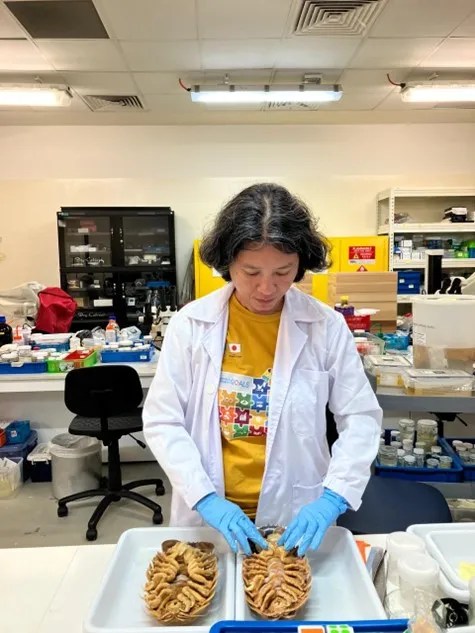
A new deep-sea chiton has been officially named by the public and described in the Biodiversity Data Journal. The name is the result of a viral, week-long collaboration between science communicator Ze Frank, Senckenberg, and Pensoft Publishers.
From over 8,000 suggestions submitted via social media, the research team responsible for describing the species selected the name Ferreiraella populi. The specific epithet populiis a Latin singular noun in the genitive case meaning “of the people”. Curiously, the name was independently suggested by 11 different contributors during the naming contest.
From a YouTube video to Taxonomy
It all began when Ze Frank featured the rare deep-sea chiton (genus Ferreiraella) in an episode of his “True Facts” YouTube series.
Equipped with an iron-clad radula (a rasping tongue) and eight protective shell plates, the chiton also hosts a tiny community of worms near its tail that feed on its excrements. Everyone was invited to propose a scientific name and justification; within a week the community responded with over 8,000 name suggestions.
“We were overwhelmed by the response and the massive number of creative name suggestions!” says Prof. Dr. Julia Sigwart, co-chair of SOSA at the Senckenberg Research Institute and Natural History Museum Frankfurt. “The name we chose, Ferreiraella populi, translates to “of the people”.
Other notable suggestions included Ferreiraella stellacadens meaning “Shooting star chiton” – named for its unique aesthete pattern and the fact that it “shot to fame” during the selection process.
Another was Fereiraella ohmu in reference to a chiton-like creature from Studio Ghibli, providing a nod to Japan, where the species was discovered.
A Specialized Resident of the Deep
Originally discovered in 2024 within the Izu-Ogasawara Trench at a depth of 5,500 meters, the new deep-sea chiton Ferreiraella populi belongs to the genus Ferreiraella, a rare and specialized group of mollusks that live exclusively on sunken wood in the deep sea.
Deep-sea sample extraction. Video Credit to Chong Chen/JAMSTEC
The new species represents an addition to a lineage of chitons that has been little researched to date and provides further evidence that deep-sea wood-fall ecosystems host highly specialized and still largely undiscovered communities,
explains Sigwart
Chitons are often described as a cross between a snail and a beetle. However, unlike common mollusks with a single shell, chitons possess eight separate shell plates(valves). This unique anatomy allows them to roll into a protective ball or cling to the irregular surfaces of deep-sea wood-falls.
Found in both warm coastal waters and coral reefs as well as the deep sea, chitons can live at depths of up to 7,000 meters under extreme conditions and in absolute darkness.
How is a scientific name formed?
Ever wonder how a creature goes from “that deep-sea thing” to a formal scientific entry? Every newly discovered species is assigned a scientific name as part of its original taxonomic description.
This follows Carl Linnaeus’s principle of binomial nomenclature and consists of two parts: the genus name (the first part, capitalized and italicised) and the specific epithet (the second part, lowercase and italicised).
The name is assigned by the author(s) of the first description in a scientific publication, adhering to international codes such as the ICZN (zoology) or the ICN (botany). The name must be novel, unique, and latinized. Usually, epithets are often derived from characteristics like color or size, geographic locations, mythology, or personal names used to honor a specific individual.
Ferreiraella populi in its natural habitat. Video credit to Chong Chen/JAMSTEC
Ferreiraella populi exemplifies the overwhelming biodiversity of the oceans, the vast majority of which remains unexplored. Many species go extinct before we even know they exist – this is especially true for marine invertebrates,
says Sigwart
“It can often take ten, if not twenty years, for a new species to be studied, scientifically described, named, and published. At SOSA, we have therefore made it our mission to streamline these processes while simultaneously engaging the public with these fascinating creatures. Finding a name for the chiton together on social media is a wonderful opportunity to do just that!” comments Sigwart.
“Ferreiraella populi has now been described and given a scientific name only two years after its discovery. This is crucial for the conservation of marine diversity, especially in light of the threats it faces such as deep-sea mining!” she says.
Research paper:
(SOSA) SOSA, Chen C, Frank H, Kraniotis L, Nakadera Y, Schwabe E, Sigwart JD, Trautwein B, Vončina K (2026) Ocean Species Discoveries 28–30 — new species of chitons (Mollusca, Polyplacophora) and a public naming competition. Biodiversity Data Journal 14: e180491. https://doi.org/10.3897/BDJ.14.e180491