The Sith Lord of the Sea: Supergiant Isopod in the WoRMS’ Top 10 Marine Species of 2025

The supergiant deep-sea isopod of the genus Bathynomus makes it to WoRMS Top 10 Marine Species of 2025.

What is now celebrated globally as Taxonomist Appreciation Day began in 2013. 19 March was declared by Dr. Terry McGlynn – a researcher and professor at California State University, Dominguez Hills – as a new holiday to highlight the extraordinary importance of taxonomy and taxonomist scientists to research in other fields.

To celebrate the scientists who classify, define, and name all things living, the World Register of Marine Species (WoRMS) has issued its Top 10 Marine Species of 2025, honouring the discoveries in marine biology throughout the past year.

Last year saw fascinating discoveries in the world of marine life. And today, we are super excited to share with you the species that made it to the Top 10 this year, first published in Pensoft’s open-access journal ZooKeys.

How are these lists compiled? It is a rigorous process, where WoRMS first invites all their editors to nominate their favourites, and then asks a small committee of taxonomists and data managers to provide their votes.

Now, without further ado, join us into the Dark Side to find out exactly why and how this particular species turned up at the top.

The Supergiant Isopod

The head of Bathynomus vaderi. Image by Nguyen Thanh Son

Meet Bathynomus vaderi, a supergiant isopod belonging to the genus Bathynomus. Species from this genus can reach more than 30 cm in length and are known in Vietnam as bọ biển or “sea bugs.” Bathynomus vaderi marks the first record of such a species in Vietnamese waters.

As you might have guessed, the moniker vaderi is inspired by the appearance of its head, which closely resembles the distinctive and iconic helmet of Darth Vader, the most famous character of Star Wars.

From the Market to the Lab

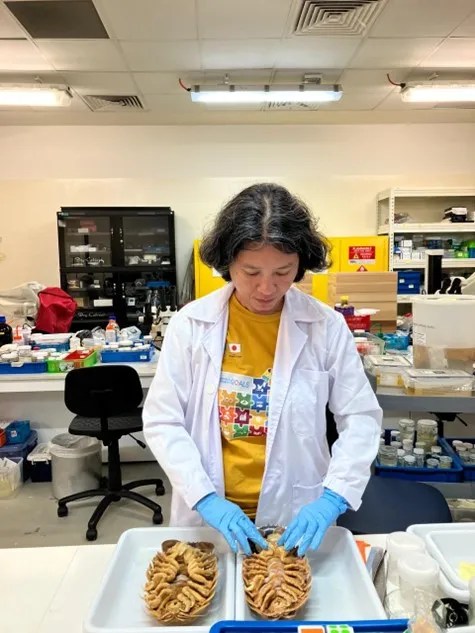
The story of how it was found is quite compelling. In contrast to the traditional image of deep-sea expeditions, Bathynomus vaderi was obtained from local sellers where the isopods are fished.

In March 2022, staff from Hanoi University purchased four giant isopod individuals from Quy Nhơn City and sent two of them to Peter Ng from the National University of Singapore for identification. Subsequently, this sparked an international collaboration between Ng, Conni M. Sidabalok (National Research and Innovation Agency, Indonesia), and Nguyen Thanh Son (Vietnam National University). Together, this expert team studied the specimens and confirmed they had discovered a species new to science.

Video by Kyle Hill on YouTube.

A Deep-Sea Delicacy

Giant isopods like Bathynomus vaderi have become an expensive delicacy in Vietnam. Until 2017, local fishermen only sold them as low-priced bycatch, but in recent years, the media has drawn public attention to this unusual seafood. Some even claim it is more delicious than lobster, the “king of seafood.”

The Importance of the Find

News story by Margherita Bassi via the Smithsonian magazine.

This discovery is a reminder of just how much we still don’t know about the vast deep-sea environment. If such a supergiant isopod could remain hidden for so long, it speaks to the extraordinary amount of work still needed to uncover the rich biodiversity of Southeast Asian waters – work that depends on the combined efforts of researchers and taxonomists, whose contributions are at the frontline of conservation.

The celebration is not over; we invite you to explore the Pensoft-published species that have previously made it to the WoRMS Top 10 and revisit the ocean’s most fascinating discoveries:

Original study:

Ng PKL, Sidabalok CM, Nguyen TS (2025) A new species of supergiant Bathynomus A. Milne-Edwards, 1879 (Crustacea, Isopoda, Cirolanidae) from Vietnam, with notes on the taxonomy of Bathynomus jamesi Kou, Chen & Li, 2017. ZooKeys 1223: 289-310. https://doi.org/10.3897/zookeys.1223.139335

Taxonomist Day at Pensoft: Three species in the WoRMS’ Top 10 Marine Species of 2019 described in our journals

Happy Taxonomist Appreciation Day, everyone!

In a lovely tradition, the World Register of Marine Species (WoRMS) issued the Top 10 Marine Species of 2019 for the ninth time around on time for this special day! 

In what has also already become a tradition we are particularly proud of, it’s not one, but several species described as new to science in Pensoft journals that make it to the renowned list! Even if it’s a slight step back from last year’s five entries, this year, we see a total of three species making it to the list: the Vibranium Fairy Wrasse (Cirrhilabrus wakanda) and the Green Rat Clingfish (Barryichthys algicola), both published in ZooKeys, and Thiel’s Boring Amphipod (Bircenna thieli) first known from the pages of Evolutionary Systematics.

Struggling to put a face to the name? Let us bring the stories behind these fantastic discoveries for you: 


The real-life fairy wrasse, whose scales shine bright like sci-fi vibranium

Even if the “twilight zone” – the ocean depths from 60 to 150 meters underneath the water surface, are long known to be teeming with all sorts of fascinating reef-dwelling lifeforms that still await discovery, California Academy of Sciences’ (CAS) initiative Hope for Reefs and partners are already concerned with the protection of these fragile habitats. One of the ways they do this is by deploying the taxonomic approach: recording and defining every creature the current environmental crisis could be putting in danger.

One of the latest discoveries made by the CAS team and Yi-Kai Tea, lead author and PhD student at the University of Sydney, is a stunning wrasse species with colours so mesmerising and vibrant that immediately triggered the creativity of the scientists. Discovered amongst the dusky coral reefs of eastern Zanzibar, off the coast of Tanzania, the species received the scientific name Cirrhilabrus wakanda in a nod to the Marvel Entertainment comics and movie Black Panther, where Wakanda is a mythical nation. 

The fish also goes under its common name: Vibranium Fairy Wrasse, because of its hypnotising scales reminiscent of the fictional metal. In the franchise, the vibranium is a rare, robust and versatile ore capable of manipulating energy. In its turn, the scales of the Vibranium Fairy Wrasse have a pigment so strong, their shades survive even when preserved.

“When we thought about the secretive and isolated nature of these unexplored African reefs, we knew we had to name this new species after Wakanda,”

said Yi-Kai Tea.

Story via Forbes*

Find more in the WoRMS’ press release.

***

Research article in ZooKeys:

Conway KW, Moore GI, Summers AP (2019) A new genus and two new species of miniature clingfishes from temperate southern Australia (Teleostei, Gobiesocidae). ZooKeys 864: 35-65. https://doi.org/10.3897/zookeys.864.34521


The clingy, yet long unknown green fish

You might think that a common name for a genus of tiny, less than 21 mm long marine inhabitants, such as ‘Rat Clingfish’ is way too unusual already, but it’s getting even more curious when you find out about those species’ mind-boggling lifestyle. 

These two miniature clingfishes were first spotted around microalgae in Australia back in the 1980s and since then they would puzzle scientists so much they would simply refer to them as “Genus B”. However, this was about to change, when in 2019, the US-Australian research team of Drs Kevin W. Conway, Glenn I. Moore and Adam P. Summers collected and studied enough specimens found in dense stands of macroalgae in intertidal and shallow subtidal areas along the coast of southern Australia. There, the two clingfishes use their well-developed adhesive discs located on their tummies to attach to the microalgae. Because of their miniature size, they have evolved multiple reduced and novel distinctive features.

As a result of their study, we now have the genus Barryichthys, whose common name is Rat Clingfish, and two new to science species assigned to it: the Brown Rat Clingfish (Barryichthys hutchinsi) and the Green Rat Clingfish (Barryichthys algicola), where the latter was found to be particularly intriguing thanks to its peculiar green colouration and a species name translated to “one who inhabits the algae”.

Find more in the WoRMS’ press release.

***

Research article in ZooKeys:

Conway KW, Moore GI, Summers AP (2019) A new genus and two new species of miniature clingfishes from temperate southern Australia (Teleostei, Gobiesocidae). ZooKeys 864: 35-65. https://doi.org/10.3897/zookeys.864.34521 


The boring vegetarian amphipod  

Another impressive creature with a taste for algae described in 2019 from Australia is the Thiel’s Boring Amphipod, which is indeed boring. The tiny crustacean, which can be found in colonies of hundreds in Tasmania, eats its way through its favourite bull kelp leaving behind tunnels.

Another peculiarity about the species is its head, which when seen from the front resembles that of an ant!

With its species name: Bircenna thieli, the scientists behind the study – Drs Elizabeth Hughes (Natural History Museum of London, UK) and Anne-Nina Lörz (University of Hamburg, Germany) pay tribute to respected crustacean expert Prof. Dr. Martin Thiel, who had originally collected some of the studied specimens.

Find more in the WoRMS’ press release.

***

Research article in Evolutionary Systematics:

Hughes LE, Lörz A-N (2019) Boring Amphipods from Tasmania, Australia (Eophliantidae: Amphipoda: Crustacea). Evolutionary Systematics 3(1): 41-52. https://doi.org/10.3897/evolsyst.3.35340