The beta release of an innovative collaborative stand-alone authoring tool transforms manuscript preparation with semantic enrichment and real-time collaboration capabilities.
Scholarly publisher and technology provider Pensoft Publishers announces the beta launch of ORPHO, a revolutionary online platform designed to streamline collaborative scientific writing and produce AI-ready, future-proof scholarly literature.
ORPHO presents a significant advancement in scholarly publishing technology, combining intuitive writing features with sophisticated semantic enrichment capabilities. The new platform builds upon Pensoft’s fifteen years of experience as a developer of semantic publishing infrastructure.
Key Features
Within a shared online workspace, researchers can start with built-in customisable templates, create their own or import an existing file. They can then team up with collaborators in real time using track changes, role-based user rights, inline comments, and document-level chat. More significantly, ORPHO automatically structures scientific content according to international publishing standards, making research outputs findable, discoverable, interoperable and reusable (FAIR) once published.
Unlike its predecessor, the ARPHA Writing Tool, ORPHO is available as a standalone real-time collaborative workspace decoupled from journals hosted on Pensoft’s ARPHA Publishing Platform. Once a manuscript is ready, authors receive AI-FAIR machine-readable content that can be formatted to meet multiple journal requirements at the click of a button.
The platform’s adaptability to domain-specific workflows is currently being piloted in biodiversity science. ORPHO integrates seamlessly with leading biodiversity data aggregators, including the Global Biodiversity Information Facility (GBIF), Barcode of Life Data Systems (BOLD) and PlutoF, via import and export facilities for structured data, making ORPHO particularly valuable for researchers handling taxonomic, ecological and biodiversity data.
ORPHO: A new intelligent workspace for scientific writing.
Why ORPHO?
The name draws inspiration from multiple sources which reflect the tool’s philosophy and heritage. Named after Orphium: a unique plant genus endemic to South Africa whose sole species (Orphium frutescens) is known as the sea rose, ORPHO reflects the platform’s distinctive nature, heritage, and core philosophy.
It also evokes Orpheus, the legendary musician of ancient Thrace whose home region, the Rhodopi Mountains, lies in present-day Bulgaria, where ORPHO’s developer, Pensoft, is headquartered. The name thus honours the tool’s origins whilst embodying the exceptional creative performance it enables.
***
Prof. Dr. Lyubomir Penev, founder and CEO of Pensoft, comments:
“We are well aware that researchers today face an overwhelming list of formatting requirements and technical demands in an AI-driven landscape. It is true that rapid technological advancement presents both immense opportunities and mounting complexities for researchers.
We built ORPHO to remove that friction by offering an intuitive, collaborative workspace that lets scientists focus on their research. As a scientific publisher, our mission is to make scholarly publishing a seamless, rewarding experience fit for the modern age.”
The beta release invites researchers, institutions and publishing platforms to trial ORPHO and provide feedback. Access is available at orpho.net.
Researchers have discovered sixteen new species of fungus living unnoticed inside garden and wild flowers across northern Thailand, more than quintupling the number of such fungi known to occur in the country.
Researchers have discovered sixteen new species of fungusliving unnoticed inside garden and wild flowers across northern Thailand, more than quintupling the number of such fungi known to occur in the country.
The fungi belong to Aureobasidium, a genus of dark, yeast-like organisms found almost everywhere on Earth, from human skin to glacial ice. Several members of the group are already prized in industry for producing useful enzymes, fighting plant disease and even breaking down plastic. Yet despite their familiarity, little was known about the diversity within Thailand’s tropical flowers.
Researchers from Chiang Mai University and Kasetsart University collected 54 fungal strains from 31 species of flower during a 2024 survey, among them bougainvillea, butter daisy, and periwinkle. Using a combination of DNA analysis across five gene regions, microscopy and growth trials, the team distinguished sixteen entirely new species, alongside five already known species (four of which had never before been recorded in Thailand).
Professor Nakarin Suwannarach of Chiang Mai University.
“Our team was motivated to study Aureobasidium because it was one of the most frequently isolated fungal genera from our flower samples.
We observed considerable variation among the isolates in colony morphology and other phenotypic characteristics, which suggested that there might be much greater species diversity than previously recognised.”
Distinguishing the new species was far from straightforward. Many looked almost identical under the microscope, and the DNA markers usually relied upon proved unable to tell them apart.
“This highlighted the limitations of relying on morphology alone, as well as on commonly used molecular markers.
By integrating multiple loci with morphological, physiological and growth-temperature data, we were able to distinguish closely related species more accurately. This was particularly surprising because Aureobasidium is a well-known fungal genus, yet our results revealed substantial previously unrecognised diversity in Thailand.”
Most of the new species take their names from the flowers in which they were found, including Aureobasidium bougainvilleae, A. catharanthi and A. plumeriae, while others honour the northern Thai locations where they were collected.
Two species, A. saisamorniae and A. savitreeae, were named in tribute to two of Thailand’s leading mycologists, Professor Saisamorn Lumyong and Professor Savitree Limtong.
“We wanted the names to tell a story, either about where these fungi came from or about the people who have helped advance mycological research in Thailand.”
Professor Suwannarach
Bougainvillea. Credit: Nakarin Suwannarach.
Beyond the taxonomy, the team says the findings matter for the future. A small number of Aureobasidium species have been linked to opportunistic infections, so having an accurate record of which species occur naturally will help scientists spot and respond to any change in their behaviour over time.
“This study demonstrates that multilocus phylogenetic analysis is not simply a tool for naming new species. It can reveal hidden fungal diversity and provide essential baseline information for understanding and monitoring fungal populations in the future.”
The 10th Symposium of the International Association for Lichenology took place in Trieste, where Pensoft showcased its plant science and mycology journal portfolio.
Held once every four years, the symposium is an important event for the global lichenology community, and this edition proved more popular than ever, drawing over 350 participants from around the world – more than double the number originally expected.
Lichenology is a wonderfully niche field, but IAL10 showed just how far-reaching and collaborative the community is. Delegates travelled from every corner of the globe to discuss taxonomy, lichen-associated microorganisms, biodiversity and conservation, ecophysiology, environmental biomonitoring, and cultural heritage preservation.
Pensoft’s stand at IAL10
Maria Kolesnikova, our Head of Marketing, Sales and Events, at the Pensoft stand at IAL10.
We were pleased to have our own stand at the symposium, where we showcased our journals in plant science and mycology, including:
MycoKeys: publishes papers on the monophyletic kingdom Fungi containing taxonomic or ecological data on any taxon of any geological age from any part of the world with no limit to manuscript size;
IMA Fungus: considers contributions from all areas of mycology expected to be of interest to the wider mycological community, from basic research to applications
PhytoKeys: publishes papers in systematic Botany containing taxonomic/floristic data on any taxon of any geological age from any part of the world
Italian Botanist: publishes original research covering all fields of Botany in its wider sense, including Mycology, ranging from molecular to ecosystem studies
Biodiversity Data Journal: publishes papers in biodiversity science containing taxonomic, floristic/faunistic, morphological, genomic, phylogenetic, ecological or environmental data on any taxon of any geological age from any part of the world
Vegetation Classification and Survey: publishes original papers that develop new vegetation typologies as well as applied studies that use such typologies, for example, in vegetation mapping, ecosystem modelling, nature conservation, land use management or monitoring
Pensoft’s journals in plant science and mycology.
It was a great opportunity to speak directly with researchers and students about publishing their work, and to reconnect with authors and editors already part of our community.
Garima Singh – Subject Editor and Author in MycoKeys.
Muhammad Usman, Author in MycoKeys.
Edyta Mazur – Author in Mycokeys.
Pier Luigi Nimis – Subject Editor and Reviewer in MycoKeys.
Talks that caught our attention
Among the many excellent presentations at IAL10, two in particular stood out to us:
Juri Nascimbene presenting his talk at IAL10 – Historical lichen collections as a time capsule.
Juri Nascimbene at Pensoft’s stand.
Juri Nascimbene, a subject editor and author at MycoKeys and an author for Italian Botanist, Vegetation Classification and Survey, and Biodiversity Data Journal, presented on the historical lichen collections held at the University of Bologna’s herbarium (BOLO). His talk explored how these collections, some dating back to the work of Ulisse Aldrovandi in the sixteenth century, allow researchers to track species distributions across centuries.
Using material such as Antonio Bertoloni’s Hortus Siccus Florae Italicae, which contains 850 georeferenced lichen specimens, Nascimbene’s team has been able to trace the long-term presence of species such as Lobaria pulmonaria in the chestnut groves of the Northern Apennines, and the disappearance of cold-adapted species such as Alectoria ochroleuca from high-altitude sites.
It was a fascinating look at how historical herbaria can inform our understanding of global change today!
Martin Grube presenting his talk at IAL10 – Lichens in motion.
We also attended a talk by Martin Grube, a reviewer and author at MycoKeys, who challenged the common perception of lichens as slow-growing organisms. His presentation examined the hygroscopic movements lichens undergo as they take up and lose water, and the mechanical stresses this creates within their thalli.
Grube introduced tools for measuring these mechanical properties and discussed what they might reveal about the evolution and function of lichen structures, thus offering a compelling primer on comparative thallus mechanics.
A new special issue in MycoKeys
While at IAL10, we were pleased to announce a new special issue in MycoKeys: Proceedings of the 10th International Conference of the International Association for Lichenology (IAL10), edited by Mauro Tretiach, Fabio Candotto Carniel, and Lucia Muggia. The special issue will bring together original research articles and short communications covering the full breadth of lichen symbiosis research. We look forward to seeing the community’s latest work published there.
Announcement of a special issue in MycoKeys at IAL10.
Celebrating the award winners
Congratulations to all of this year’s IAL10 award winners:
Group photograph of the award winners at IAL10.
Best Posters
Honorata Wacławek, “Phylogenetic insights into freshwater Gyalidea (Gomphillaceae, Graphidales) from the high Andes of Bolivia”
Ariel Sebastián Udaeta Sanchez, “First axenic cultures of saxicolous lichens from Tucumán (NW Argentina): growth timelines and representation of under-studied neotropical lineages”
Best Flash Talks
Ciaran Kelly, “Comparative genomic analyses of antimicrobial proteins encoded by lichen-forming fungi”
Anna Pasinato, “The metabolic divide: fungal genomes reveal an unequal distribution of biosynthetic gene clusters”
Best Oral Presentations
Victoria K., “Hidden cohabitants: metagenomic insights into global occurrence patterns of black fungi associated with lichens”
Diego Garfias Gallegos, “Central metabolism and development are rewired in lichenized cyanobacteria”
Until next time
IAL10 was a wonderful opportunity to reconnect with the lichenology community, and we were delighted to meet so many authors from our journals in person. Thank you to everyone who stopped by our stand, attended a talk with us, or simply shared a conversation about lichens.
We look forward to continuing our collaboration with the Italian Lichenological Society and seeing you all again at the next symposium.
Between 26-31 July, Pensoft Publishers joined more than 2,600 ecologists, researchers, and conservation professionals in Salt Lake City for the 111th Annual Meeting of the Ecological Society of America (ESA2026).
Pensoft Publishers joined more than 2,600 ecologists, researchers, and conservation professionals in Salt Lake City for the 111th Annual Meeting of the Ecological Society of America (ESA2026) between 26-31 July.
This year’s conference theme, “Ecology in an Era of Uncertainty,” could not have felt more timely. Uncertainty is nothing new to ecological research – it’s built into measurements, mechanisms, and predictions.
But new sources of uncertainty are now reshaping the field: the rise of artificial intelligence, post-pandemic shifts in career development, and growing instability in research funding. Throughout the week, the ESA community came together not only to share cutting-edge ecological research, but also to think collectively about how to navigate these emerging challenges – trading multidisciplinary, creative solutions to keep the field resilient in the face of what’s next.
The Opening Session
The Grand Ballroom was packed for the opening session, where Conference Chairs Daniel Stover and Andrea Swei welcomed attendees. Despite a challenging year for funding and travel, the 111th annual meeting of ESA 2026 hosted 2,600 registered attendees 330 sessions and 884 posters,
The opening address was delivered by Diane Pitaki, Chief Scientist and Vice President for Science at the National Wildlife Federation, who spoke about ecology standing at a crossroads amid the biodiversity crisis and shifting political headwinds, urging the community to actively “defend conservation science.”
Among the meeting’s standout moments was the plenary from Tanya Berger-Wolf, Professor of Computer Science and Ecology at Ohio State University and a leading figure in AI for ecology and biodiversity.
Notably, Berger-Wolf will be a keynote speaker at TDWG 2026 in Oslo (20-25 September) – where Pensoft Publisherswill once again be exhibiting, so stay tuned for future updates.
Situated right at the entrance of the exhibition hall, Pensoft’s booth revelled in attention from attendees throughout the week.
Pensoft’s team at ESA 2026 in Salt Palace Convention Center.
Pensoft’s busy stand at the 111th Annual Meeting of the Ecological Society of America.
Pensoft’s busy stand at the 111th Annual Meeting of the Ecological Society of America.
The beautiful Denitsa Peneva’s illustrations at ESA 2026.
A particular highlight was our trio of diamond open-access journals – free to publish in and free to read – that drew considerable interest from attendees:
Individual-Based Ecology promotes a distinctive individual-based perspective on ecology, aiming to bridge individual behaviour and broader ecological patterns.
Advances in Pollinator Research is designed as an innovative platform for the full spectrum of pollinator science, from pollination ecology and pollinator-plant interactions to molecular ecology, conservation, and more.
Agricultural and Environmental Modelling (AEM), meanwhile, offers an innovative approach to publishing, dedicated to advancing both the science and practice of modelling across agriculture, food systems, natural resources, and environmental sciences.
Brochure of the diamond open-access Individual Based Ecology Journal.
Close up photo of the Advances in Pollinator Research brochure at ESA 2026.
Nicole Nogoy, managing editor of Agricultural and Environmental Modelling at ESA 2026.
Attendees curious about AEM had the chance to speak directly with its Managing Editor, Nicole Nogoy, who was on site throughout the conference to discuss publishing opportunities and promote the journal’s search for Subject Editors.
We also introduced attendees to our newest addition, the diamond open-accessJournal of Regeneration. For those interested in sharing early-stage research or project outcomes, Research Ideas and Outcomes (RIO) offered another avenue worth exploring, publishing everything from project proposals and data to policy briefs and null results.
Those looking for a new publisher or white-label solutions had the opportunity to exploreARPHA, Pensoft’s own publishing platform, which supports the full journey from manuscript writing and peer review to publication, dissemination, and archiving – all in one seamless workflow.
Combined brochure of EU-Funded project in which Pensoft participates.
Beyond the journals and publishing solutions, the team took the opportunity to spotlight some of Pensoft’s ongoing EU-funded projects, including our pollination initiatives and our continued work with eLTER.
This time around, our team created “Pensoft Species Quiz,” challenging booth visitors to identify the correct Latin name for a series of species beautifully illustrated by Denitsa Peneva. Being more than just a fun activity, it became a natural conversation starter – leading into deeper discussions about Pensoft’s journals, services, and potential collaborations with attendees.
Some of the winners from our quiz at ESA 2026.
Some of the winners from our quiz at ESA 2026.
Happy winners from our interactive quiz game at ESA 2026.
Attendees interacting with our fun quiz.
The Agricultural and Environmental Modelling Poster Award
AEM’s Managing Editor – Nicole Nogoy ran a poster competition at the meeting, and it turned out to be one of the highlights of our week. Three researchers stood out:
Julian Resasco (University of Colorado, Boulder) took home the prize for overall best presentation with a hand-drawn comic-book poster on climate change effects on Basque country thistles;
Gwendolyn Lloyd (Indiana University) impressed us with her research on arthropods and mites in agricultural soils;
Emily Redding (Fort Hays State University, KS) joined in with a poster on fire suppression’s effects on Juniper-dependent bird species, having been inspired to bring modelling into her own research.
We also took part in a raffle organised by ESA, to which each exhibitor contributed a prize.
Kanchana Balasubramanian one of the winners of Pensoft Publishers’ raffle prizes at ESA2026.
Elizabeth Afkhami Searcy received our book “Mapping Ecosystem Services” as part of the Ecological Society of America’s conference raffle.
ESA2026 was a strong reminder of just how much energy – and uncertainty – is currently shaping the ecology community. Between thought-provoking plenaries on AI and conservation science, engaging conversations sparked by our species quiz, and the enthusiasm we saw around the AEM poster competition, it was a week full of meaningful connections for Pensoft.
We’re already looking forward to the next time, and we hope you’re looking forward to it, too!
As a longstanding supporter of vegetation science publishing, and publisher of Vegetation Classification and Survey, Pensoft was proud to sponsor EGC 2026 and attend throughout the week.
From 19 to 23 July 2026, Sofia hosted the 21st Eurasian Grassland Conference (EGC 2026), organised by the Eurasian Dry Grassland Group (EDGG), a working group of the International Association for Vegetation Science (IAVS). EDGG is dedicated to research on, and the conservation of, natural and semi-natural grasslands across the Palaearctic biogeographic realm, spanning any taxonomic group, whether plants and vegetation, animals or fungi.
This year’s conference was held under the theme “Connecting science and conservation for grassland sustainability”, with the aim of highlighting how research into grassland ecosystems connects with management practices and conservation goals on the ground.
Grasslands, particularly species-rich semi-natural grasslands and Eurasian steppes, are among the most threatened habitat types in one of the most heavily urbanised and intensively managed regions in the world, despite providing a wide range of ecosystem services. Bringing scientific knowledge together with conservation practice was therefore a central thread running through the week.
The conference was hosted by the Institute of Biodiversity and Ecosystem Research (IBER) at the Bulgarian Academy of Sciences. IBER conducts research across fundamental and applied ecology, biodiversity, nature conservation and the sustainable use of biological resources. The institute also provides scientific and methodological support to state institutions and NGOs, making it a fitting host for a conference concerned with the practical application of grassland science.
As a longstanding supporter of vegetation science publishing, and publisher of Vegetation Classification and Survey (VCS), one of IAVS’s official journals, Pensoft was proud to sponsor EGC 2026 and attend with an information stand throughout the week.
Pensoft’s stand at the 21st Eurasian Grassland Conference.
A gathering of the grassland community
EGC 2026 brought together around 60 participants, from early-career researchers to established names in vegetation science. Among the attendees were several members of the editorial board of VCS, including Editors-in-Chief Idoia Biurrun and Jürgen Dengler, as well as members of the IAVS council:
We were also delighted to catch up with authors who have published with us across several of our journals, including Biodiversity Data Journal (Naim Berisha), PhytoKeys (Marcin Nobel) and VCS(Arkadiusz Nowak).
Naim Berisha, an author in BDJ, at Pensoft’s stand at EGC 2026.
Marcin Nobis, a subject editors for PhytoKeys, at Pensoft’s stand at EGC 2026.
Arkadiusz Nowak, an author and editorial board member for VCS, at Pensoft’s stand at EGC 2026.
Our stand attracted a steady flow of visitors over the course of the week:
Conference participants visiting Pensoft’s stand at the 21st Eurasian Grassland Conference.
Pensoft’s journal portfolio in vegetation science.
Throughout the event, we shared our vegetation science portfolio, including VCSand Vegetation, Ecology and Diversity (VED), with strong additional interest in our following open-access journals:
Biodiversity Data Journal (BDJ) – a community peer-reviewed journal, designed to accelerate publishing, dissemination and sharing of biodiversity-related data of any kind.
MycoKeys– dedicated to the taxonomy, phylogeny, biogeography, evolution and ecology of the fungal kingdom, including lichens, and publishing everything from new species descriptions to checklists, monographs and methodology papers.
Nature Conservation – a rapid, peer-reviewed journal spanning all aspects of nature conservation, from populations to whole ecosystems, and from microorganisms and fungi to higher plants and animals.
A new special feature on the way
We were pleased to learn, just ahead of the conference, of a forthcoming VCS special feature tied to the event: “Vegetation of the Balkan Peninsula”, edited by Jürgen Dengler, Erwin Bergmeier and Urban Šilc.
The special feature welcomes contributions on any vegetation type from the Balkan Peninsula, including syntaxon revisions at national or supranational level, regional vegetation monographs, synthetic overviews of a country’s or region’s syntaxa, nomenclatural proposals, habitat typologies and applications, and long and short database reports.
VCS offers Gold Open Access publishing, holds a Journal Impact Factor of 2.7, and provides reduced article processing charges for IAVS members, with the option of complete waivers. Further details on the special feature will be announced soon on the VegSciBlog and across Vegetation Classification and Survey’s channels.
Scientific highlights
The five-day scientific programme was organised around five sessions: patterns, classification and biogeography of Palaearctic grasslands; grasslands of the Balkan Peninsula; animals in Palaearctic grasslands; innovative methods, experimental approaches and open science in grassland research; and global change, conservation, restoration and management of Palaearctic grasslands.
Participants at the 21st Eurasian Grassland Conference.
Jürgen Dengler – Global change in European grasslands: insights from local to continental studies.
Anna Kuzemko – Impact ofmilitary actions on the steppe ecosystems of Ukraine.
One of the highlights of the week was our own Head of Journal Development and PR, Iva Boyadzhieva, presenting on how Pensoft supports FAIR publishing for biodiversity and conservation research. Her talk set out how, as biodiversity and sustainability research gains momentum through greater international and interdisciplinary collaboration and the pressures of an unfolding environmental crisis, bridging scientific knowledge and conservation practice has become ever more critical.
Iva Boyadzhieva presenting – “At the forefront of FAIR publishing for biodiversity and conservation research”.
We also enjoyed Editor-in-Chief of VCS Jürgen Dengler’s talk on global change in European grasslands, which drew on regional resurveys of historic vegetation plots, combined analyses of multiple resurvey datasets, and decades of plot data from the European Vegetation Archive (EVA).
Anna Kuzemko’s talk on the impact of military actions on the steppe ecosystems of Ukraine was another highlight of the week. Her research offered a valuable basis for prioritising and planning the restoration of Ukraine’s damaged steppe habitats going forward.
Anna Kuzemko – Impact of military actions on the steppe ecosystems of Ukraine.
Awards
Pensoft also sponsored a best presentation and poster competition at the conference. Best Presentation was awarded to Sara Nigro for her talk “Climate and management changes drive semi-natural grassland community assembly over twenty years”, based on the resurvey of 49 vegetation plots in central Italy over two decades, revealing how climatic warming and shifting management practices are reshaping mountain semi-natural grasslands.
Best Poster went to Nadiia Skobel for “Drivers of vascular plant diversity in cultural heritage sites: a case study of old cemeteries (southern Ukraine)”, which showcased how old cemeteries in the grass steppe zone of southern Ukraine act as important refuges for native and steppe specific flora amid widespread habitat loss elsewhere in the region.
Looking ahead
EGC 2026 offered a valuable opportunity to connect with the authors, editors and researchers who make up the vegetation science community, and to see first hand how grassland research is being put to work for conservation across the Palaearctic. The next Eurasian Grassland Conference will take place in 2027 in Dilijan, Armenia – stay tuned for further updates!
Closing ceremony of the 21st EurasianGrassland Conference.
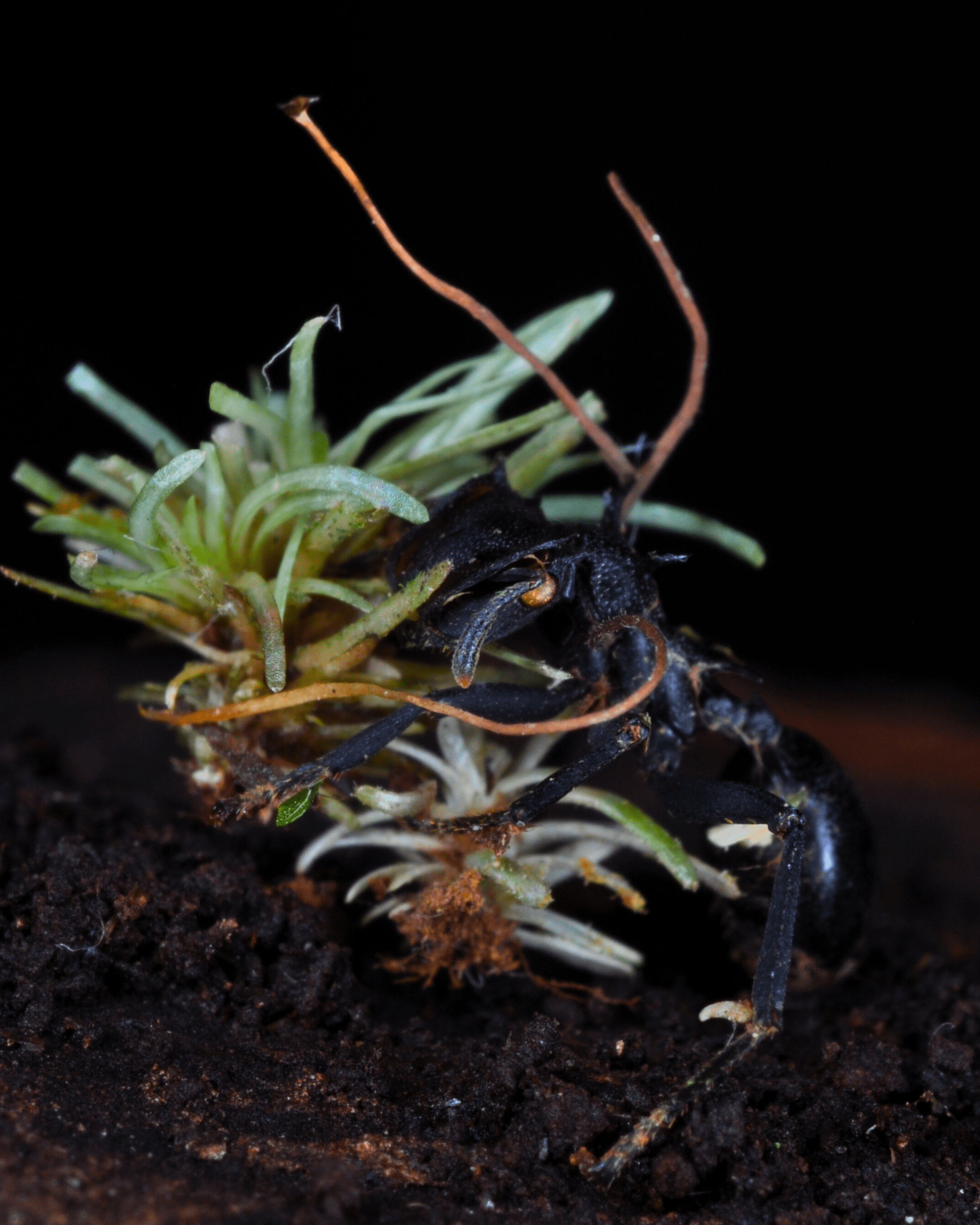
Research led by INPA scientists reveals that the parasite, famous for altering ant behavior, also shelters within vegetation, suggesting a dual ecological journey never before observed in manipulating lineages of the genus.
A team led by researchers at the National Institute for Amazonian Research (INPA), in Manaus, has found evidence that the “zombie-ant” fungus (genus Ophiocordyceps), globally known for controlling ant behavior and forcing infected ants to bite onto plants before dying, also lives hidden inside mosses in the Amazon rainforest.
By analysing the DNA of mosses collected at the Ducke Reserve in Manaus, the scientists detected the same parasitic fungus present not only in infected and manipulated insects, but also in the mosses where the infected insect is manipulated to bite. This indicates that the fungus has one life stage as an insect parasite and another, endophytic (living inside the plant) stage that had gone unnoticed until now.
Camponotus nidulans ants infected by O. camponoti-nidulantis found among bryophytes at the Adolpho Ducke Forest Reserve. Specimen “TAJ59” found on Octoblepharum moss. Image credit: Tales Alves-Júnior et al.
Specimen “TAJ63” also found on Octoblepharum moss. Image credit: Tales Alves-Júnior et al.
The genus Ophiocordyceps comprises more than 350 species of fungi known for infecting a wide range of insects. Some of these species are famous for a behaviour that sounds like science fiction: after infecting an ant, the fungus alters its behaviour and forces it to leave the colony, climb the vegetation, and clamp its mandibles onto a specific spot, the so-called “death grip,” shortly before dying and releasing its spores.
In 2020, studies in China had already shown that a species from the same genus, known as “Himalayan gold” (O. sinensis), lived endophytically in plants in alpine regions. The major breakthrough of this new INPA study is demonstrating this same dual lifestyle in fungi that manipulate the insect to specifically and consistently bite plants that harbor the endophytic stage of the “zombie fungus.”
This suggests that the behavioral manipulation goes beyond the fungus-ant association, and that the plant harbouring the fungus’ endophytic phase may also possibly influence the manipulation itself.
The research, published in the open-access journal IMA Fungus, was carried out at the Adolpho Ducke Forest Reserve, north of Manaus, and relied on metabarcoding, a technique that allows researchers to read the DNA of all fungi present in an environmental sample at once.
Ophiocordyceps-infected insects found attached to bryophytes. Camponotusrenggeri ant infected by O.camponoti-renggeri (TAJ32) biting into a Plagiochila liverwort while gripping an Octoblepharum moss with its tarsal claws. Image credit: Tales Alves-Júnior et al.
The results revealed that the fungus was present not only in infected ants but also consistently in the surrounding mosses, including in plants located more than 10 metres away from any ant infected by the parasite.
In the Amazon, researchers had already noticed that some manipulated ant species predominantly seek out mosses to bite for the “death grip,” but little was known about a possible prior colonisation of the moss by the same insect-parasitising fungus.
DNA analyses showed that even highly host-specialised fungal lineages, such as O. camponoti-nidulantis (infecting Camponotus nidulans) and O. kniphofioides (infecting Cephalotes atratus), were sheltered within bryophytes in the surrounding vegetation.
Ophiocordyceps kniphofioides in a turtle ant (Cephalotes sp.), found attached to an Octoblepharum moss. Image credit: Tales Alves-Júnior.
The discovery reshapes our understanding of the life cycle of these fungi and how these organisms evolve and survive. The ability to associate with plants may help the fungus persist through periods when insect hosts are scarce, and could also help explain the intriguing fidelity of certain fungal lineages to specific moss types.
“We have always thought of this fungus (Ophiocordyceps) as a parasite exclusive to insects, especially the ones it manipulates. What our data suggest is that the story is much larger: the same fungus appears to be ubiquitous in the surrounding moss communities. Our results illustrate a far closer link between the lifecycles of the plants and fungi involved in the behavioral manipulation of Amazonian ants.”
Tales Alves Jr., biologist, Master’s in Botany from INPA and lead author of the study.
“The well-known behavioral manipulation caused by Ophiocordyceps may not result solely from the interaction between fungus and ant, but from a complex relationship among the fungus, its host, and the plant where the same fungus lives silently as an endophyte.”
Alves-Júnior T, Araújo JPM, Góes-Neto A, Mendes-Pereira T, Zartman CE (2026) Metabarcoding reveals a hidden endophytic stage of the ‘zombie-ant’ fungus in Amazonian mosses. IMA Fungus 17: e196998. https://doi.org/10.3897/imafungus.17.196998
The seal recognises institutions that consistently share open-access agricultural research with the global community.
Pensoft has been awarded the Seal of Recognition for the FAO AGRIS Active Data Provider of the Year for 2027. The seal is granted by the Food and Agriculture Organisation of the United Nations through its AGRIS initiative, and it recognises institutions that consistently share open-access agricultural research with the global community.
Notably, Pensoft joined the FAO AGRIS network back in 2024, and the organisation has renewed our seal every year since, a recognition we’re proud to have kept.
What has changed is the scale of our contribution. In 2024, Pensoft’s records on AGRIS numbered just under 15,000. Today, that figure has doubled to nearly 30,000, drawn from all 51 of our journals that fall within the scope of FAO AGRIS. The subjects covered are wide-ranging, spanning taxonomy, biodiversity, conservation and biogeography – these are all areas that feed directly into sustainable agriculture and natural resource management.
Through AGRIS, this research travels well beyond our own journals to researchers, policymakers and practitioners worldwide, adding to the shared pool of open knowledge that supports global food security and environmental sustainability. We’re glad to keep contributing to that effort, and look forward to continuing our work with FAO AGRIS in the years to come.
About FAO
The Food and Agriculture Organisation (FAO) is a specialised agency of the United Nations that leads international efforts to defeat hunger. Its goal is to achieve food security for all, ensuring that people have regular access to enough high-quality food to lead active, healthy lives. With 194 members, 193 countries and the European Union, FAO works in over 130 countries worldwide.
About Pensoft
Founded in 1992 “by scientists, for scientists,” Pensoft is an academic open-access publishing company well known worldwide for its cutting-edge publishing tools, workflows and methods for text and data publishing of journals, books and conference materials. In 2010, Pensoft became the first scientific publisher to introduce semantic enrichments in scholarly publications. Through its Research and Technical Development department, the company is involved in a range of research and technology projects.
Highlights from Pensoft’s booth from the 8th European Congress of Conservation Biology (ECCB 2026) in Leiden.
Between 6-10 July, more than 850 participants from 25 countries gathered in Leiden, the Netherlands, for the 8th European Congress of Conservation Biology (ECCB) 2026.
The congress was organised by the Society for Conservation Biology (SCB) and hosted at Leiden University (FWN/CML), in partnership with Hortus botanicus, Wageningen University & Research (WUR), and NIOO-KNAW, with support from the Leiden Biodiversity Network.
Opening ceremony of ECCB 2026
Head of PR and Journal Development representing Pensoft at ECCB 2026.
Exhibitor and poster hall at ECCB 2026.
Effective Biodiversity Conservation
Under the theme “Effective Biodiversity Conservation,” the congress brought together researchers, policymakers, and practitioners to explore how biodiversity can be safeguarded over the long term. Its core message was that effective conservation cannot rest on the efforts of conservationists alone. It requires coordinated, multidisciplinary, science-based action across society.
Opening ceremony of ECCB 2026.
Prof. Dr. Geert de Snoo and his “1% of GDP for safeguarding nature!” presentation
Dr. Laura Bosco, President of SCB Europe, opened the congress and set the scene for the week ahead. Prof. Dr. Geert de Snoo, one of the congress’s co-organisers, followed with the presentation: “1% of GDP for safeguarding nature!” – a call to set aside 1% of global GDP to help close the biodiversity funding gap, given that half of the world’s GDP depends on natural ecosystem services, and to protect 30% of the Earth’s land and oceans by 2030.
From there, the programme ran packed with symposia, roundtables, and workshops covering policymaking and effectiveness, conservation planning, new methods for measuring and quantifying biodiversity, eDNA for conservation, citizen science, and remote sensing, alongside a poster session held each day.
Pensoft at he 8th European Congress of Conservation Biology (ECCB) 2026.
Our stand stood out with professionally designed booth walls and enjoyed a strong flow of visitors throughout the congress. Delegates met Pensoft’s Head of Journal Development and PR, Iva Boyadzhieva, who answered questions about publishing opportunities and scholarly resources, including Advanced Books, Pensoft’s platform for publishing open-access monographs, edited volumes, and other book-length scholarly works.
People spinning Pensoft’s Fortune Wheel to win prizes.
People signing up to Pensoft’s newsletter and spinning the wheel.
For the first time, our booth also ran an interactive game, where visitors could spin a wheel to win some prizes. The game rules were simple: visitors filled out a subscription form for one or more journals, spun a wheel featuring the names of journals relevant to the congress, and won a sticker matching the journal they landed on.
Visitor at Pensoft’s booth at the 8th European Congress of Conservation Biology, interacting with the wheel.
Curiously, the illustrations on the vivid stickers are not coincidental: each features a scientific illustration by Denitsa Peneva of a species discussed in a publication from across Pensoft’s scholarly portfolio – a nod to the authors who chose one of our journals to share their research.
Individual-Based Ecology and Agricultural and Environmental Modelling on focus at ECCB 2026.
A particular highlight was our trio of diamond open-access journals, free to publish in and free to read, that drew considerable interest from attendees:
Individual-Based Ecologypromotes a distinctive individual-based perspective on ecology, aiming to bridge individual behaviour and broader ecological patterns.
Advances in Pollinator Research covers the full spectrum of pollinator science, from pollination ecology to conservation, designed as an innovative platform for the full spectrum of pollinator science, from pollination ecology and pollinator-plant interactions to molecular ecology, conservation and more.
Agricultural and Environmental Modelling, meanwhile, offers an innovative approach to publishing, dedicated to advancing both the science and practice of modelling across Agriculture, Food Systems, Natural Resources, and Environmental Sciences.
Familiar faces at the stand
Deputy Editor-in-Chief of Nature Conservation, Dr. Annegret Grimm-Seyfarth, at Pensoft’s booth at ECCB 2026.
Prof. Davy McCracken, Subject Editor at Nature Conservation.
Dr. Niels Raes, project coordinator of Biodiversity Meets Data at ECCB 2026.
Martina Viti and Annika Zuleger, authors that have published across Pensoft’s journal at ECCB 2026.
Our booth was visited by Nature Conservation’s Deputy Editor-in-Chief Annegret Grimm-Seyfarth. Earlier that week, she also co-organised a symposium, “How can Wildlife Detection Dogs contribute to effective biodiversity conservation in Europe?” As well as one of Nature Conservation’s Subject Editor, Prof. Davy McCracken and Dr. Niels Raes, the project coordinator of Biodiversity Meets Data.
We also met one of our authors, Andra Neagu, in person. We recently ran a PR campaign on her and her team’s research analysing more than 1,100 media reports from 2007 to 2024 to uncover patterns in wildlife poaching across Romania, which you can read here.
Andra Neagu, an author at Nature Conservation at Pensoft’s booth at ECCB 2026.
Andra Neagu next to her scientific poster at ECCB 2026.
Looking ahead
Closing ceremony of ECCB 2026.
Closing ceremony of ECCB 2026.
It was a pleasure to be part of ECCB 2026 and to connect with so many researchers, policymakers, and practitioners working toward effective biodiversity conservation.
Save the date: SCB’s 33rd International Congress for Conservation Biology (ICCB 2027) will be held in Puebla, Mexico, at the end of June or beginning of July 2027.
A newly discovered fungal species has been named after the King of Sweden to mark the 50th anniversary of his reign.
Originally published by Uppsala University
Researchers at Uppsala University have discovered a completely new fungal species, which they chose to name after the King of Sweden. The species has been given the Latin name Semicentenialea rex, which means fifty-year anniversary of the King. It is the first known representative of a new class of fungi that will be called Semicentenialomycetes.
The new fungus was isolated from roots in the ground in Jädraås in the province of Gästrikland, and represents a new lineage among what are primarily rust fungi. Rust fungi are a type of fungi that causes diseases in plants, usually by infecting the leaves. Based on DNA sequencing from soil samples, the researchers know that the class occurs in soil and roots from different ecosystems across almost the entire world, but rarely at high abundance.
The images show Semicentenialea rex both as a colony and under the microscope. After eight weeks of growth, the fungus forms a small colony on the culture plate. The microscopic images reveal a network of hyphae with so-called clamp connections – structures that connect adjacent cells in the hyphae of basidiomycete fungi. To follow fungal development, the researchers stained the nuclei pink and the cell walls blue. Three types of swollen cells can be observed within the hyphae: basidium-like cells, teliospore- or probasidium-like cells, and intercalary swellings. These structures are examined in greater detail in the following figures. Credit to Anna Rosling.
There are probably at least two other species in the class, but they do not appear to be as common as Semicentenialea rex. Since it only seems to live deep down in the ground, we are curious about what life strategy it has. We are going to study how it affects the roots of plants in the soil and how it propagates.
The researchers analysed hundreds of genes to determine where the newly discovered fungus Semicentenialea rex belongs in the fungal tree of life. The results show that S. rex, previously known as GS25, forms a distinct lineage within the Pucciniomycotina. To confirm its placement, genes from both closely related and more distantly related fungi were compared, including species from both the Basidiomycota and the Ascomycota. Credit to Anna Rosling.
The species diversity in kingdom Fungi is largely unexplored. Based on sequencing of environmental DNA, it is estimated that there are several million species of fungi across the globe. But because most live concealed in the soil, wood or insects for example, it has only been possible to describe and name a small proportion of them. Without names, it is difficult to communicate about these species, genera, classes and even phyla of hitherto unknown fungi.
It was during a study root fungal diversity, when the researchers were culturing fungi from pine tree roots collected from mineral soil at Ivantjärnheden field station near Jädraås that the researchers identified a new fungal species that turned out to represent a new class of fungi.
Exciting with a root-associated fungus
Veera Tuovinen-Nogerius and Anna Rosling, both of Uppsala University, have led an international team of researchers in the work of characterising the morphology of the new species and its phylogenetic placement. The results have now been published in the International Mycology Association’s journal IMA Fungus.
A new class is exciting enough but in this case, it’s especially exciting because we have a root-associated fungus that evolutionarily speaking sits among the rust fungi in Puccinomycotina. Rust fungi are obligate parasites that infect plants and cause diseases above ground.
says Anna
Suitably named after the King of Sweden
This figure presents additional structures that are likely to play a role in the fungal life cycle. Among them are intercalary swellings and teliospore-like cells, which contain spore-like structures with one or more nuclei. The researchers documented several stages of development, ranging from young swellings and spore formation to germination and the emergence of new hyphae. Some structures produce thick promycelium-like hyphae, while others release small yeast-like cells through budding. These observations suggest that Semicentenialea rex has a complex life cycle involving several different cell types and spore forms. This resembles rust fungi within the Pucciniomycotina, which are known for producing multiple types of spores. Credit to Anna Rosling/Uppsala University.
Finding names for new species is a pleasant challenge for all researchers doing this type of research. This particular one was named Semicentenialea rex to pay tribute to King Carl XVI Gustaf of Sweden when he celebrated 50 years on the throne in 2023.
says Anna Rosling, who in connection with the official celebration of the King’s golden jubilee presented a picture and a description of the species to him.
Now that the species has a new name, it will facilitate future communication and studies of the role of Semicentenialea rex in the ecosystem.
Original source:
Nogerius VT, Sánchez-García M, Kluting K, Heinonsalo J, Ryberg M, Toome M, Haridas S, Mondo S, LaButti K, Nolan M, Lipzen A, Koriabine M, Bauer D, Barry K, Grigoriev IV, Aime MC, Rosling A (2026) Another dark taxon comes to light: Semicentenialomycetes, a new class within the Pucciniomycotina (Basidiomycota), and its first described representative, Semicentenialea rex. IMA Fungus 17: e189848. https://doi.org/10.3897/imafungus.17.189848
Newly discovered groups of “zombie” fungi have been found to mummify spiders and adapt their physical forms.
Deep within the humid leaf litter of China and the dense canopies of Brazil’s Atlantic Forest, a silent ambush unfolds.
While we often think of spiders as the ultimate predators of the undergrowth, they have an arch-nemesis: araneopathogenic fungi. These “zombie” fungi are capable of parasitising spiders by hijacking their bodies and consuming them from the inside out.
Two studies published in the open-access peer-reviewed scientific journals MycoKeys and IMA Fungus, respectively,offer insight into this macabre world of spider assassins.
In Southeast Asia, researchers led by Chen-xin Chang of the Guizhou University of Traditional Chinese Medicine have identified three new species of Gibellula fungi in China and Laos, which erupt from spiders in branch-like structures: Gibellula pseudopigmentosa, Gibellula pseudosolita, and Gibellula sinensis. These species are distinguished from one another by their slight variations in sexual reproductive structures and morphology. The below figure displays morphological plates, showing the three fungi species at both a macroscopic and microscopic level – notice their unique conidial heads and spore arrangements, coloured in blue.
Morphologies of Gibellula pseudopigmentosa, Gibellula pseudopigmentosa, Gibellula pseudosolita, and Gibellula sinensis. Photo credit: Chang et al.
To identify new species of spider-pathogenic fungi, the research group conducted field surveys in the forest leaf of China and Laos, where they collected specimens for detailed laboratory study. A combination of traditional microscopy and modern DNA sequencing rendered the discovery possible. The fungi’s sighting in Laos is particularly significant because it provides the first formal record of the Gibellula genus in the region.
This study – published in MycoKeys– therefore serves to fill a major distributional gap in Southeast Asia, as well as expand our understanding of the morphological diversity within this group of spider-pathogenic fungi.
Meanwhile, in Brazil, a study led by Joao Paulo Machado De Araújo of the University of Copenhagen and the Royal Botanic Gardens of Kew, published in IMA Fungus, described a new species of Purpureocillium fungus belonging to the Purpureocilliumatypicola group: Purpureocillium atlanticum. This fungus specifically targets trapdoor spiders inhabiting burrows on the forest floor, where it mummifies the host in white mycelia and subsequently emerges from its cephalothorax in the form of a purple fruiting body.
The discovery was notably featured in The Guardian, where it was placed alongside other unusual botanical and fungal discoveries compiled by the Royal Botanic Gardens, Kew.
Phylogeny of hypocrealean fungi (A), highlighting the Purpureocillium atypicola complex (B) and morphology of the new species, P. atlanticum (C–G). Photo credit: Araújo et al.
Purpureocillium atypicola was originally recorded in Japan by Yasuda (1894), and was thought to be a single species found all over the world for over a century. The discovery of the Purpureocillium atlanticum in Brazil is significant because it finally confirms that Purpureocillium atypicola is actually a global complex of many unique species.
To identify this new fungus, De Araújo’s research group used taxogenomics, a method which entailed bringing portable DNA sequencing gear directly into the Brazilian rainforest. By analysing the genetic code of the fungus and its environment immediately in the field, they were able to identify the specimen within justfour days as opposed to waiting months for traditional lab results.
Both of these studies highlight the impressive diversity of spider-pathogenic fungi across distinct global environments. They additionally reveal the different evolutionary strategies of their respective species – while Purpureocillium atlanticum has adapted to infect underground trapdoor spiders by producing purple stalks to escape burrows, the Gibellula species represent the most diverse genus of spider parasites, found primarily in forest debris.
As researchers continue to map these complex ecological networks, it becomes clear that preserving threatened biomes, including the Atlantic Forest and the jungles of Southeast Asia, is critical to expanding our knowledge in fungal taxonomy.
Araújo JPM, Przelomska NAS, Smith RJ, Drechsler-Santos ER, Alves-Silva G, Martins-Cunha K, Hosoya T, Luangsa-ard JJ, Perrigo A, Repullés M, Matos-Maraví P, Woods R, Pérez-Escobar OA, Antonelli A (2025) A new species of Purpureocillium (Ophiocordycipitaceae) fungus parasitizing trapdoor spiders in Brazil’s Atlantic Forest and its associated microbiome revealed through in situ “taxogenomics”. IMA Fungus 16: e168534. https://doi.org/10.3897/imafungus.16.168534
Chang C-xin, Chen H, Loinheuang C, Dai Y-dong, Wang Y (2026) Morphological and phylogenetic analyses reveal three new species of Gibellula (Cordycipitaceae, Hypocreales) from spiders. MycoKeys 127: 135-154. https://doi.org/10.3897/mycokeys.127.177871
To stay up-to-date with new studies made openly available from the MycoKeys and IMA Fungus journal, subscribe to their journal newsletters via Email Alert on their journal websites, and don’t forget to follow them on social media!