Our in-house indexing team works tirelessly to maintain the highest standards and to secure indexing for Pensoft-published journals across a growing range of indexing services. Our team works closely with journal editors and leverages the automated and manual workflows of the ARPHA Publishing Platform to export rich XML metadata, submit content to global databases, and maintain long-term digital preservation.
As of August 2026, these four Pensoft-published, open-access, peer-reviewed journals are now indexed in CABI.
Frontiers of Biogeography publishes research on the geographic distribution of organisms and the processes shaping biodiversity patterns across space and time.
Phytologia Balcanica focuses on the flora, vegetation, and plant diversity of the Balkan Peninsula and surrounding regions.
Vegetation Ecology and Diversity publishes studies on plant community ecology, vegetation classification, and biodiversity patterns worldwide.
Indexing will begin with the latest volume, covering articles published from the start of 2026.
CABI’s full-text repository, as of May 2026, spans over 1,003,300 documents and continues to grow, fully integrated into CABI’s databases – including CAB Abstracts, Global Health, Subject Collections, and Database Subsets. Furthermore, readers with a CABI subscription gain instant, automatic access to all corresponding full-text material.
This marks a step forward in ensuring that research published in these journals reaches an even wider audience of researchers, policymakers, and practitioners worldwide.
Between 26-31 July, Pensoft Publishers joined more than 2,600 ecologists, researchers, and conservation professionals in Salt Lake City for the 111th Annual Meeting of the Ecological Society of America (ESA2026).
Pensoft Publishers joined more than 2,600 ecologists, researchers, and conservation professionals in Salt Lake City for the 111th Annual Meeting of the Ecological Society of America (ESA2026) between 26-31 July.
This year’s conference theme, “Ecology in an Era of Uncertainty,” could not have felt more timely. Uncertainty is nothing new to ecological research – it’s built into measurements, mechanisms, and predictions.
But new sources of uncertainty are now reshaping the field: the rise of artificial intelligence, post-pandemic shifts in career development, and growing instability in research funding. Throughout the week, the ESA community came together not only to share cutting-edge ecological research, but also to think collectively about how to navigate these emerging challenges – trading multidisciplinary, creative solutions to keep the field resilient in the face of what’s next.
The Opening Session
The Grand Ballroom was packed for the opening session, where Conference Chairs Daniel Stover and Andrea Swei welcomed attendees. Despite a challenging year for funding and travel, the 111th annual meeting of ESA 2026 hosted 2,600 registered attendees 330 sessions and 884 posters,
The opening address was delivered by Diane Pitaki, Chief Scientist and Vice President for Science at the National Wildlife Federation, who spoke about ecology standing at a crossroads amid the biodiversity crisis and shifting political headwinds, urging the community to actively “defend conservation science.”
Among the meeting’s standout moments was the plenary from Tanya Berger-Wolf, Professor of Computer Science and Ecology at Ohio State University and a leading figure in AI for ecology and biodiversity.
Notably, Berger-Wolf will be a keynote speaker at TDWG 2026 in Oslo (20-25 September) – where Pensoft Publisherswill once again be exhibiting, so stay tuned for future updates.
Situated right at the entrance of the exhibition hall, Pensoft’s booth revelled in attention from attendees throughout the week.
Pensoft’s team at ESA 2026 in Salt Palace Convention Center.
Pensoft’s busy stand at the 111th Annual Meeting of the Ecological Society of America.
The beautiful Denitsa Peneva’s illustrations at ESA 2026.
A particular highlight was our trio of diamond open-access journals – free to publish in and free to read – that drew considerable interest from attendees:
Individual-Based Ecology promotes a distinctive individual-based perspective on ecology, aiming to bridge individual behaviour and broader ecological patterns.
Advances in Pollinator Research is designed as an innovative platform for the full spectrum of pollinator science, from pollination ecology and pollinator-plant interactions to molecular ecology, conservation, and more.
Agricultural and Environmental Modelling (AEM), meanwhile, offers an innovative approach to publishing, dedicated to advancing both the science and practice of modelling across agriculture, food systems, natural resources, and environmental sciences.
Brochure of the diamond open-access Individual Based Ecology Journal.
Close up photo of the Advances in Pollinator Research brochure at ESA 2026.
Nicole Nogoy, managing editor of Agricultural and Environmental Modelling at ESA 2026.
Attendees curious about AEM had the chance to speak directly with its Managing Editor, Nicole Nogoy, who was on site throughout the conference to discuss publishing opportunities and promote the journal’s search for Subject Editors.
We also introduced attendees to our newest addition, the diamond open-accessJournal of Regeneration. For those interested in sharing early-stage research or project outcomes, Research Ideas and Outcomes (RIO) offered another avenue worth exploring, publishing everything from project proposals and data to policy briefs and null results.
Those looking for a new publisher or white-label solutions had the opportunity to exploreARPHA, Pensoft’s own publishing platform, which supports the full journey from manuscript writing and peer review to publication, dissemination, and archiving – all in one seamless workflow.
Combined brochure of EU-Funded project in which Pensoft participates.
Beyond the journals and publishing solutions, the team took the opportunity to spotlight some of Pensoft’s ongoing EU-funded projects, including our pollination initiatives and our continued work with eLTER.
This time around, our team created “Pensoft Species Quiz,” challenging booth visitors to identify the correct Latin name for a series of species beautifully illustrated by Denitsa Peneva. Being more than just a fun activity, it became a natural conversation starter – leading into deeper discussions about Pensoft’s journals, services, and potential collaborations with attendees.
Some of the winners from our quiz at ESA 2026.
Happy winners from our interactive quiz game at ESA 2026.
Attendees interacting with our fun quiz.
The Agricultural and Environmental Modelling Poster Award
AEM’s Managing Editor – Nicole Nogoy ran a poster competition at the meeting, and it turned out to be one of the highlights of our week. Three researchers stood out:
Julian Resasco (University of Colorado, Boulder) took home the prize for overall best presentation with a hand-drawn comic-book poster on climate change effects on Basque country thistles;
Gwendolyn Lloyd (Indiana University) impressed us with her research on arthropods and mites in agricultural soils;
Emily Redding (Fort Hays State University, KS) joined in with a poster on fire suppression’s effects on Juniper-dependent bird species, having been inspired to bring modelling into her own research.
We also took part in a raffle organised by ESA, to which each exhibitor contributed a prize.
Kanchana Balasubramanian one of the winners of Pensoft Publishers’ raffle prizes at ESA2026.
Elizabeth Afkhami Searcy received our book “Mapping Ecosystem Services” as part of the Ecological Society of America’s conference raffle.
ESA2026 was a strong reminder of just how much energy – and uncertainty – is currently shaping the ecology community. Between thought-provoking plenaries on AI and conservation science, engaging conversations sparked by our species quiz, and the enthusiasm we saw around the AEM poster competition, it was a week full of meaningful connections for Pensoft.
We’re already looking forward to the next time, and we hope you’re looking forward to it, too!
As a longstanding supporter of vegetation science publishing, and publisher of Vegetation Classification and Survey, Pensoft was proud to sponsor EGC 2026 and attend throughout the week.
From 19 to 23 July 2026, Sofia hosted the 21st Eurasian Grassland Conference (EGC 2026), organised by the Eurasian Dry Grassland Group (EDGG), a working group of the International Association for Vegetation Science (IAVS). EDGG is dedicated to research on, and the conservation of, natural and semi-natural grasslands across the Palaearctic biogeographic realm, spanning any taxonomic group, whether plants and vegetation, animals or fungi.
This year’s conference was held under the theme “Connecting science and conservation for grassland sustainability”, with the aim of highlighting how research into grassland ecosystems connects with management practices and conservation goals on the ground.
Grasslands, particularly species-rich semi-natural grasslands and Eurasian steppes, are among the most threatened habitat types in one of the most heavily urbanised and intensively managed regions in the world, despite providing a wide range of ecosystem services. Bringing scientific knowledge together with conservation practice was therefore a central thread running through the week.
The conference was hosted by the Institute of Biodiversity and Ecosystem Research (IBER) at the Bulgarian Academy of Sciences. IBER conducts research across fundamental and applied ecology, biodiversity, nature conservation and the sustainable use of biological resources. The institute also provides scientific and methodological support to state institutions and NGOs, making it a fitting host for a conference concerned with the practical application of grassland science.
As a longstanding supporter of vegetation science publishing, and publisher of Vegetation Classification and Survey (VCS), one of IAVS’s official journals, Pensoft was proud to sponsor EGC 2026 and attend with an information stand throughout the week.
Pensoft’s stand at the 21st Eurasian Grassland Conference.
A gathering of the grassland community
EGC 2026 brought together around 60 participants, from early-career researchers to established names in vegetation science. Among the attendees were several members of the editorial board of VCS, including Editors-in-Chief Idoia Biurrun and Jürgen Dengler, as well as members of the IAVS council:
We were also delighted to catch up with authors who have published with us across several of our journals, including Biodiversity Data Journal (Naim Berisha), PhytoKeys (Marcin Nobel) and VCS(Arkadiusz Nowak).
Naim Berisha, an author in BDJ, at Pensoft’s stand at EGC 2026.
Marcin Nobis, a subject editors for PhytoKeys, at Pensoft’s stand at EGC 2026.
Arkadiusz Nowak, an author and editorial board member for VCS, at Pensoft’s stand at EGC 2026.
Our stand attracted a steady flow of visitors over the course of the week:
Conference participants visiting Pensoft’s stand at the 21st Eurasian Grassland Conference.
Pensoft’s journal portfolio in vegetation science.
Throughout the event, we shared our vegetation science portfolio, including VCSand Vegetation, Ecology and Diversity (VED), with strong additional interest in our following open-access journals:
Biodiversity Data Journal (BDJ) – a community peer-reviewed journal, designed to accelerate publishing, dissemination and sharing of biodiversity-related data of any kind.
MycoKeys– dedicated to the taxonomy, phylogeny, biogeography, evolution and ecology of the fungal kingdom, including lichens, and publishing everything from new species descriptions to checklists, monographs and methodology papers.
Nature Conservation – a rapid, peer-reviewed journal spanning all aspects of nature conservation, from populations to whole ecosystems, and from microorganisms and fungi to higher plants and animals.
A new special feature on the way
We were pleased to learn, just ahead of the conference, of a forthcoming VCS special feature tied to the event: “Vegetation of the Balkan Peninsula”, edited by Jürgen Dengler, Erwin Bergmeier and Urban Šilc.
The special feature welcomes contributions on any vegetation type from the Balkan Peninsula, including syntaxon revisions at national or supranational level, regional vegetation monographs, synthetic overviews of a country’s or region’s syntaxa, nomenclatural proposals, habitat typologies and applications, and long and short database reports.
VCS offers Gold Open Access publishing, holds a Journal Impact Factor of 2.7, and provides reduced article processing charges for IAVS members, with the option of complete waivers. Further details on the special feature will be announced soon on the VegSciBlog and across Vegetation Classification and Survey’s channels.
Scientific highlights
The five-day scientific programme was organised around five sessions: patterns, classification and biogeography of Palaearctic grasslands; grasslands of the Balkan Peninsula; animals in Palaearctic grasslands; innovative methods, experimental approaches and open science in grassland research; and global change, conservation, restoration and management of Palaearctic grasslands.
Participants at the 21st Eurasian Grassland Conference.
Jürgen Dengler – Global change in European grasslands: insights from local to continental studies.
Anna Kuzemko – Impact ofmilitary actions on the steppe ecosystems of Ukraine.
One of the highlights of the week was our own Head of Journal Development and PR, Iva Boyadzhieva, presenting on how Pensoft supports FAIR publishing for biodiversity and conservation research. Her talk set out how, as biodiversity and sustainability research gains momentum through greater international and interdisciplinary collaboration and the pressures of an unfolding environmental crisis, bridging scientific knowledge and conservation practice has become ever more critical.
Iva Boyadzhieva presenting – “At the forefront of FAIR publishing for biodiversity and conservation research”.
We also enjoyed Editor-in-Chief of VCS Jürgen Dengler’s talk on global change in European grasslands, which drew on regional resurveys of historic vegetation plots, combined analyses of multiple resurvey datasets, and decades of plot data from the European Vegetation Archive (EVA).
Anna Kuzemko’s talk on the impact of military actions on the steppe ecosystems of Ukraine was another highlight of the week. Her research offered a valuable basis for prioritising and planning the restoration of Ukraine’s damaged steppe habitats going forward.
Anna Kuzemko – Impact of military actions on the steppe ecosystems of Ukraine.
Awards
Pensoft also sponsored a best presentation and poster competition at the conference. Best Presentation was awarded to Sara Nigro for her talk “Climate and management changes drive semi-natural grassland community assembly over twenty years”, based on the resurvey of 49 vegetation plots in central Italy over two decades, revealing how climatic warming and shifting management practices are reshaping mountain semi-natural grasslands.
Best Poster went to Nadiia Skobel for “Drivers of vascular plant diversity in cultural heritage sites: a case study of old cemeteries (southern Ukraine)”, which showcased how old cemeteries in the grass steppe zone of southern Ukraine act as important refuges for native and steppe specific flora amid widespread habitat loss elsewhere in the region.
Looking ahead
EGC 2026 offered a valuable opportunity to connect with the authors, editors and researchers who make up the vegetation science community, and to see first hand how grassland research is being put to work for conservation across the Palaearctic. The next Eurasian Grassland Conference will take place in 2027 in Dilijan, Armenia – stay tuned for further updates!
Closing ceremony of the 21st EurasianGrassland Conference.
Between 6-10 July, more than 850 participants from 25 countries gathered in Leiden, the Netherlands, for the 8th European Congress of Conservation Biology (ECCB) 2026.
The congress was organised by the Society for Conservation Biology (SCB) and hosted at Leiden University (FWN/CML), in partnership with Hortus botanicus, Wageningen University & Research (WUR), and NIOO-KNAW, with support from the Leiden Biodiversity Network.
Opening ceremony of ECCB 2026
Head of PR and Journal Development representing Pensoft at ECCB 2026.
Exhibitor and poster hall at ECCB 2026.
Effective Biodiversity Conservation
Under the theme “Effective Biodiversity Conservation,” the congress brought together researchers, policymakers, and practitioners to explore how biodiversity can be safeguarded over the long term. Its core message was that effective conservation cannot rest on the efforts of conservationists alone. It requires coordinated, multidisciplinary, science-based action across society.
Opening ceremony of ECCB 2026.
Prof. Dr. Geert de Snoo and his “1% of GDP for safeguarding nature!” presentation
Dr. Laura Bosco, President of SCB Europe, opened the congress and set the scene for the week ahead. Prof. Dr. Geert de Snoo, one of the congress’s co-organisers, followed with the presentation: “1% of GDP for safeguarding nature!” – a call to set aside 1% of global GDP to help close the biodiversity funding gap, given that half of the world’s GDP depends on natural ecosystem services, and to protect 30% of the Earth’s land and oceans by 2030.
From there, the programme ran packed with symposia, roundtables, and workshops covering policymaking and effectiveness, conservation planning, new methods for measuring and quantifying biodiversity, eDNA for conservation, citizen science, and remote sensing, alongside a poster session held each day.
Pensoft at he 8th European Congress of Conservation Biology (ECCB) 2026.
Our stand stood out with professionally designed booth walls and enjoyed a strong flow of visitors throughout the congress. Delegates met Pensoft’s Head of Journal Development and PR, Iva Boyadzhieva, who answered questions about publishing opportunities and scholarly resources, including Advanced Books, Pensoft’s platform for publishing open-access monographs, edited volumes, and other book-length scholarly works.
People spinning Pensoft’s Fortune Wheel to win prizes.
People signing up to Pensoft’s newsletter and spinning the wheel.
For the first time, our booth also ran an interactive game, where visitors could spin a wheel to win some prizes. The game rules were simple: visitors filled out a subscription form for one or more journals, spun a wheel featuring the names of journals relevant to the congress, and won a sticker matching the journal they landed on.
Visitor at Pensoft’s booth at the 8th European Congress of Conservation Biology, interacting with the wheel.
Curiously, the illustrations on the vivid stickers are not coincidental: each features a scientific illustration by Denitsa Peneva of a species discussed in a publication from across Pensoft’s scholarly portfolio – a nod to the authors who chose one of our journals to share their research.
Individual-Based Ecology and Agricultural and Environmental Modelling on focus at ECCB 2026.
A particular highlight was our trio of diamond open-access journals, free to publish in and free to read, that drew considerable interest from attendees:
Individual-Based Ecologypromotes a distinctive individual-based perspective on ecology, aiming to bridge individual behaviour and broader ecological patterns.
Advances in Pollinator Research covers the full spectrum of pollinator science, from pollination ecology to conservation, designed as an innovative platform for the full spectrum of pollinator science, from pollination ecology and pollinator-plant interactions to molecular ecology, conservation and more.
Agricultural and Environmental Modelling, meanwhile, offers an innovative approach to publishing, dedicated to advancing both the science and practice of modelling across Agriculture, Food Systems, Natural Resources, and Environmental Sciences.
Familiar faces at the stand
Deputy Editor-in-Chief of Nature Conservation, Dr. Annegret Grimm-Seyfarth, at Pensoft’s booth at ECCB 2026.
Prof. Davy McCracken, Subject Editor at Nature Conservation.
Dr. Niels Raes, project coordinator of Biodiversity Meets Data at ECCB 2026.
Martina Viti and Annika Zuleger, authors that have published across Pensoft’s journal at ECCB 2026.
Our booth was visited by Nature Conservation’s Deputy Editor-in-Chief Annegret Grimm-Seyfarth. Earlier that week, she also co-organised a symposium, “How can Wildlife Detection Dogs contribute to effective biodiversity conservation in Europe?” As well as one of Nature Conservation’s Subject Editor, Prof. Davy McCracken and Dr. Niels Raes, the project coordinator of Biodiversity Meets Data.
We also met one of our authors, Andra Neagu, in person. We recently ran a PR campaign on her and her team’s research analysing more than 1,100 media reports from 2007 to 2024 to uncover patterns in wildlife poaching across Romania, which you can read here.
Andra Neagu, an author at Nature Conservation at Pensoft’s booth at ECCB 2026.
Andra Neagu next to her scientific poster at ECCB 2026.
Looking ahead
Closing ceremony of ECCB 2026.
It was a pleasure to be part of ECCB 2026 and to connect with so many researchers, policymakers, and practitioners working toward effective biodiversity conservation.
Save the date: SCB’s 33rd International Congress for Conservation Biology (ICCB 2027) will be held in Puebla, Mexico, at the end of June or beginning of July 2027.
Held from 22-26 June 2026, the symposium brought together researchers working across the full spectrum of the field, from Earth Observation and vegetation databases to plant community interactions, seed regeneration, and long-term vegetation dynamics. From opening keynotes to the closing ceremony, the energy, curiosity, and collegiality of our community made this one for the books.
A Packed Scientific Programme
The opening ceremony of the 68th IAVS Annual Symposium.
Pensoft’s stand at the 68th Annual Symposium.
Pensoft’s stand at the 68th IAVS Annual Symposium.
Alongside the core symposium topics, this year’s programme featured seven special sessions on some of the field’s most pressing questions, including bringing different vegetation classification approaches together, plant biogeography and macroecology, scaling laws in vegetation ecology, belowground functional ecology and more.
Moreover, the session themed “Bringing the different vegetation classification approaches together”, sponsored by the IAVS Vegetation Classification Working Group, will be used as a basis for assembling a Special Collection in the open-access journal Vegetation Classification and Survey (VCS).
Two of VCS’ Editors-in-Chief also took the stage this year: Prof. Jürgen Dengler shared a presentation called “Plant invasions in grasslands of Switzerland: invaders, spatial patterns and effects on biodiversity”.
While Dr. Idoia Biurrun presented “The power of scale: uncovering biodiversity patterns and environmental drivers in riparian forests”.
Spotlight On Our Vegetation Science Journals
Speaking of that journal, we’ve been proud collaborators with IAVS since 2020, when we launched Vegetation Classification and Survey (VCS) together as the association’s newest journal. At this year’s symposium, we had the chance to showcase both VCS and our other flagship vegetation title, Vegetation Ecology and Diversity (VED), to the community.
Vegetation Classification and Survey promotional materials from the 68th IAVS Annual Symposium.
Vegetation Classification and Survey (VCS) is an international, peer-reviewed, online journal on plant community ecology, published on behalf of IAVS. It is devoted to vegetation survey and classification at any organisational and spatial scale, welcoming original papers that develop new vegetation typologies as well as applied studies, from vegetation mapping and ecosystem modelling to nature conservation and land-use management.
Five years after launch, VCS is boasting a2025 Scopus CiteScore of 4.7(up from 3.6 the year before), and the journal is now ranked Q1 across all the categories in which it is indexed.
Vegetation Ecology and Diversity promotional materials from the 68th IAVS Annual Symposium.
Vegetation Ecology and Diversity (VED) is a peer-reviewed, open-access journal owned by the Italian Society of Vegetation Science (SISV). It publishes original research covering all aspects of vegetation, from plant communities to landscapes, with a particular focus on plant community ecology and vegetation surveys used to advance ecological models, classify vegetation, map ecosystems, and monitor and conserve European habitats.
A Productive Conversation About VCS’s Future
Pensoft’s team presenting during the Editorial Meeting at the 68th IAVS Annual Symposium.
Editorial meeting at the 68th IAVS Symposium.
Editorial Meeting at IAVS 2026.
For Pensoft, one of the standout moments of the symposium was the VCS editorial meeting, where we had the chance to sit down with members of the journal’s editorial board for a candid and productive discussion about Vegetation Classification and Survey‘s current position and its prospects for future growth. It was a valuable opportunity to hear directly from the people shaping the journal’s direction and to plan the next steps together.
Pensoft’s Head of Marketing, Sales and Events with Susan WiserP resident of IAVS during the 68th Annual Symposium.
During the symposium, Pensoft’s stand was visited by Susan Wiser, President of IAVS, giving our on-site team the chance to discuss our ongoing publishing collaboration.
Celebrating The Next Generation Of Vegetation Scientists
Celia González-López receiving the Young Scientist Award at the 68th IAVS Annual Symposium.
Оne of the many highlights that week was seeing the Young Scientist Award go to Celia González-López, recognising her outstanding early-career contributions to the field. Curiously, González-López is among the co-authors of a recent paper in Natural History Collections and Museomics, describing a workflow for creating 3D-printed insect replicas to make museum collections more accessible for education and outreach.
Looking Ahead
Group photo at the end of the conference. Credit to IAVS.
It was a great pleasure to become part of the IAVS community, and we look forward to an even stronger collaboration and many productive achievements together in the years to come.
Save the date: the 69th IAVS Annual Symposium will be held in Kumasi, Ashanti Region, Ghana, from 12-16 July 2027.
You can follow Pensoft on Bluesky, Facebook, X and LinkedIn to keep up all the latest updates and the events we are attending.
Yet another hectic year has passed for our team at Pensoft, so it feels right to look back at the highlights from the last 12 months, as we buckle up for the leaps and strides in 2025.
In the past, we have used the occasion to take you back to the best moments of our most popular journals (see this list of 2023 highlights from ZooKeys, MycoKeys, PhytoKeys and more!); share milestones related to our ARPHA publishing platform (see the new journals, integrations and features from 2023); or let you reminisce about the coolest research published across our journals during the year(check out our Top 10 new species from 2021).
In 2022, when we celebrated our 30th anniversary on the academic scene, we extended our festive spirit throughout the year as we dived deep into those fantastic three decades. We put up Pensoft’s timeline and finished the year with a New Species Showdown tournament, where our followers on (what was back then) Twitter voted twice a week for their favourite species EVER described on the pages of our taxonomic journals.
Spoiler alert: we will be releasing our 2024 Top 10 New Species on Monday, 23 December, so you’d better go to the right of this screen and subscribe to our blog!
As we realised we might’ve been a bit biased towards our publishing activities over the years, this time, hereby, we chose to present you a retrospection that captures our best 2024 moments from across the departments, and shed light on how the publishing, technology and project communication endeavours fit together to make Pensoft what it is.
In truth, we take pride in being an exponentially growing family of multiple departments that currently comprises over 60 full-time employees and about a dozen freelancers working from all corners of the world, including Australia, Canada, Belgium and the United Kingdom. Together, we are all determined to make sure we continuously improve our service to all who have trusted us: authors, reviewers, editors, client journals, learned societies, research institutions, project consortia and other external collaborators.
After all, great deeds are only possible when you team up with great like-minded people!
In 2024, at Pensoft, we were hugely pleased to see a significant growth in the published output at almost all our journals, including record-breaking numbers in both submissions and publications at flagship titles of ours, including the Biodiversity Data Journal, PhytoKeys and MycoKeys.
Later in 2024, our colleagues, who work together with our clients to ensure their journals comply with the requirements of the top scholarly databases before they apply for indexation, informed us that another two journals in our portfolio have had their applications to Clarivate’s Web of Science successfully accepted. These are the newest journal of the International Association of Vegetation Science: Vegetation and Classification, and Metabarcoding and Metagenomics: a journal we launched in 2017 in collaboration with a team of brilliant scientists working together at the time within the DNAquaNet COST Action.
In 2024, we also joined the celebrations of our long-time partners at the Museum für Naturkunde Berlin, whose three journals: Zoosystematics and Evolution, Deutsche Entomologische Zeitschrift and Fossil Record are all part of our journal portfolio. This year marked the 10th Open Access anniversary of the three journals.
In the meantime, we also registered a record in new titles either joining the Pensoft portfolio or opting for ARPHA Platform’s white-label publishing solution, where journal owners retain exclusivity for the publication of their titles, yet use ARPHA’s end-to-end technology and as many human-provided services as necessary.
Pensoft’s CEO and founder Prof. Dr. Lyubomir Penev with Prof. Dr. Marc Stadler, Editor-in-Chief of IMA Fungus and President of the International Mycological Association at the Pensoft booth at the 12th International Mycological Congress (August, the Netherlands).
Amongst our new partners are the International Mycological Association who moved their official journal IMA Fungus to ARPHA Platform. As part of Pensoft’s scholarly portfolio, the renowned journal joins another well-known academic title in the field of mycology: MycoKeys, which was launched by Pensoft in 2011. The big announcement was aptly made public at this year’s 12th International Mycological Congress where visitors of the Pensoft stand could often spot newly elected IMA President and IMA Fungus Chief editor: Marc Stadler chatting with our founder and CEO Lyubomir Penev by the Pensoft/MycoKeys booth.
On our end, we did not stop supporting enthusiastic and proactive scientists in their attempt to bridge gaps in scientific knowledge. In January, we launched the Estuarine Management and Technologies journal together with Dr. Soufiane Haddout of the Ibn Tofail University, Morocco.
Later on, Dr. Franco Andreone (Museo Regionale di Scienze Naturali, Italy) sought us with the idea to launch a journal addressing the role of natural history museums and herbaria collections in scientific progress. This collaboration resulted in the Natural History Collections and Museomics journal, officially announced at the joint TDWG-SPNHC conference in Okinawa, Japan in August.
Around this time, we finalised our similarly exciting journal project in partnership with Prof. Dr. Volker Grimm (UFZ, Germany), Prof. Dr. Karin Frank (UFZ, Germany), Prof. Dr. Mark E. Hauber (City University of New York) and Prof. Dr. Florian Jeltsch (University of Potsdam, Germany). The outcome of this collaboration is called Individual-based Ecology: a journal that aims to promote an individual-based perspective in ecology, as it closes the knowledge gap between individual-level responses and broader ecological patterns.
The three newly-launched journals are all published under the Diamond Open Access model, where neither access, nor publication is subject to charges.
As you can see, we have a lot to be proud of in terms of our journals. This is also why in 2024 our team took a record number of trips to attend major scientific events, where we got the chance to meet face-to-face with long-time editors, authors, reviewers and readers of our journals. Even more exciting was meeting the new faces of scientific research and learning about their own take on scholarship and academic journals.
Pensoft’s CEO and founder Prof. Dr. Lyubomir Penev welcomed editors at PhytoKeys to the Pensoft-PhytoKeys-branded booth at the XX International Botanical Congress in July 2024 (Spain).
We cannot possibly comment on Pensoft’s tech progress in 2024 without mentioning the EU-funded project BiCIKL (acronym for Biodiversity Community Integrated Knowledge Library) that we coordinated for three years ending up last April.
This 36-month endeavour saw 14 member institutions and 15 research infrastructures representing diverse actors from the biodiversity data realm come together to improve bi-directional links between different platforms, standards, formats and scientific fields.
Following these three years of collaborative work, we reported a great many notable research outputs from our consortium (find about them in the open-science project collection in the Research Ideas and Outcomes journal, titled “Towards interlinked FAIR biodiversity knowledge: The BiCIKL perspective”) that culminated in the Biodiversity Knowledge Hub: a one-stop portal that allows users to access FAIR and interlinked biodiversity data and services in a few clicks; and also a set of policy recommendations addressing key policy makers, research institutions and funders who deal with various types of data about the world’s biodiversity, and are thereby responsible to ensuring there findability, accessibility, interoperability and reusability (FAIR-ness).
Apart from coordinating BiCIKL, we also worked side-by-side with our partners to develop, refine and test each other’s tools and services, in order to make sure that they communicate efficiently with each other, thereby aligning with the principles of FAIR data and the needs of the scientific community in the long run.
During those three years we made a lot of refinements to our OpenBiodiv: a biodiversity database containing knowledge extracted from scientific literature, built as an Open Biodiversity Knowledge Management System, and our ARPHA Writing Tool. The latter is an XML-based online authoring environment using a large set of pre-formatted templates, where manuscripts are collaboratively written, edited and submitted to participating journals published on ARPHA Platform. What makes the tool particularly special is its multiple features that streamline and FAIRify data publishing as part of a scientific publication, especially in the field of biodiversity knowledge. In fact, we made enough improvements to the ARPHA Writing Tool that we will be soon officially releasing its 2.0 version!
OpenBiodiv – The Open Biodiversity Knowledge Management System
ARPHA Writing Tool 2.0
Amongst our collaborative projects are the Nanopublications for Biodiversity workflow that we co-developed with KnowledgePixels to allow researchers to ‘fragment’ their most important scientific findings into machine-actionable and machine-interpretable statements. Being the smallest units of publishable information, these ‘pixels of knowledge’ present an assertion about anything that can be uniquely identified and attributed to its author and serve to communicate a single statement, its original source (provenance) and citation record (publication info).
Nanopublications for Biodiversity
In partnership with the Swiss-based Text Mining group of Patrick Ruch at SIB and the text- and data-mining association Plazi, we brought the SIB Literature Services (SIBiLS) database one step closer to solidifying its “Biodiversity PMC” portal and working title.
Understandably, we spent a lot of effort, time and enthusiasm in raising awareness about our most recent innovations, in addition to our long-standing workflows, formats and tools developed with the aim to facilitate open and efficient access to scientific data; and their integration into published scholarly work, as well as receiving well-deserved recognition for their collection.
We just can’t stress it enough how important and beneficial it is for everyone to have high-quality FAIR data, ideally made available within a formal scientific publication!
🗨️Imagine if ALL these links were provided as hyperlinks within a #scholarly publication!
Pensoft’s CTO Teodor Georgiev talks about innovative methods and good practices in the publication of biodiversity data in scholarly papers at the First national meeting of the Bulgarian Barcode of Life (BgBOL) consortium (December, Bulgaria).
🤔What is a Data Paper?
👍 A means to describe a #dataset – like the ones on @GBIF – in a standardised, widely accepted #scientific article format.
👇🧵Highlights from @LyuboPenev's talk at the int'l symposium "#BiodiversityData in montane & arid Eurasia" in Kazakhstan 🇰🇿
Pensoft’s CEO and founder Prof. Dr. Lyubomir Penev presenting his “Data papers on biodiversity” talk at the “Biodiversity data in montane and arid Eurasia” symposium jointly organized by GBIF and by the Institute of Zoology of Republic of Kazakhstan (November, Kazakhstan).
.
📸Today, at the @EASEeditors symposium, our @teodorpensoft gave a sneak peek into the AI-assisted tools at @ARPHAplatform we have been working on (e.g. Word -> JATS XML conversion) and the #ARPHA Writing Tool 2.0 (coming up in early 2025)!🎉
Pensoft’s CTO Teodor Georgiev presents new features and workflows currently in testing at the ARPHA Writing Tool 2.0 at the EASE Autumn Symposium 2024 (online event).Pensoft’s Head of Journal development, Marketing and PR Iva Boyadzhieva talks about Pensoft’s data publishing approach and innovations at the German Ecological Society 53rd Annual Conference (September, Germany).
Pensoft as a science communicator
At our Project team, which is undoubtedly the fastest developing department at Pensoft, science communicators are working closely with technology and publishing teams to help consortia bring their scientific results closer to policy actors, decision-makers and the society at large.
Ultimately, bridging the notorious chasm between researchers and global politics boils down to mutual understanding and dialogue.
Pensoft’s communication team attended COP16 (November 2024, Colombia) along with partners at the consortia of CO-OP4CBD, BioAgora and RESPIN: three Horizon Europe projects, whose communication and dissemination is led by Pensoft.
Throughout 2024, the team, comprising 20 science communicators and project managers, has been working as part of 27 EU-funded project consortia, including nine that have only started this year (check out all partnering projects on the Pensoft website, ordered from most recently started to oldest). Apart from communicating key outcomes and activities during the duration of the projects, at many of the projects, our team has also been actively involved in their grant proposal drafting, coordination, administration, platform development, graphic and web design and others (see all project services offered by Pensoft to consortia).
📸As leaders of the “Stakeholder engagement, comms & dissemination” WP at @BCubedProject, we joined the annual meeting to report on project branding, #scicomm & #DataManagement.
Naturally, we had a seat on the front row during many milestones achieved by our partners at all those 27 ongoing projects, and communicated to the public by our communicators.
Amongst those are the release of the InsectsCount web application developed within the Horizon 2020 project SHOWCASE. Through innovative gamification elements, the app encourages users to share valuable data about flower-visiting insects, which in turn help researchers gain new knowledge about the relationship between observed species and the region’s land use and management practices (learn more about InsectsCount on the SHOWCASE prroject website).
Another fantastic project output was the long-awaited dataset of maps of annual forest disturbances across 38 European countries derived from the Landsat satellite data archive published by the Horizon Europe project ForestPaths in April (find more about the European Forest Disturbance Atlas on the ForestPaths project website).
In a major company highlight, last month, our project team participated in COP29 in Baku, Azerbaijan with a side event dedicated to the role of open science and science communication in climate- and biodiversity-friendly policy.
Pensoft’s participation at COP29 – as well as our perspective on FAIR data and open science – were recently covered in an interview by Exposed by CMD (a US-based news media accredited to cover the event) with our science communicator Alexandra Korcheva and project manager Boris Barov.
You see, A LOT of great things worth celebrating happened during the year for us at Pensoft: all thanks to ceaselessly flourishing collaboration based on transparency, trust and integrity. Huge ‘THANK YOU!’ goes to everyone who has joined us in our endeavours!
Here’s to many more shared achievements coming up in 2025!
***
Now, to keep up with our next steps in real time, we invite you to follow Pensoft on social media on BlueSky,X,Facebook,InstagramandLinkedin!
Don’t forget to also enter your email to the right to sign up for new content from this blog!
By the time authors – who have acknowledged third-party financial support in their research papers submitted to a journal using the Pensoft-developed publishing platform: ARPHA – open their inboxes to the congratulatory message that their work has just been published and made available to the wide world, a similar notification will have also reached their research funder.
This automated workflow is already in effect at all journals (co-)published by Pensoft and those published under their own imprint on the ARPHA Platform, as a result of the new partnership with the OA Switchboard: a community-driven initiative with the mission to serve as a central information exchange hub between stakeholders about open access publications, while making things simpler for everyone involved.
All the submitting author needs to do to ensure that their research funder receives a notification about the publication is to select the supporting agency or the scientific project (e.g. a project supported by Horizon Europe) in the manuscript submission form, using a handy drop-down menu. In either case, the message will be sent to the funding body as soon as the paper is published in the respective journal.
“At Pensoft, we are delighted to announce our integration with the OA Switchboard, as this workflow is yet another excellent practice in scholarly publishing that supports transparency in research. Needless to say, funding and financing are cornerstones in scientific work and scholarship, so it is equally important to ensure funding bodies are provided with full, prompt and convenient reports about their own input.”
comments Prof Lyubomir Penev, CEO and founder of Pensoft and ARPHA.
“Research funders are one of the three key stakeholder groups in OA Switchboard and are represented in our founding partners. They seek support in demonstrating the extent and impact of their research funding and delivering on their commitment to OA. It is great to see Pensoft has started their integration with OA Switchboard with a focus on this specific group, fulfilling an important need,”
adds Yvonne Campfens, Executive Director of the OA Switchboard.
***
About the OA Switchboard:
A global not-for-profit and independent intermediary established in 2020, the OA Switchboard provides a central hub for research funders, institutions and publishers to exchange OA-related publication-level information. Connecting parties and systems, and streamlining communication and the neutral exchange of metadata, the OA Switchboard provides direct, indirect and community benefits: simplicity and transparency, collaboration and interoperability, and efficiency and cost-effectiveness.
About Pensoft:
Pensoft is an independent academic publishing company, well known worldwide for its novel cutting-edge publishing tools, workflows and methods for text and data publishing of journals, books and conference materials.
All journals (co-)published by Pensoft are hosted on Pensoft’s full-featured ARPHA Publishing Platform and published in a way that ensures their content is as FAIR as possible, meaning that it is effortlessly readable, discoverable, harvestable, citable and reusable by both humans and machines.
In a new editorial, Plant Sociology’s Editor-in-Chief Daniela Gigante and Co-editors Gianni Bacchetta, Simonetta Bagella and Daniele Viciani reflect on the current position and outlook of the official journal of the Italian Society of Vegetation Science (Società Italiana di Scienza della Vegetazione or SISV), now that it has completed its first issue since transitioning to the scientific publisher and technology provider Pensoft and ARPHA Platform earlier this year.
The Editorial board briefly analyses the issues around the inaccessibility to scholarly research and suitable scholarly outlets still persisting in our days that impede both readers and authors across branches of science. Naturally, they go on to focus on the situation in vegetation science, where, unfortunately, there are rather few outlets open to original research related to any aspect within vegetation science.
By telling their own experience, but also citing the stories of other similarly positioned society journals, including other journals that have moved to Pensoft’s self-developed ARPHA Platform over the past several years (e.g. Journal of Hymenoptera Research, European Science Editing, Italian Botanist, Vegetation Classification and Survey, Nota Lepidopterologica), the editors present an example how to address the challenges of securing the long-term sustainability and quality for a journal used to being run by a small editorial staff in what they refer to as a “home made” method.
Other society journals that have moved to Pensoft’s self-developed ARPHA Platform over the past several years
In this process, the SISV supported its official scholarly outlet to be published as a “gold open access” journal and ensured that the APCs are kept to a reasonable low in line with its non-profit international business model. Further discounts are available for the members of the Society.
Then, the journal management also reorganised its Editorial Board and welcomed a dedicated Social media team responsible for the increased outreach of published research in the public domain through the channels of Twitter and Facebook.
Besides making the publications publicly available as soon as they see the light of day, the journal strongly supports other good open science practices, such as open data dissemination. In Plant Sociology, authors are urged to store their vegetation data in the Global Index of Vegetation-Plot Databases (GIVD). Additionally, the journal is integrated with the Dryad Digital Repository to make it easier for authors to publish, share and, hence, have their data re-used and cited.
The team behind Plant Sociology is perfectly aware of the fact that it is only through easy to find and access knowledge about life on Earth that the right information can reach the right decision-makers, before making the right steps towards mitigating and preventing future environmental catastrophes.
“A journal focusing on all aspects of natural, semi-natural and anthropic plant systems, from basic investigation to their modelisation, assessment, mapping, management, conservation and monitoring, is certainly a precious tool to detect environmental unbalances, understand processes and outline predictive scenarios that support decision makers. In this sense, we believe that more and more OA journals focused on biodiversity should find space in the academic editorial world, because only through deep knowledge of processes and functions of a complex planet, humankind can find a way to survive healthy,”
elaborate the editors.
To take the burden of technical journal management off the shoulders of Plant Sociology’s own editorial team, the journal has entrusted Pensoft to provide a user-friendly and advanced submission system, in addition to the production, online publishing and archiving of the accepted manuscripts. Thus, the editorial team is able to focus entirely on the scientific quality of the journal’s content.
“The renewal of Plant Sociology is a challenge that we have undertaken with conviction, aware of the difficulties and pitfalls that characterize the life of a scientific journal today. Entrusting the technical management of the journal to a professional company aims to improve its dissemination and attractiveness, but also to focus our efforts only on scientific content,”
explain the editors.
***
About Plant Sociology:
Plant Sociology publishes articles dealing with all aspects of vegetation, from plant community to landscape level, including dynamic processes and community ecology. It favours papers focusing on plant sociology and vegetation survey for developing ecological models, vegetation interpretation, classification and mapping, environmental quality assessment, plant biodiversity management and conservation, EU Annex I habitats interpretation and monitoring, on the ground of rigorous and quantitative measures of physical and biological components. The journal is open to territorial studies at different geographic scale and accepts contributes dealing with applied research, provided they offer new methodological perspectives and a robust, updated vegetation analysis.
The first 2020 papers of the open-access, peer-reviewed international journal Plant Sociology are now available on the journal’s new, user-friendly and visually appealing website
Having succeeded the historical journals of the Italian Society of Vegetation Science (Società Italiana di Scienza della Vegetazione): Fitosociologia (1990-2011) and Notiziario della Societa Italiana di Fitosociologia (1964-1989), the open-access, peer-reviewed international journal Plant Sociology undergoes another major transformation by moving to the technologically advanced ARPHA Platform, after signing with the scholarly publisher and technology provider Pensoft.
As a result of the recently started partnership, the first 2020 papers of Plant Sociology are now available on the journal’s new website. All pre-2020 issues remain available on the former website.
With a wide scope covering vegetation studies from plant community to landscape level, Plant Sociology puts a special focus on topics such as Plant Sociology and vegetation survey for developing ecological models, as well as plant classification, monitoring, assessment, management and conservation, as long as the studies are based on rigorous and quantitative measures of physical and biological components.
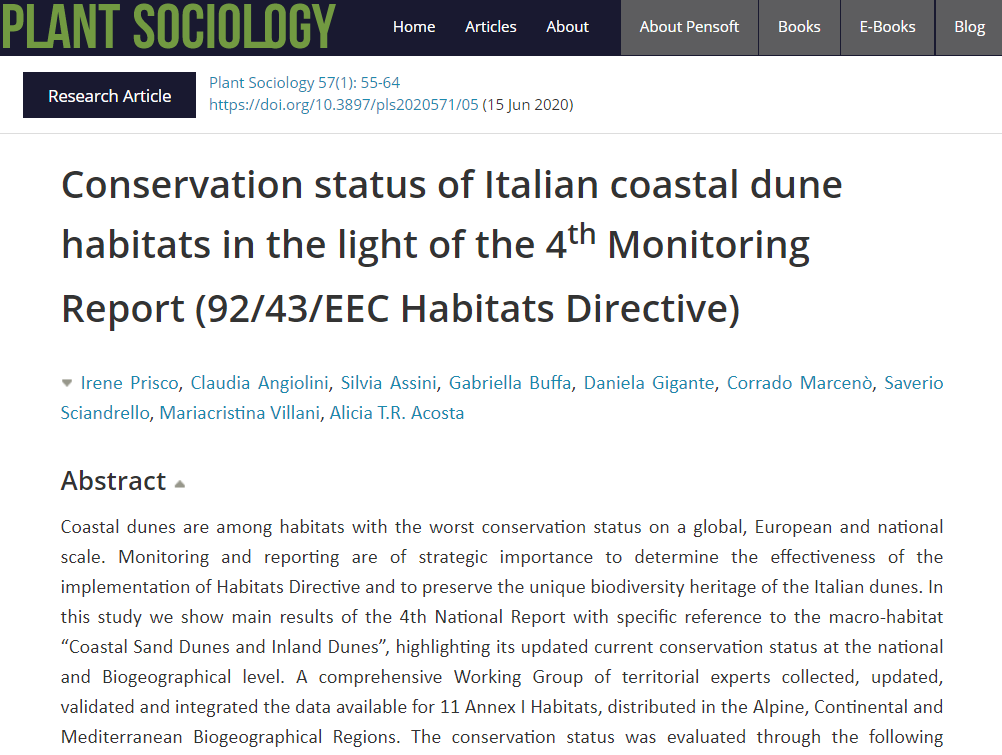
Amongst the first newly published papers is an article by a team from the University of L’Aquila, which reports on two years of observations of the vegetation dynamics at the Gran Sasso – Monti della Laga National Park in central Italy, after the protected area suffered from an accidental fire of anthropogenic origin in 2017. With their study, the researchers aim to determine the potential of the Sentinel-2 satellite as a tool to measure, identify and monitor the short-term response of vegetation in a peculiar mountainous landscape.
Another new publication presents a phytosociological survey on the weed vegetation of two crops of Protected Designation of Origin: the bean “Fagiolo Cannellino di Atina” and the red pepper “Peperone di Pontecorvo” – both growing exclusively within a few hundreds of square kilometres in the Province of Frosinone (central Italy), conducted at four selected farms by researchers at the Sapienza University of Rome.
Thanks to the Pensoft’s signature open-access scholarly publishing platform ARPHA, Plant Sociology demonstrates a complete makeover, including a modern and user-friendly interface in addition to a long list of high-tech perks, meant to ensure that published articles are easy to discover, access, cite and reuse by both humans and machines all over the world.
Furthermore, all users of the journal’s system: authors, editors and reviewers alike, are to greatly benefit from ARPHA’s integrated approach to the publication process. This means that once submitted each manuscript goes through the whole cycle: from review and copy/layout editing to publication, dissemination and archiving without leaving ARPHA’s collaboration-focused online environment.
Plant Sociology has a completely renewed Editorial board, which sees Daniela Gigante from the University of Perugia in the role of Editor-in-Chief, and Simonetta Bagella (University of Sassari), Gianni Bacchetta (University of Cagliari) and Daniele Viciani (University of Florence) as Co-editors. The Editorial board is complemented by a Consultant editor and an Editorial secretary (respectively, Edoardo Biondi and Diana Galdenzi, both from the Polytechnic University of Marche, Ancona). A large, international Editorial team includes 35 members with specific skills and long-dated expertise in various fields related to vegetation science. A dedicated Social media team takes care of the dissemination of the journal.
“At the Plant Sociology‘s Editorial board, we are looking with great expectations to the cooperation with Pensoft, certain that the publisher’s skills and experience will support the journal in its growth and consolidation as an international reference point for vegetation science studies,”
says Editor-in-Chief Dr Daniela Gigante.
“It’s delightful to have the Italian Society of Vegetation Science putting their trust in us with their signature journal. With our strong background in scholarly publishing, technology development and open science practices, I am certain that we are to provide the right venue for a high-quality and enterprising journal like Plant Sociology,”
says ARPHA’s and Pensoft’s founder and CEO Prof. Lyubomir Penev.