Pensoft at the Nordic Oikos-GfÖ 2026 conference: Integrating the Diversity of Ecology

Between 13-17 September 2026, Pensoft Publishers joined the Nordic Oikos-GfÖ 2026 conference in Odense, Denmark.

Between 13-17 September 2026, Pensoft Publishers joined the Nordic Oikos-GfÖ 2026 conference, jointly organised by the Nordic Society Oikos and the Ecological Society of Germany, Austria and Switzerland (GfÖ) in Odense, Denmark.

Themed “Integrating the Diversity of Ecology”, the event welcomed over 1,000 researchers in the field from across career stages, who had the opportunity to enjoy conference talks across 36 thematic sessions, as many as six keynote talks, two poster sessions, several open society meetings and quite a few social events, including excursions and a conference dinner. 

Conference delegates enjoying the musical clock installation mounted on an elevated balcony on the glass façade of the ODEON building, where the Nordic Oikos-GfÖ 2026 conference took place between 14 and 17 September 2026.

Throughout the scientific event, conference delegates had the opportunity to also explore the various publishing services offered by Pensoft to authors of research, journal managers, conference organisers; the diverse portfolio of almost 100 open-access peer-reviewed journals published on Pensoft’s ARPHA Publishing Platform.

Beyond publishing solutions, a key focus was given to OBSGESSION: a Horizon Europe-funded project where Pensoft is actively involved. To better understand and predict changes in terrestrial and freshwater ecosystems, the OBSGESSION consortium integrates multi-source Earth Observation data (such as high-resolution satellite imagery and drone monitoring) with ground-based in-situ research, including advanced environmental DNA (eDNA) sampling. By coupling these data streams with cutting-edge detection-attribution modelling and machine learning algorithms, the project generates scalable Essential Biodiversity Variables (EBVs). These ecological approaches and analytical frameworks are actively tested and validated through six biodiversity pilots across diverse European ecosystems. In the open-science Research Ideas and Outcomes journal, you can find a collection of project outputs, including research papers, project reports and deliverables, and guideline papers published across journals and platforms.

As a leader of the “Dissemination, Multi-stakeholder outreach and synergies” work package at OBSGESSION, Pensoft is tasked with stakeholder engagement and community building, ultimately contributing to the high impact of the resulting outputs, methodologies, and policy recommendations that aim to strengthen public understanding of biodiversity change.  

At the Pensoft-OBSGESSION-branded booth, conference participants would stop by to chat with Pensoft’s Head of Journal development and PR: Iva Boyadzhieva and Senior Communications Officer: Desislava Raykova.

As a leader of the “Dissemination, Multi-stakeholder outreach and synergies” work package at OBSGESSION, Pensoft is tasked with stakeholder engagement and community building, ultimately contributing to the high impact of the resulting outputs, methodologies and policy recommendations that aim to strengthen public understanding of biodiversity change.

*

One of the six keynote talks was presented by Prof. Dr. Isabell Hensen (Martin Luther University Halle, Germany), who received the GfÖ Honorary Medal 2026 for her leading, forward-looking contributions to ecological research and the scientific community. Her work examines how genetic variation, environmental conditions, disturbance, and plant-animal interactions shape plant populations, with particular emphasis on rare species, biological invasions, and the regeneration of degraded forests.

In her talk, titled “One spark is enough: regeneration ecology of Andean forests under global change”, she reported on post-fire regeneration processes in tropical Andean forests, based on long-term field experiments and observational studies. 

Hensen focused on the well-studied endemic plant genus Polylepis, which forms the world’s highest-elevation forests and illustrates how fire has shaped ecosystem dynamics over millennia. Her talk also mentioned a 2022 monograph of the genus, published in the Pensoft journal PhytoKeys by Tatiana Erika Boza Espinoza (Pontificia Universidad Católica del Perú) and Michael Kessler (University of Zurich), which brought together results from 35 years of field and herbarium experience.

*

On Wednesday, Pensoft’s Iva Boyadzhieva delivered a presentation titled “Scholarly Communication: Lessons from the Publisher’s Kitchen”. She highlighted the vital role publishers play in helping researchers communicate their insights not only to peers, but also to decision-makers and the public. Emphasizing the publisher’s responsibility to support authors with robust infrastructure and dedicated human expertise, she outlined how Pensoft works to FAIRify scholarly publishing and future-proof scientific knowledge in an era of rapid AI development and expanding research output.

*

Pensoft’s team was delighted to meet up with dedicated readers, authors, reviewers, and editors from across Pensoft’s portfolio, as well as introduce Pensoft journals to attendees discovering them for the first time.

Unsurprisingly, well-established society journals published by Pensoft, such as Frontiers of Biogeography, NeoBiota, Vegetation Classification and Survey, Vegetation Ecology and Diversity and Italian Botanist drew plenty of attention, alongside long-standing Pensoft’s own titles like Nature Conservation, PhytoKeys, One Ecosystem and the Biodiversity Data Journal. 

Visitors were also particularly intrigued by several newly launched Pensoft journals. Developed in close collaboration with passionate researchers, these fresh outlets directly address key gaps in academic publishing. 

One of the newly launched journals in the spotlight was Agricultural and Ecological Modelling (AEM), which provides a unique scholarly outlet thanks to its modern approach to publishing by increasing transparency, giving credit to research objects across the entire modelling research lifecycle. This is achieved through publishing specialised article types, such as: Formal Model, Model Testing and Calibration, Model Implementation and Documentation, Data Papers and Software Descriptions. These new publishing formats are designed to keep pace with advances in Modelling research and to make it FAIR (Findable, Accessible, Interoperable, and Reusable) by enabling scholarly credit for diverse research outputs, often created by different groups of authors. For the time being, AEM remains a Diamond Open Access journal, meaning that it will not charge authors for open-access publication. 

Other recently founded journals addressing emerging and fast-developing disciplines within the ecological field that took the spotlight were:

  • Individual-Based Ecology: launched to support understanding and predicting ecological systems’ response to rapidly changing and novel conditions by linking individual responses to responses at higher levels of organisation.
  • Advances in Pollinator Research: a multidisciplinary journal publishing research on pollination ecology, pollinator-plant interactions, pollinator health and drivers of pollinator declines, crop and wild flower pollination, pollinator conservation practices, molecular ecology of pollinators, pollinator and pollination monitoring, decision support for policy and socio-economics.
  • Journal of Regeneration: a multidisciplinary journal for the dissemination of research results on regeneration and tissue repair across phyla. These mechanisms can be framed within an evolutionary framework and integrate a variety of cellular processes involving stem cells, dedifferentiating or even transdifferentiating cells. 

All of these journals operate with no article fees for either authors, nor readers.

To receive updates on new publications and relevant news, sign up for Email Alerts on any journal’s homepage. Creating a Pensoft account also allows users to  easily customise their notification preferences, follow additional journals, or filter updates by research topic. You can also follow journals on social media, including BlueSky, Facebook and Linkedin.

*

Supporting European Policy Through Priority Essential Biodiversity Variables (EBVs)

Delegates at the event showed strong interest in OBSGESSION’s first policy brief: “Prioritising Essential Biodiversity Variables (EBVs) to support European Union (EU) policy needs based on the EU’s Biodiversity Strategy for 2030.” To tackle a critical challenge in environmental monitoring, OBSGESSION focuses on prioritising key EBVs to directly support the EU Biodiversity Strategy 2030 – a roadmap designed to put Europe’s biodiversity on a path to recovery through 102 specific actions and sub-actions.

To align these policy needs with actionable data, the OBSGESSION team conducted an assessment to identify priority EBV candidates. By categorising EBV-applicable actions and indicators across different ecosystem realms and implementation stages, the project pinpointed the most essential variables needed to strengthen monitoring, reporting, and policy execution. The document is based on a deliverable by the project (D1.1 Policy Landscape and Needs Assessment).

This policy brief is part of a broader, ongoing effort within OBSGESSION to bridge the gap between biodiversity data and policy execution. To dive deeper into the science behind this topic, the project has hosted a dedicated seminar series exploring key aspects of the framework:

Bringing Methodologies to Life Across European Ecosystems

Beyond theoretical frameworks, OBSGESSION grounds its research in six biodiversity validation pilots across Europe. The case studies represent European biodiversity and ecosystem conservation challenges at scales varying from local to regional. Full details on each ecosystem pilot are now available in a collection of newly published pilot factsheets, which made their debut at the conference, where people could take a look at their digital versions. 

Reading those materials gives an insight into the practical testing environment to demonstrate how Earth observation, field research, and ecological modelling come together to deliver actionable biodiversity insights. You can also check out OBSGESSION’s biodiversity pilots on the project’s website.

The OBSGESSION in a Nutshell video presents a concise overview of the project’s overarching mission and components.

*

To relive the conference by exploring the detailed programme alongside the full abstracts, visit the conference website.

Keep up with future updates and news from Pensoft by following us on Bluesky, Facebook, X, and LinkedIn. 

Peer Review Week 2026: Building Capacity for the Long Run

Pensoft Publishers mark Peer Review Week 2026 by spotlighting some of its Editors-in-Chief across its diverse portfolio.

Every September since 2015, the scholarly publishing world has paused to examine the process that quietly underwrites the integrity of scientific knowledge. This year, Peer Review Week runs from 14 to 18 September, bringing together publishers, societies, funders, libraries and researchers to talk about the often unglamorous but essential job of reviewing each other’s work.

The 2026 theme was chosen by community vote – 2,115 votes in total, the highest participation in Peer Review Week’s history. “Peer Review Capacity: Volume, Speed, and Quality” emerged as the winner, taking 40% of the vote. The result reflects a strain the whole system is experiencing: submissions are rising faster than the pool of willing, qualified reviewers, while authors and funders expect faster decisions than ever. While editors are being asked to hold the line on rigour with the same volunteer hours they always had – or less.

So, to celebrate the essential work that reviewers do, highlight some of the strains the current system is under, and show how we at Pensoft are trying to support our reviewers, we wanted to spotlight our editors-in-chief, the people who see the submission pipeline every single day, by asking them what “capacity” really means to them, and what would need to change for peer review to become more sustainable.

Capacity starts with people

Person working on a laptop
Person working on a laptop. Credit to poungsaed_eco via Envato.

We asked our editors how they would describe “peer review capacity“. Almost every answer was rooted in the same place: people, and whether enough of them are still willing to do the work.

Mark Hauber, Editor-in-Chief of the journal Individual-based Ecology, points to:

It’s about people – their willingness to give the best scientific thought to review and evaluate a fellow scientist’s work.

Tammy Robinson, Editor-in-Chief of NeoBiota, described the day-to-day challenge of finding those people:

NeoBiota editors try to avoid repeatedly asking the same people to review, but it’s very difficult to get people to accept a review invitation these days.

While for Florian Leese, Editor-in-Chief of Metabarcoding and Metagenomics, the strain of growing submissions without letting quality or turnaround times slip is a daily balancing act he’s refreshingly candid about:

Submissions in MBMG are growing faster than the time I and our editors can give them – and I think it’s worth saying that openly.

Open Laptop Displaying a Blue Network of Data
Open Laptop Displaying a Blue Network of Data. Credit to GoldenDayz via Envato.

This is precisely the problem Pensoft set out to address earlier this year, when ARPHA – our end-to-end publishing platform – integrated with Prophy, an AI-driven reviewer-discovery tool that matches manuscripts to qualified researchers from a database of millions. Across more than 90 ARPHA-powered journals, editorial teams can now reach well beyond the small circle of familiar names, surfacing reviewers by expertise and research focus rather than by who comes to mind first – directly widening the pool editors like Robinson are struggling to tap.

Freeing up expertise for what matters most

Pensoft designed the ARPHA Publishing Platform to carry every manuscript through review, editing, publication, dissemination and archiving within a single collaborative environment – precisely so that the whole publishing process is made straightforward. 

ARPHA homepage
ARPHA homepage

As Leese reflects:

The workflow side is not the problem; ARPHA handles editor assignment, plagiarism checks and the mechanics of the process efficiently, and the Pensoft team is quick to spot where things are piling up and need fixes.

Where he sees the next opportunity is in the technical, time-consuming checks that sit just beneath editorial judgment: 

What no workflow tool currently helps with is the part that actually defines quality in our field: are the sequence data and metadata deposited and usable, are the bioinformatic steps reproducible, do the results actually support the conclusions? Those checks take time that has to be carved out of an already full working day, for editors as much as for reviewers.

As numbers rise, the honest answer is that editors will need support – trained data auditors, or validated AI-based tools from the publisher that pre-screen the technical parts – or the model of the volunteer editor/reviewer will not scale. We are not there yet, but we are at the point where that has to be said.

Prof. Benjamin Burkhard, Editor-in-Chief of One Ecosystem adds:

I think that One Ecosystem and ARPHA are providing a very straight-forward authoring, editing and reviewing system. Everything happens directly in the same platform, so no additional documents have to be filled. I also appreciate that the reviewers can (optionally) reveal their identity, which adds a lot of transparency to the whole process and helps to avoid/reduce unconstructive comments.

Making reviewing sustainable

“Recognition” was the word the editors returned to most often when the conversation turned to sustainability, and this is an area in which Pensoft has been investing for a decade and continues to develop.

Person working on a computer
Person working on a computer. Credit to puhhha via Envato.

Since 2016, ARPHA has been integrated with Publons (now part of Web of Science’s Reviewer Recognition Service), so every review logged through the platform becomes part of a reviewer’s visible professional record rather than disappearing into an inbox.

Editors and reviewers across the Pensoft portfolio also receive discounts on article processing charges.

Hauber shared his vision for sustainability in five years:

A broad reviewer base, with folks at all stages of their academic and industry careers, still willing to review and evaluate peer-workers’ studies.

Robinson sees growth coming from investing in the next generation:

Training courses for early career researchers so that they are upskilled and can be drawn in as skilled reviewers. This will be good for them and the system.

Burkhard notes:

I think the community needs to be strengthen and encouraged to do reviews. If each publishing author would review as many articles as they are submitting, the problem of reviewer fatigue would be solved rather easily. Otherwise we need to think about rewarding system for reviewers, perhaps even offering a small financial incentive.

Leese proposes fewer publications and a bit more visibility for reviewers’ input: 

Stop rewarding the number of papers. My proposal: publish less, and treat reviewing as an obligation to the community that scales with your own output. Review roughly twice as many papers as you publish, and make that visible as a metric. ‘Are you paying back?’ should be a question that counts in evaluations.

He also laid out what he sees as the two changes that would help most, and what’s at stake if the field doesn’t act on them:

Two things would help in parallel. First, better recognition or (even monetary) rewards for reviewers, as long as it does not end up inflating article processing charges. Second, and specifically for a data-heavy field like in our journal: the publishing field should take the necessary but tedious checks – data and metadata availability, code, reproducibility – away from reviewers and automate them, so that human expertise is spent where it is really needed: study design, context, whether the data support the claims, and whether something essential is missing that only an expert would notice. Classical peer review is at a turning point. It can be reformed, and I think it should be; the alternative is that it slowly gets replaced by AI-generated reviews that may often not do the job as we had hoped for.

Building toward that future

Past or future sign.
Past or future sign. Credit to fotodestock via Envato.

Having been around for 34 years, Pensoft treats Peer Review Week as more than a thank-you. Rather, it reflects a continued effort to build a publishing environment that makes reviewing sustainable, from AI-assisted reviewer matching to permanent recognition to the tools that take tedious checks off editors’ plates.

The record turnout in this year’s theme vote shows the community itself has named capacity as the defining challenge of this moment. As we look at insights from editors like Mark Hauber, Tammy Robinson, Florian Leese and Benjamin Burkhard, the message is clear: the field can only be sustainable if reviewing is treated as seriously as publishing.

Pensoft and ARPHA integrate with Prophy to speed up reviewer discovery across 90+ scholarly journals

Prophy’s AI-driven discovery system will provide editors with a broader and more diverse pool of qualified peer reviewers based on automated semantic analysis.

In a new partnership between open-access scholarly publisher Pensoft and the AI-driven reviewer discovery system provider: Prophy, the editorial teams at all journals hosted on the publisher’s ARPHA Platform receive access to a broader and more diverse global pool of researchers. 

The integration connects ARPHA’s editorial and peer review workflows with Prophy’s continuously updated database of millions of active, qualified researchers. As a result, editorial teams across more than 90 open-access peer-reviewed journals powered by ARPHA can now opt to enjoy data-driven reviewer recommendations based on structured analysis of researcher expertise and publication history, with matches based on each manuscript’s topic, field, and research focus.

This development responds to a growing challenge in scholarly publishing. As submission volumes rise, the pressure on a relatively small pool of frequently invited reviewers increases, which eventually leads to delays and reviewer fatigue. By expanding the pool of potential experts and improving how they are identified with the help of semantic analysis, the integration supports a more sustainable and balanced approach to peer review.

“By working with Prophy, we’re helping editors discover expertise that might otherwise be overlooked, opening the door to a more inclusive, well-distributed, and resilient peer review ecosystem. This is about using technology not to replace human judgment, but to support it in a smarter and more responsible way.”

Prof. Dr. Lyubomir Penev, founder and CEO of Pensoft and ARPHA.

“We’re excited to work with Pensoft and ARPHA to bring smarter reviewer discovery to their editorial teams. Peer review should be efficient and fair, and this partnership helps with both. Editors can find the right expertise faster, which means less time searching and fewer delays. This integration helps editorial teams manage growing submission volumes without burning out their reviewer networks.”

Oleg Ruchayskiy, CEO of Prophy.

To further support editorial teams and client journals’ owners, Pensoft and ARPHA are offering the Prophy integration free of charge to all journals on the platform until the end of 2026. 

The partnership reflects Pensoft and ARPHA’s continued focus on equipping journals with practical, forward-looking tools that strengthen peer review, support editors, and help ensure the long-term sustainability of scholarly publishing.


Stay up to date with the latest from Pensoft and ARPHA by subscribing to our blogs and following us on social media, including BlueSky, Facebook and Linkedin.

Centrally-managed collections & Peer review flexibility at RIO

RIO updated its article collection approach to evolve into a “project-driven knowledge hub”, where a project coordinator, institution or conference organiser can create and centrally manage a collection under their own logo.

In 2015, Research Ideas and Outcomes (RIO) was launched to streamline dissemination of scientific knowledge throughout the research process, recognised to begin with the inception of a research idea, followed by the submission of a grant proposal and progressing to, for example, data / software management plans and mid-stage project reports, before concluding with the well-known research and review paper.


In order to really expedite and facilitate access to scientific knowledge, the hurdles for engagement with the process need to be minimized for readers, authors, reviewers and editors alike. RIO aims to lay the groundwork for constructive scientific feedback and dialogue that would then lead to the elaboration and refinement of the research work well in its early stage. 

Recently, RIO published its 300th article – about a software for analyzing time series data from a microclimate research site in the Alps – and at that occasion, the RIO team wrote an editorial summarizing how the articles published in RIO so far facilitate engagement with the respective research processes. One of the observations in this regard was that while providing access to the various stages of the research cycle is necessary for meaningful engagement, there is a need for the various outcomes to be packed together, so that we can provide a more complete context for individual published outcomes.

Read the new editorial celebrating RIO’s 5th anniversary and looking back on 300 publications. 

RIO introduced updates to its article collection approach to evolve into a “project-driven knowledge hub”, where a project coordinator, research institution or conference organiser can create and centrally manage a collection under their own logo, so that authors can much more easily contribute. Further, research outputs published elsewhere – including preprints – are also allowed, so that the collection displays each part of the ‘puzzle’ within its context. In this case, the metadata of the paper, i.e. title, authors and publication date, are displayed in the article list within the collection, and link to the original source.

Apart from allowing the inclusion of the whole diversity of research outcomes published in RIO or elsewhere, what particularly appeals to projects, conferences and institutions is the simplicity of opening and managing a self-branded collection at RIO. All they need to do is pay a one-time fee to cover the setup and maintenance of the collection, whereas an option with an unlimited number of publications is also available. Then, authors can add their work – subject to approval by the collection’s editor and the journal’s editorial office – by either starting a new manuscript at RIO and then assigning it to an existing collection; pasting the DOI of a publication available from elsewhere; or posting an author-formatted PDF document to ARPHA Preprints, as it has been submitted to the external evaluator (e.g. funding agency). In the latter two cases, the authors are charged nothing, in order to support greater transparency and contextuality within the research process.

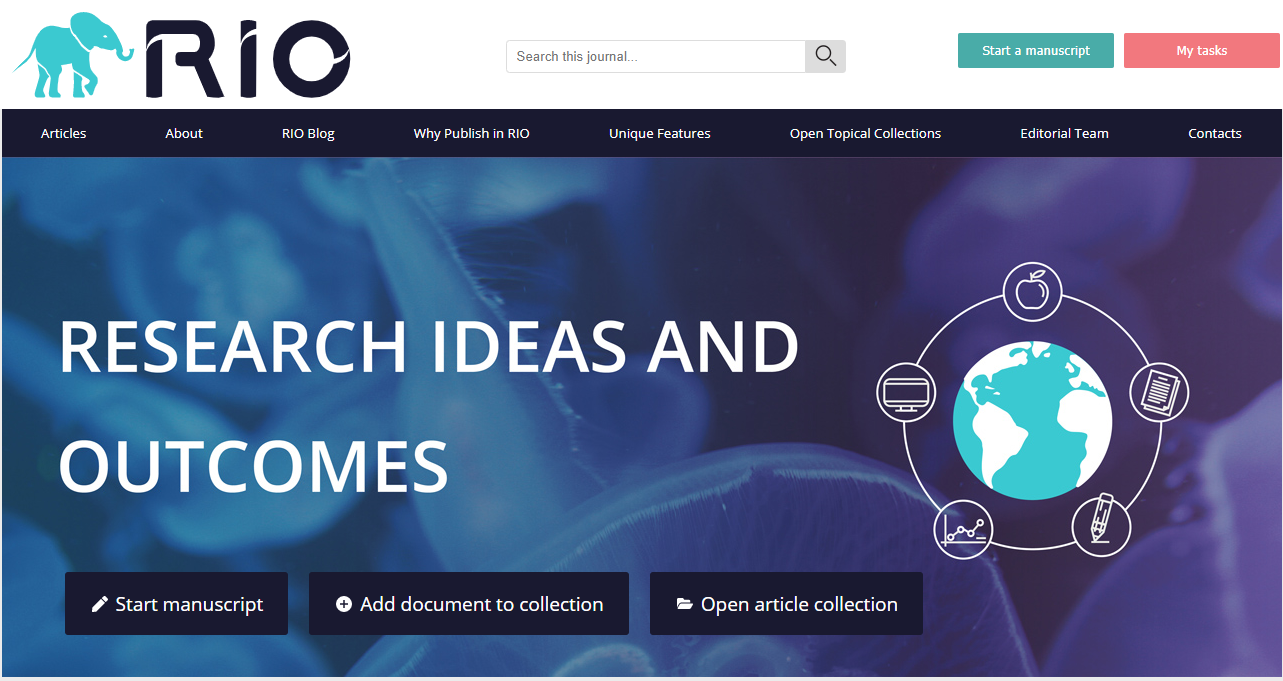
Buttons on RIO Journal’s homepage allow users to create a new collection or add a document to an existing collection by either submitting a new manuscript via RIO Journal or pasting a DOI link of a publication from elsewhere, thus allowing for the collection to link to the original source and display the article’s metadata, i.e. title, authors and publication date.

Find more information about how to edit a collection at RIO and the associated benefits and responsibilities on RIO’s website.

Another thing we have revised at RIO is the peer review policy and workflow, which are now further clarified and tailored to the specificity of each type of research outcome.

Having moved to entirely author-initiated peer review, where the system automatically invites reviewers suggested by the author upon submission of a paper, RIO has also clearly defined which article types are subject to mandatory pre-publication peer review or not (see the full list). In the latter case, RIO no longer prompts the invitation of reviewers. Within their collections, owners and guest editors can decide on the peer review mode, guided by RIO’s existing policies.

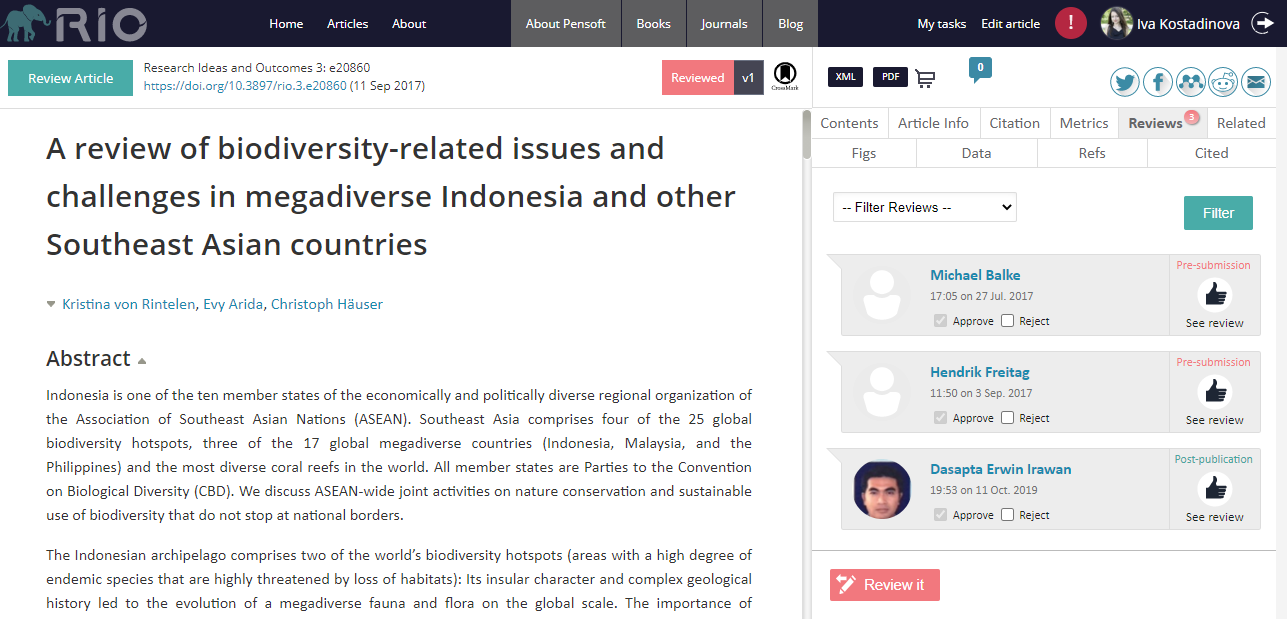
While pre-publication peer review is not always mandatory, all papers are subject to editorial evaluation and also remain available in perpetuity for post-submission review. In both cases, reviews are public and disclose the name of their author by default. In turn, RIO registers each review with its own DOI via CrossRef, in order to recognise the valuable input and let the reviewers easily refer to their contributions. 

Both pre- and post-publication reviews at RIO are openly published alongside the paper and bear their own DOI. All papers in RIO remain available for post-publication review in perpetuity (see example).

For article types where peer review is mandatory (e.g. Research Idea, Review article, Research Article, Data Paper), authors are requested to invite a minimum of three suitable reviewers upon the submission of the paper, who are then automatically invited by the system. While significantly expediting the editorial work on a manuscript, this practice doesn’t compromise the quality of peer review in the slightest, since the editor is still overlooking the process and able to invite additional reviewers anytime, if necessary. 

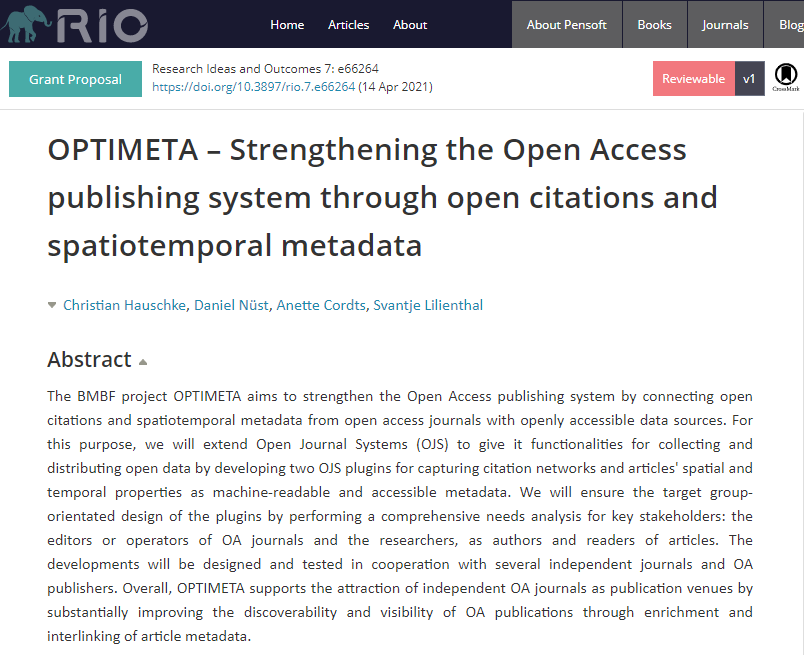
For article types where peer review is not mandatory (e.g. Grant Proposal, Data Management Plan, Project Report and various conference materials), all an author needs to do is provide a statement about the review status of their paper, which will be made public alongside the article. Given that such papers have usually already been scrutinised by a legitimate authority (e.g. funding agency or conference committee), it only makes sense to not withhold their publication and duplicate academic efforts.

By the time it is submitted to RIO, a Grant Proposal like this one has often already been assessed by a legitimate funder, so it only makes sense to not undergo the process again at RIO and thereby slowing down its public dissemination.

Additionally, where the article type of a manuscript requires pre-publication review, RIO encourages the authors to click a checkbox during the submission and post their pre-review manuscript as a preprint on ARPHA Preprints, subject to a quick editorial screening, which would only take a few days.

***

Follow RIO Journal on Twitter, Facebook and LinkedIn.

***

Further reading: