Pensoft will strengthen BEAGLE’s mission for reliable biodiversity monitoring through a distinctive visual identity and innovative communication tools to amplify the project’s results.
Biodiversity is changing rapidly worldwide, driven by threats such as invasive species and fragmented restoration efforts. To meet the targets of the EU Biodiversity Strategy for 2030 and the Global Biodiversity Framework, countries need large-scale, timely and high-quality data to track the status and trends of key species and habitats. This monitoring is essential to prevent further deterioration by 2030 and to target restoration and nature-based solutions where they are most needed.
In response to this challenge, the new EU Horizon project BEAGLE, named after Darwin’s ship as a carrier of critical biodiversity information, aims to deliver next-generation biodiversity monitoring across terrestrial, freshwater, and marine ecosystems in the EU and Associated Countries. It will do so by generating new data and mobilising already existing ones, using AI to process them, turning them into indicators and maps that directly inform and measure progress on EU policy targets.
Officially started on 1 October 2026, the Horizon Europe project BEAGLE will run for four years. Coordinated by Aarhus University, it brings together 17 organisations from 12 countries to turn fragmented data into policy-ready evidence and ensure the outputs drive real change.
BEAGLE is structured around four core objectives:
Strengthening the EU’s biodiversity monitoring network;
Operationalising high-throughput in situ observation tools;
Integrating validated data into open platforms and modelling workflows;
Developing a knowledge framework to support ecosystem recovery.
As Toke Thomas Høye (Aarhus University), the coordinator of BEAGLE puts it:
BEAGLE builds on the strong foundations of previous European biodiversity initiatives, bringing together existing data, networks, and technologies to deliver up to one billion species records, over 1,000 sensors, thousands of eDNA samples, Essential Biodiversity Variables, and policy-relevant indicators. Our ambition is to turn these results into practical tools that continue to support biodiversity monitoring, restoration and decision-making long after the project ends.
Pensoft’s role
As the partner responsible for communication, dissemination, and exploitation, Pensoft will lead the strategy for raising BEAGLE’s visibility among scientists, practitioners, policymakers, and the wider public, while ensuring the project’s outputs reach the audiences best placed to use them. This includes designing and maintaining the project’s website and social media channels and coordinating materials such as newsletters, videos, and infographics to communicate BEAGLE’s progress and findings in an accessible way. Pensoft will also support the dissemination of scientific results through open-access publishing, in line with its long-standing commitment to open science.
Pensoft has always been a defender of open access to biodiversity data. As such, we are happy to help maximise BEAGLE’s impact in turning biodiversity data into meaningful action. The project connects monitoring technology, science, and policy to create a more integrated understanding of how our environment is changing and how we can better protect and restore it.
– Nikol Stoykova, Senior Communications Officer at Pensoft Publishers
While the BEAGLE project website is under development, make sure to follow the project’s progress via our social media channels on Bluesky and LinkedIn.
Disclaimer:
BEAGLE (Biodiversity methods for advanced monitoring at large scales) receives funding from the European Union’s Horizon Europe Research and Innovation Programme (ID No 101288886). Views and opinions expressed are, however, those of the author(s) only and do not necessarily reflect those of the European Union and the European Research Executive Agency (REA). The EU and REA cannot be held responsible for them.
The specimen was collected in July 1889 during Wilhelm Kükenthal and Alfred Walter’s Arctic expedition to Spitsbergen. The trip nearly ended in disaster when their ship was crushed by pack ice in June, but the crew was rescued four days later and carried on. The flatworms were handed to the zoologist Arnold Lang, who passed them to his talented student, Marianne Plehn. She described the species in 1896 as Acelis arctica, and the genus was later renamed Plehnia in her honour.
As was common in the nineteenth century, no one recorded where the type specimens were kept afterwards, and they simply vanished from the record. The Jena specimen resurfaced when previously forgotten collection material was reorganised, and Bock found a small ground-stopper jar holding an almost dried-out polyclad, with just a little liquid keeping it from drying out completely. Its original label, handwritten by Ernst Haeckel, was still attached. An entry in Haeckel’s own ledger from 1896 confirmed the link to Plehn’s work.
The cabinet where the type specimen was found. Photo credit: Bernhard Bock.
Detective work
Of the three specimens Plehn originally examined, only this one is known to survive. Bock wrote to institutions across Germany, Sweden, Denmark, Poland, Switzerland and Norway in search of the others, without luck. He then carefully rehoused the specimen in 70% ethanol, conserved its fragile label and photographed it in high resolution for the first time. The worm is around 55 mm long and 36 mm wide, and, just as Plehn reported, it has no eyes.
The type specimen, preserved in the original glass it was stored. Photo credit: Bernhard Bock.
Who was Marianne Plehn?
Bock is keen that the story does not stop at the specimen. Plehn, he explains, is best known for co-founding fish pathology alongside Bruno Hofer:
“She helped lay the foundational framework for fish pathology and treatment. She described and classified various freshwater fish diseases.”
Her research covered parasitic and environmental diseases, including liver and metabolic disorders in salmonids and bacterial infections in commercial fisheries. In 1924 she published the Praktikum der Fischkrankheiten, which “became a standard diagnostic and teaching handbook for zoologists, veterinarians or fisheries managers across Europe for a long time”.
Her path was far from easy. Women in Germany were excluded from higher education until the early 1900s, and were permitted only as “guest listeners” who could not earn degrees. Plehn had to leave the country to study in Zurich, where she became the first woman to receive a doctorate from ETH Zurich. In 1913 she was named Königlicher Professor, the first woman in Bavaria to receive the title.
As Bock notes:
“This represents a historic milestone for women in higher education and natural sciences in Germany – despite no linked teaching certificate to the appointment. Her extensive field research and diagnostic expertise earned her widespread recognition as one of Europe’s top authorities in aquatic biology.”
For Bock, the find carries several hopes. The first is a change in attitude towards neglected collections:
“I made the experience first-hand that the decision of getting rid of something is made quite fast, without having a closer look or starting to sleuth the provenance of certain objects, as this is a very time-consuming and often dead-end job, but sometimes there are astonishing reveals!”
The second is about storytelling. “I want to tell stories, to scholars, students and visitors,” he says. Knowing who collected a specimen, and how, makes an object attractive in a way that a label never could, because “there is more to tell than just a greyish marine flatworm”.
The third is scientific. The relationships of the family Plehniidae within the polyclads remain unclear, and no earlier phylogenetic study has included P. arctica. Bock hopes the specimen might one day yield DNA sequences, making it useful for phylogenetic and systematic research.
A call for more curators
Finally, Bock sees his article as a plea for investment in people as well as in specimens: small museums, he argues, need more curator positions, not only for vertebrates but for other groups too.
“There is so much to discover that is already there, but we lack manpower.”
Asked what he finds most interesting about the work, Bock says it is the discovery itself and its provenance, “as this enriches our collection”. Others, he suggests, may be drawn to the news that a type specimen is available again, or to Plehn’s career path. Whichever it is, a grey flatworm in a small jar has proved to be a window onto a pioneering scientist and a reminder of how much may still be waiting on the shelves.
Original source:
Bock BL (2026) Rediscovery of a type specimen of Plehnia arctica (Plehn, 1896) (Polycladida, Plehniidae) described by Marianne Plehn, a pioneering woman in German zoology. Natural History Collections and Museomics 3: e200580. https://doi.org/10.3897/nhcm.3.200580
The “sea capital” of Bulgaria, the city of Varna, hosted a very special occasion during the past week – an international conference marking the 20th anniversary of the LTER-BG network. Over the past two decades, its members have been dedicated to establishing roadmaps and infrastructures for generating, consolidating and sharing ecosystem research data across the Balkan country and beyond.
In celebration of this milestone, members of the wider eLTER community, encompassing the whole of Europe, contributed to a three-day agenda packed with progress updates, innovative showcases and meaningful discussions on the past and future of long-term ecosystem, critical zone and socio-ecological research.
The participants in the LTER Bulgaria international scientific conference 2026.
Pensoft Publishers has served as the communication and dissemination partner for the eLTER Research Infrastructure for the past six years. Pensoft has also always supported the activities of LTER Bulgaria.
For this 20th anniversary conference, all 55 abstracts for oral and poster presentations were organised and published in a special collection titled “Long-Term Ecosystem Research: Contributions, Challenges and Future Perspectives” on the ARPHA Conference Abstracts, and for less than a week it has already garnered over 6,000 views.
Conference abstracts published in ARPHA Conference Abstracts.
Impressed by the statements of engagement made by young scientists within the eLTER community, the Pensoft team supported the organisers’ idea to provide an Early Career Scientist Award, which granted its recipient a free publication in the One Ecosystem journal.
As the official communication partner of eLTER and its affiliated projects, Pensoft provided dissemination materials by eLTER RI at the dedicated booth where attendees also had the opportunity to familiarise themselves with the company’s wider publishing and research project portfolio.
At the booth, participants could get acquainted with Pensoft’s wider scientific journal portfolio. With One Ecosystem and Nature Conservation covering ecosystem science and conservation practices,NeoBiota focuses on biological invasions and Advances in Pollinator Research dedicated to all things pollinator science.Individual-based Ecologypublishes research on individual-level ecological processes while the Biodiversity Data Journal supports the publication of biodiversity data. Alongside these, Research Ideas and Outcomes offers a platform for sharing research across the whole project cycle, from proposals to final results.
ORPHO and Scientiana promo materials
Metabarcoding and Metagenomics brochure.
Frontiers of Biogeography brochure.
Advances in Pollinator Research promo materials.
Individual-based Ecology promo material.
One Ecosystem journal brochure.
NeoBiota promo materials.
Beyond these commitments, Pensoft was front and centre within the event’s agenda as well.
Alexandra Tzvetkova during the opening panel.
During the opening panel, Alexandra Tzvetkova, part of the Pensoft team working for eLTER RI, welcomed the participants, reminded them to start sharing the special collection of abstracts with their networks and highlighted the innovative propositions from Pensoft that were about to be presented in the next days and could be very useful for the eLTER community in the future – Scientiana and ORPHO.
Further, two Pensoft presentations were delivered as part of the thematic session “Emerging Technologies in Ecosystem Research, Data Management and Open Science in LTER”, and brought the audience closer to the publisher’s vision for the future:
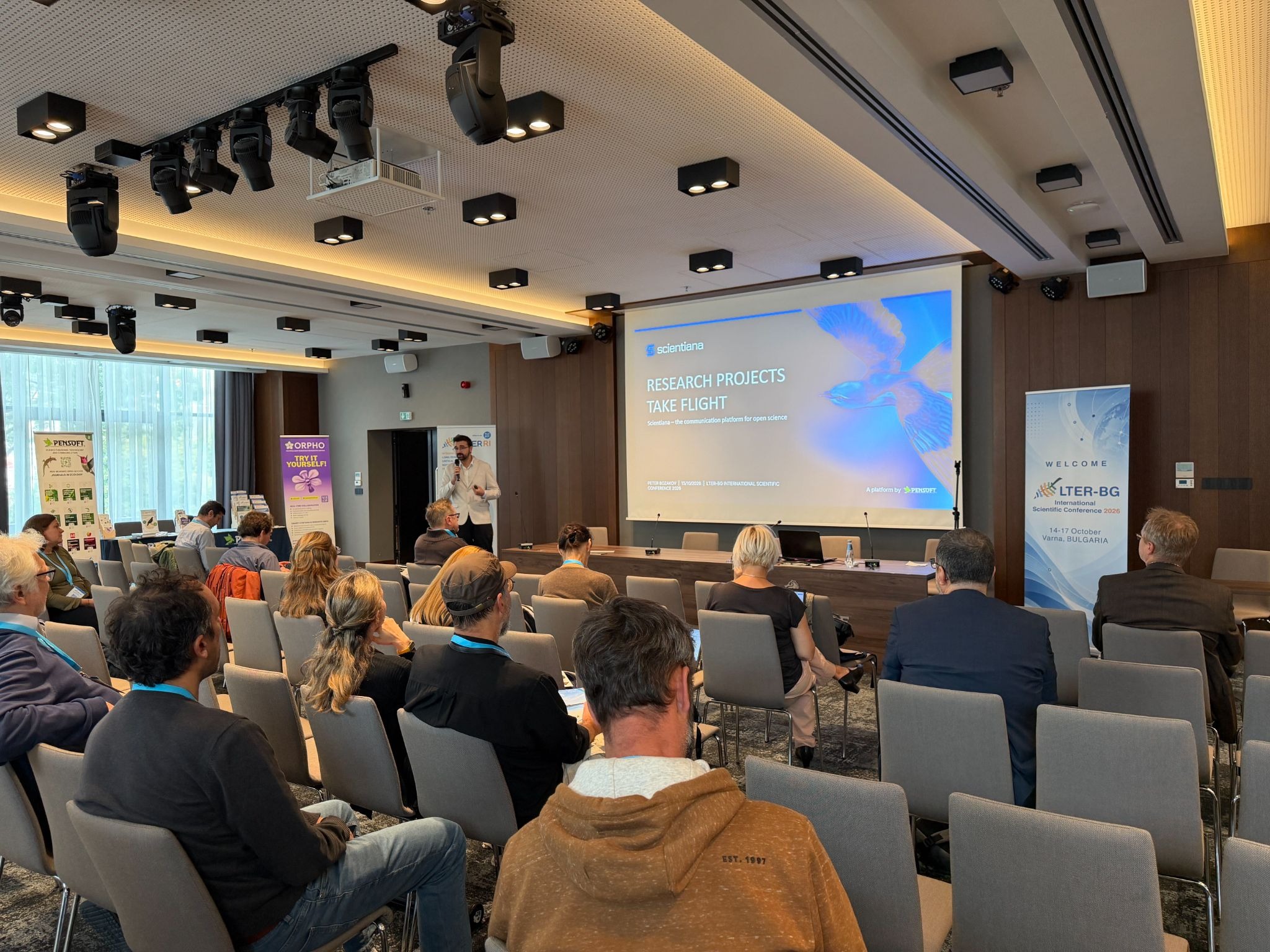
Senior Communications Officer Peter Bozakov delved into the forthcoming science communication platform for research projects Scientiana. Launching in early 2027, it is set to be a portal for consolidating knowledge, mapping out collaborations and innovating outreach in the context of past, present and future scientific initiatives at all scales.
Peter Bozakov introduces Pensoft’s newest platform – Scientiana.
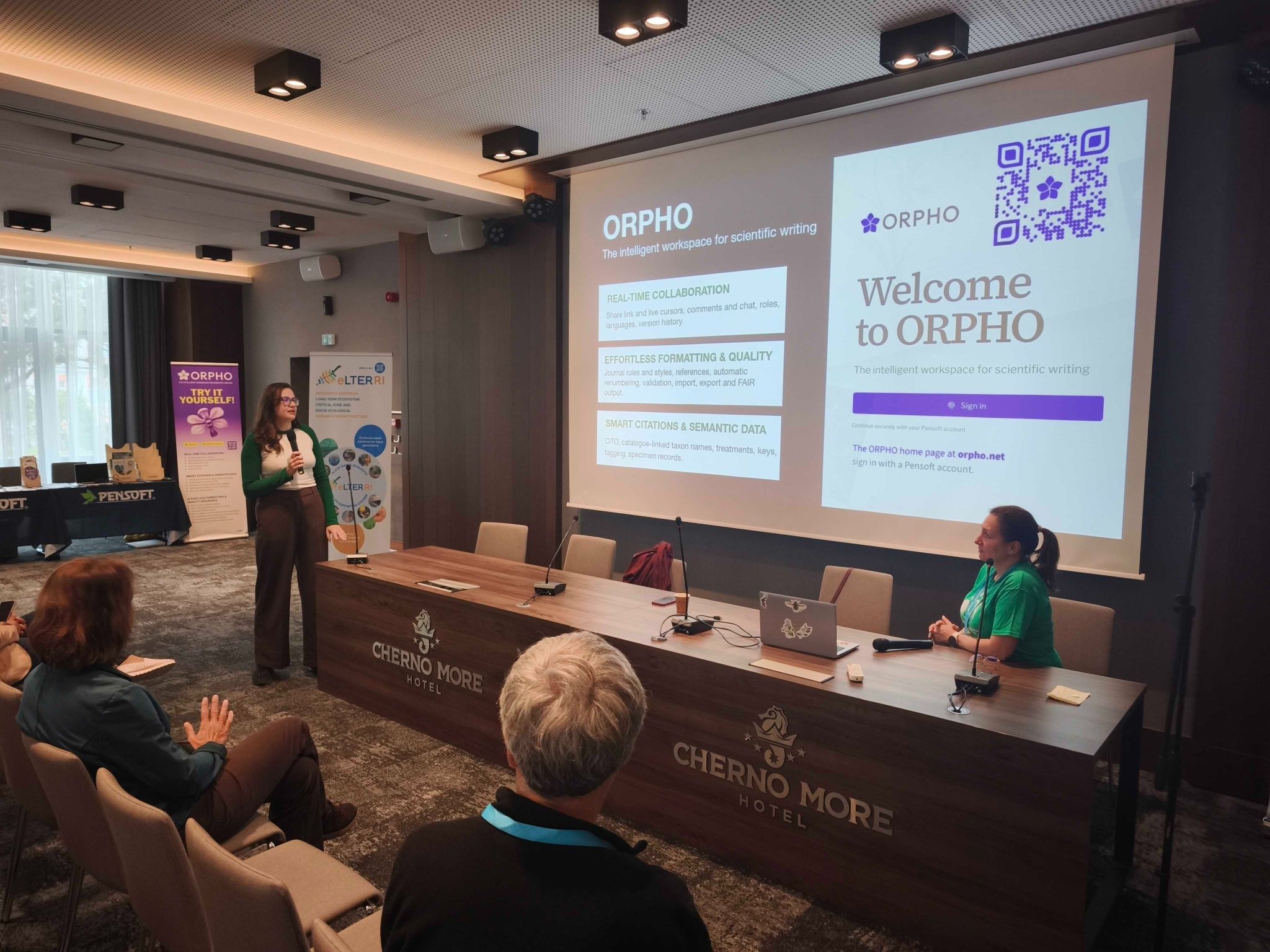
While, Events and Marketing Coordinator Victoria Stoyanova explored the new frontiers that an AI-FAIR outlook unveils in the domain of academic publishing. Specifically, she showcased the evolution of the ARPHA platform and the newly launched ORPHO, Pensoft’s next-gen collaborative writing tool, as examples of innovation placed directly in the hands of authors.
Together, ARPHA and ORPHO support the entire manuscript workflow from submission to publication, with structuring, taxon tagging, classification, and data publication taking place as part of the publication process itself.
A crash course in using ORHPO by Victoria Stoyanova
The presentations proved themselves a stepping stone to further discussions on potential collaborations with scientists, conversations that were bolstered by on-site demonstrations of the tools in question.
The conference in Varna was enjoyable, fruitful and full of hope and esteem for the better future of long-term ecosystem research. And our Pensoft team left with many ideas and an affirmed ambition to keep working to provide better solutions and services for the development of European science. What we will always remember are the words of our host – the national coordinator of LTER Bulgaria in the past 20 years, Svetla Doncheva-Bratanova:
I would like to thank the Pensoft team for the wonderful participation in the conference. You are amazing and I am certain we could do wonders together!
Many thanks to the Bulgarian LTER community and the wider eLTER community for bringing together so many passionate researchers and making these past few days special.
Researchers in French Guiana demonstrate that the golden eyes of a Neotropical treefrog can replace invasive marking techniques.
Identifying individual animals in the wild has long meant tagging, branding or clipping. For amphibians, the standard approach has often been toe-clipping, a procedure that can affect survival, physiology and behaviour.
A new study suggests that, for at least one species of treefrog, nature has already provided a more humane solution: the eyes.
Osteocephalus oophagus in situ. Photographed in French Guiana (4°02’N, 52°41’W; ) between March and May 2021. Credit: Mélissa Peignier et al., 2026.
The team examined Osteocephalus oophagus, an Amazonian treefrog whose golden irises are crossed by fine black radial lines, forming a pattern reminiscent of a human fingerprint.
Fieldwork took place over three rainy seasons, from 2021 to 2023, on a river island of roughly five hectares in the Nouragues Nature Reserve in French Guiana. Across 392 captures, the researchers identified 103 individual frogs.
Osteocephalus oophagus in situ. Photographed in French Guiana (4°02’N, 52°41’W; ) between March and May 2021. Credit: Mélissa Peignier et al., 2026.
On later encounters, they photographed each animal’s eyes without touching it and compared the images with a reference library held on a rugged tablet. Frogs recognised in this way were simply left undisturbed. The identifications were independently verified using Wild-ID, a software package for photographic mark-recapture analysis.
The iris patterns proved highly distinctive. Within a single season, between 56% and 80% of frogs were recaptured and reliably re-identified, showing that the patterns are stable enough for short-term monitoring. Photographs could even be taken of frogs in amplexus, the mating embrace, without disrupting them.
Examples of individual identification upon capture and recapture based on iris patterns in three male Osteocephalus oophagus photographed in French Guiana (4°02’N, 52°41’W; Bongers et al. 2001) between March and May 2021 and 2022. Credit: Mélissa Peignier et al., 2026.
The project began with simple admiration.
“At the time, I was doing my PhD, studying Allobates femoralis in the field in French Guiana. My first reaction was simply something along the lines of, ‘Wow, what beautiful eyes!’ That initial curiosity gradually turned into a genuine interest in the species, and I realised how little we actually know about them.”
Dr Peignier
Example of the diversity of iris patterns from eight Osteocephalus oophagus individuals photographed in French Guiana (4°02’N, 52°41’W; Bongers et al. 2001) between March and May 2021, 2022, and 2023. Credit: Mélissa Peignier et al., 2026.
The team’s motivation was also ethical.
“Other studies have used toe-clipping, which involves removing some of the digits. Personally, I was uncomfortable with this approach, especially given that these are arboreal frogs that rely on their limbs to climb trees.”
Dr Peignier
Dr Peignier hopes the method will spread.
“In a world where biodiversity is declining at an alarming rate, it is essential that we minimise our impact on the animals we study.
If we can reliably identify individuals using naturally occurring features, we may be able to reduce the need for more invasive marking techniques while still collecting the data needed to answer important scientific questions.”
Osteocephalus oophagus in situ. Photographed in French Guiana (4°02’N, 52°41’W; ) between March and May 2021. Credit: Mélissa Peignier et al., 2026.
The authors stress that suitability will vary between species, and that the approach should be tested case by case before wider adoption. Even so, they see considerable promise for amphibians with complex irises.
Fieldwork, Dr Peignier adds, had its own rewards.
“Honestly, the frogs themselves are incredibly beautiful and surprisingly chill, which makes working with them a real pleasure.”
Original source:
Bégué L, Petel F, Premel V, Raboisson G, Ringler E, Ringler M, Toszeghi M, Vacher V, Peignier M (2026) Iris pattern recognition as a non-invasive method for individual identification in Osteocephalus oophagus (Hylidae). Herpetozoa 39: 381-387. https://doi.org/10.3897/herpetozoa.39.e208000
This Open Access Week, discover how Pensoft championed open access since ZooKeys through fair APCs, ARPHA tools and FAIR data.
For millennia, people have gathered data and knowledge – about where to hunt, eat, trade, and live – and shared it through experiences, stories and songs. Today, we continue to do so by creating and sharing knowledge in order to “advance human understanding and the common good.”
This year’s International Open Access Week theme, “The Cost of Knowledge,” reminds us that sharing knowledge has a price: subscription fees and article processing charges, the time and expertise of authors, reviewers and editors, and the investment and know-how behind user-friendly digital infrastructures.
At Pensoft, open access has never been an add-on. Founded in 1992 by scientists for scientists, we launched our first journal, ZooKeys, as fully open access in 2008, and it has been open from its very first issue. After all, it has always been our thinking that research can only serve the common good when everyone can read it, use it and build on it. This is why from the very start, we wanted ZooKeys to speed up research and free the exchange of information in taxonomy.
In 2025, together with long-term collaborators from the open-science community, we founded the quite revolutionary and unique journal Research Ideas and Outcomes (RIO) with the aim to catalyse the culture change in research communication by publishing ideas, project proposals, data/software management plans and various other outcomes that would typically be lost for the scientific community. The recognition for RIO’s approach to scholarly communication came only half a year later when SPARC went on to name an Open Science Innovator.
ARPHA Publishing Platform – homepage.
Throughout our existence as a publisher all of our journals have been 100% open access. Hosted on our own ARPHA Publishing Platform and operating under CC BY license, all scholarly titles in our portfolio make sure that every article can be read, shared and reused freely while authors retain the copyright to their work.
Our proprietary ARPHA Publishing Platform offers a full-featured, end-to-end open access publishing and hosting solution, with a suite of connected services built around it.
The ARPHA suite
Apart from about 100 open-access scholarly journals, ARPHA powers the ARPHA Preprints platform, which seamlessly integrates with journals to let authors make their manuscripts publicly available upon submission; the platform also provides high-quality and technologically advanced open-access publication for conference outputs through ARPHA Proceedings and ARPHA Conference Abstracts. Through Advanced Books, authors and researchers can bring whole open access books to readers in semantically enhanced HTML and PDF formats.
ORPHO – the next-gen tool for scientific writing
Most recently, we launched ORPHO, our next-generation collaborative workspace for scientific writing. Within ORPHO, researchers and authors can enrich their manuscripts semantically, so that their research, as well as underlying data remains FAIR (Findable, Accessible, Interoperable, and Reusable) and AI-ready.
Together, these tools streamline the publication of text and semantically rich data, making openness a natural part of the research workflow rather than an extra step.
Also, along with Plazi, we run the Biodiversity Literature Repository on Zenodo, which gives articles, figures and taxonomic treatments their own DOIs and releases them under CC0, so the data inside publications can be found, cited and reused by platforms such as GBIF.
This is what a publisher built by scientists can offer: a model that treats knowledge as something to be shared, prices that stay open and transparent, and infrastructure that makes research easier to find, reuse and trust.
Throughout our existence as a scholarly publisher and technology provider, Pensoft has always considered it our responsibility to ensure that valuable research outputs are shared efficiently with the world. This gives everyone, everywhere, the opportunity to make sense of and use this knowledge, while giving full credit to the scientists behind it. This is how, in our vision, scientific work and knowledge can achieve optimal impact on society and future research.
comments Iva Boyadzhieva, Head of Journal development and PR at Pensoft.
Reclaiming knowledge as a common good
Open Access Week 2026 at Pensoft
As this year’s Open Access Week puts it:
“Momentum is growing for approaches to treat knowledge as a common good and not a commodity to be mined.” – Open Access Week 2026
We believe that momentum is real, and we have seen it grow ever since the first issue of ZooKeys. At Pensoft we are proud to say that we have championed open access in publishing, building the tools, workflows and partnerships that make it work in practice, and we will keep doing so alongside the institutions, funders, editors and researchers who share this commitment.
Analysing 52 specimens with a genetic method known as MIG-seq, the team found that an insect previously regarded as a single species, Omoplax desecta, in fact comprised two.
Researchers have used genome-wide DNA data to identify a new insect species on the Ogasawara Islands, a remote Japanese archipelago roughly 900 to 1,000 kilometres south of Tokyo. The findings suggest that evolution among island insects is more intricate than appearances imply. The study is published in the open-access journal ZooKeys.
The Ogasawara Islands are a UNESCO World Natural Heritage site, celebrated for their endemic land snails and plants. Their insects, of which some 440 endemic species are known, have received far less evolutionary attention.
Analysing 52 specimens with a genetic method known as MIG-seq, the team found that an insect previously regarded as a single species, Omoplax desecta, in fact comprised two. Populations on the Chichijima and Hahajima island groups were genetically distinct, and subtle differences in male genitalia confirmed the split. The Hahajima population is now described as Omoplax sandoru, named after the local name of its host plant.
Omoplax desecta (nymph). Image credit: Jun Souma.Omoplax desecta (adult). Image credit: Jun Souma.
Souma was first drawn to Omoplaxdesecta by its unusual diet:
“The reason I took a particular interest in Omoplax desecta is that it feeds on both the native plant Rhaphiolepis indica var. tashiroi and the introduced plant Calophyllum inophyllum in the Chichijima island group.
This is quite unusual for lace bugs, which typically exhibit high host specificity. I was also intrigued by the fact that it is distributed across multiple island groups, which is different from other Omoplax species.”
The Hahajima population posed its own puzzle:
“I had wondered why it fed exclusively on Rhaphiolepis indica var. tashiroi and why there were no individuals with dark brown to black pronotum, which are sometimes seen in the Chichijima island group.
After conducting population genetic and phylogenetic analyses, I began to suspect that this population might be a distinct species. Upon closely observing their morphological characteristics, I was certain of this.”
Jun Souma, conducting observation on Calophyllum inophyllum where Omoplax desecta feeds. Image credit: Jun Souma.
The evolutionary tree also overturned expectations:
“The most surprising finding of my research was that species feeding on the same plant and appearing very similar are not necessarily sister groups.
Adaptive radiation among insects on oceanic islands may be more complex than comparisons of morphological characteristics and life histories would suggest at first glance.”
The results point to both geographic isolation and shifts between host plants as drivers of speciation.
Rhaphiolepis indica var. tashiroi. Image credit: Jun Souma.
Of particular interest is the insect’s adoption of Calophyllum inophyllum, a tree introduced by people. The data indicate that this host shift occurred once, and recently.
“I also find it interesting that the introduction of Calophyllum inophyllum by humans may have led to a budding of future speciation in Omoplax desecta.”
Jun Souma
Calophyllum inophyllum. Image credit: Jun Souma.
The authors note that DNA could not be obtained from two rare species, leaving parts of the story unresolved. Further sampling will be needed to trace how these insects reached the islands and diversified.
Original source:
Souma J, Nakahama N (2026) Genome-wide SNP data reveal phylogenetic relationships and further new species of lace bugs (Hemiptera, Heteroptera, Tingidae) endemic to the Japanese oceanic islands (the Ogasawara Islands), providing insight into their speciation. ZooKeys 1294: 175-203. https://doi.org/10.3897/zookeys.1294.205145
For more articles on zoology, visit the ZooKeys website and follow the journal on BlueSky and Facebook.
It is with deep sadness that Pensoft bids farewell to Prof. Dr. Josef Settele, a longtime friend, author, editor, and partner.
On 9 October 2026, Prof. Dr. Josef Settele passed away unexpectedly. The news has left all of us at Pensoft shaken and deeply saddened. To the wider scientific world, he was considered one of Europe’s most influential biodiversity researchers. But to us, he was “Sepp”: a good friend, a colleague and a collaborator of many years.
A scientist who built bridges
Prof. Dr. Josef Settele trained as an agroecologist at the University of Hohenheim and later joined the newly founded Helmholtz Centre for Environmental Research (UFZ) in Leipzig in 1993. There he headed the Department of Conservation Biology. Over the following decades he became a leading voice on insect conservation, and on how climate change and land use affect biodiversity.
Prof. Settele. Photo from Prof. Stoev’s personal archive.
He coordinated large international teams, and his work reached from the lab and the field to the halls where policy is made. He served as a Coordinating Lead Author for the IPCC’s Fifth Assessment Report. He was a Co-Chair of the IPBES Global Assessment on Biodiversity and Ecosystem Services, and had been a member of the IPBES Multidisciplinary Expert Panel since 2022. He was also a regular on the “Highly Cited Researchers” list.
His great expertise in the ecology of insects in cultural landscapes, in biodiversity, land use and social-ecological systems, and at the science-society-policy interface made him an invaluable voice in the global conversation on biodiversity, one that scientists, policymakers and the public alike trusted and listened to.
A partner from the very start
Our collaboration with Sepp began with a milestone in Pensoft’s own history. When Pensoft was still an emerging publisher and partner in the early years of EU-funded research, Sepp played an essential role in our journey.
Remembering the long friendship between Sepp and Pensoft, the company’s founder and CEO Prof. Lyubomir Penev, said:
It is hard to believe that my beloved friend Sepp is no longer with us! He has been with Pensoft since the very early days of our company, starting as a keen lover of our butterfly books in the late 1990s. His attitude to Pensoft since then has always been encouraging, supportive and inspirational!
Reflecting on Pensoft’s early days working on EU-funded research projects, Prof. Penev adds:
Sepp was also the first to invite us to join an EU consortium, that of the famous EU’s Sixth Framework Programme project ALARM (Assessing LArge-scale environmental Risks for biodiversity with tested Methods), running 2004-2009. In ALARM Sepp not only foresaw but also prototyped the concept of the European Research Area (ERA) in the field of ecology by bringing together 67 partners from 35 countries, producing more than 1,000 scientific publications.
ALARM was so brilliantly coordinated by Sepp, with such a passion, tolerance and love, that it still motivates and excites its partners to continue working together, keeping the ALARM spirit of collaboration and friendship!
Thank you my friend, for all your love and courage! We miss you!
says Prof. Lyubomir Penev.
ATLAS of Biodiversity Risk book cover.
One stark example for his legacy is the book “Atlas of Biodiversity Risk”, published by Pensoft in 2010, which was entirely the result of Josef’s efforts as a coordinator of ALARM. Together with R. Grabaum, V. Grobelnick, V. Hammen, S. Klotz, L. Penev, and I. Kühn (Eds.), he succeeded in synthesizing a vast amount of information to present in a comprehensive, easy-to-read, and richly illustrated format the major pressures, impacts, and risks associated with biodiversity loss on a global scale.
EC Commissioner Janez Potocnik in conversations with Lyubomir Penev short before a copy of the “Atlas of Biodiversity Risk” was handed over by the editors to Commissioner Potocnik on the June 1, 2010, during the Green Week in Brussels. Dr. Penev is co-editor of the atlas and director of Pensoft Publishing Company Sofia, which produced the atlas. The cooperation with Pensoft is one of the success stories of cooperations with small and medium sized enterprises within EC research projects on biodiversity. Photo Credit to GREEN WEEK 2010/ EUROPEAN COMMISSION.
The book immediately attracted the attention of the scientific community and policymakers, who required such an analysis to formulate and develop relevant policies within the European Commission. A case in point is the interest shown in the book by EU Commissioner Janez Potočnik during Green Week in Brussels on June 1, 2010.
Karl Falkenberg, Director General of the DG Environment of the European Commission, in active dialogue with Josef Settele short before a copy of the “Atlas of Biodiversity Risk” was handed over to him on the June 2, 2010, during the Green Week in Brussels. Dr. Settele is the main editor of the Atlas. Together with a team of five colleagues he coordinated the EC project ALARM, from which this atlas originated. He is scientist at the Helmholtz-Centre for Environmental Research — UFZ. Photo Credit to GREEN WEEK 2010/ EUROPEAN COMMISSION.
Shortly after ALARM, Sepp went on to initiate two further EU-funded projects and once again invited Pensoft to join. MACISexamined how climate change, and our responses to it, affect biodiversity across Europe, and what policies could limit the damage. COCONUTwhich examined how historic and current land use change drives biodiversity loss, and used that knowledge to model future scenarios and develop policy options for land use management.
Reminiscing about his relationship with Sepp, Pensoft’s Chief Operating Officer, Prof. Pavel Stoev, says:
I must have met Sepp sometime around 2009–2010, when our more intensive correspondence regarding the SCALES (Securing the Conservation of biodiversity across Administrative Levels and spatial, temporal, and Ecological Scales) project in which he was involved began. However, we became truly close during the LEGATO project (“Land-use Intensity and Ecological Engineering – Assessment Tools for Risks and Opportunities in Irrigated Rice-Based Production Systems”), which he coordinated. Throughout the project, we held numerous scientific meetings and conducted fieldwork in Vietnam, Malaysia, Indonesia, and the Philippines, spending a great deal of time together discussing various scientific issues and planning publications.
The friendship we forged during that project endured for many years across a series of subsequent scientific initiatives; the last of these collaborations was the MAMBO project (“Modern Approaches to the Monitoring of Biodiversity”), where we co-led Work Package 7, focusing on communication and policy.
Prof. Dr. Josef Settele giving a talk about LEGATO project. Photo from Prof. Stoev’s personal archive.
Reflecting on his character, he adds:
Sepp was always a smiling, deeply spirited man with a wonderful sense of humour. He pursued his scientific path with immense enthusiasm and the composure of someone truly in his element. Yet, for him, practical application was just as important as fundamental research. This is clearly evident from the many leadership roles he held in international nature conservation initiatives, such as IPBES.
One of the conservation efforts to which he dedicated significant energy was securing support for the Nature Restoration Law, an endeavour that ultimately succeeded. We actively participated in this campaign by writing letters to Bulgarian Members of the European Parliament.
Sepp was a trusted partner in further collaborative projects over the years. He was part of the ongoing project BioAgora, which his team at UFZ co-coordinates, contributing to the effort for the development of the EU Science Service for Biodiversity.
Alexandra Korcheva, a science-policy communications officer working on BioAgora adds:
Rarely does one meet people that are so free, so wise, and yet so down-to-Earth. Prof. Settele was easy to talk to, and at the same time he was so experienced and knowledgeable. From my interactions with him, I have been inspired both as a biodiversity science-policy communicator, and as an early-career researcher. He left a bright trail in his field of work, and has inspired many to follow in his steps. May he rest in peace, and sincere condolences to all his family and friends!
Books soon followed, and over the years Sepp became one of our most prolific authors, with 97 works published with us. Several of them became some of the most influential book titles in our portfolio:
Sepp never saw science as something that should stay inside academia. Thus, in 2005 he launched the German Butterfly Monitoring Scheme, which became one of the country’s best-known citizen science projects and invited ordinary people to help track the state of nature.
Communicating science effectively became a large part of his life’s work. He explained why biodiversity matters, how ecosystems are faring, what drives their decline and what can be done to protect them for the long term. He took that message to politicians and journalists, and he was just as willing to sit down with groups whose political or economic goals, and views, differed from his own.
Our farewell
Prof. Dr. Josef Settele, circa 2012. From Prof. Stoev’s personal archive.
Pensoft has lost a dear friend, and the biodiversity community has lost a great champion. We are deeply grateful for everything he gave us: his trust, his ideas, his energy and his friendship. His work lives on in the journals, the books, the projects and the many researchers he inspired.
Our thoughts are with his family, his colleagues at UFZ and all who knew him.
An open-access 3D model of the world’s largest woodpecker brings an extinct Mexican bird into the public eye.
Researchers have created a detailed, animated 3D model of the Imperial Woodpecker (Campephilus imperialis), a spectacular bird that has not been confirmed in the wild since 1956. The model, built from a museum specimen and the only known film footage of the living bird, is freely available to scientists, educators and the public.
3D model of an Imperial Woodpecker mid-flight with wings extended. The left wing (A) has been labelled and colour-coded according to feather type present in the model. The right wing (B) exposes the underlying 3D armature that drives the motion and articulation of the wing. Image credit: Joshua Medina et al., 2026.
The Imperial Woodpecker was the largest woodpecker on record, reaching more than 60 centimetres in length. It lived in the old-growth pine forests of Mexico’s Sierra Madre Occidental and is presumed extinct following widespread logging of its habitat. Around 100 preserved specimens exist in museums worldwide, and the only moving images of the species are a few seconds of grainy film shot in 1956.
“The Imperial Woodpecker hasn’t been seen in the wild for nearly 70 years. Creating a digital specimen let us re-capture a glimpse of the bird’s real likeness and behaviour in a way that’s easy to access and share.”
The Research Team
From museum skin to moving bird
The reconstruction began with a female specimen held at the Moore Laboratory of Zoology, which houses the world’s largest collection of Mexican birds. The team photographed the specimen 288 times from every angle and used photogrammetry, a technique that turns overlapping photographs into a 3D surface, to capture its shape with sub-millimetre accuracy. Measurements of the head, bill, body, wings and tail were taken throughout to keep the digital bird true to the original.
3D model of an Imperial Woodpecker ascending a tree. The model is shown fully rendered with colour derived from 3D specimen scans and photographs (A), with the underlying mesh exposed in the image to the right (B). Below, still frames of a live female Imperial Woodpecker in the Sierra Madre Occidental, Mexico show the bird climbing (C) and mid-flight (D). Video frames reproduced from Lammertink et al. (2011, fig. 1). Image credit: Joshua Medina et al., 2026.
Feathers proved the greatest challenge. Because it is difficult to see individual feathers on a specimen, the team modelled individual feather shapes on those of the Pileated Woodpecker, the largest living woodpecker in North America, then resized and adjusted them to match the known proportions of the Imperial Woodpecker. Wing patterning was drawn from scientific illustrations and checked against the available visual record.
Wing-tip displacement over the course of the animation sequence, tracked from the tip of the terminal phalanx. Graphs show displacement in the mediolateral (x) axis, the dorsoventral (y) axis and the anteroposterior (z) axis, each measured in metres, plotted against animation frame number. Peaks and troughs in each axis correspond to discrete wingbeat cycles, with intervening plateaus reflecting periods of soaring where wing-tip movement is minimal. Image credit: Joshua Medina et al., 2026.
Using the open-source software Blender, the researchers then built a digital skeleton to drive the model’s movement. Ten primary, ten secondary and twelve tail feathers were each individually modelled and rigged, so that they can spread, bend and fold independently. To the team’s knowledge, this makes the model one of the first open, specimen-based bird reconstructions to combine a photogrammetric body with individually animated feathers.
Two animations bring the model to life: a looping flight sequence and a short clip of the bird climbing a tree trunk and drumming against the bark. Both are grounded in the 1956 film footage, supplemented by behavioural video of the Pileated Woodpecker and published data on woodpecker wingbeat timing.
Four phases of the wingbeat cycle of C.imperialis, shown in dorsal view (A) and lateral view (B). Beginning with the wings fully extended at the top of the upstroke (1), the wingtips sweep downward through the downstroke to their lowermost point (2), before the wings fold and draw back towards the body (3) and finally extend again as they rise to complete the upstroke (4). Image credit: Joshua Medina et al., 2026.
A tool for science and for public awareness
Beyond its visual appeal, the model is designed as a reproducible scientific resource. Researchers can use it to estimate body volume and surface area, compare shape with living relatives, or run simulations of flight and feather movement. The authors note it could also inform the design of bird-inspired flying robots.
The team hopes the work will also reach audiences far beyond the laboratory:
“The Imperial Woodpecker might be the last bird species to have gone extinct in continental North America, but arguably 99.9% of people have never heard of it.
If a digital specimen can increase public awareness of extinct species by even a fraction of a percent, that’s millions of people who have an idea for what extinction can erase from the planet.”
Russell Campbell measuring the Imperial Woodpecker specimen. Image credit: Joshua Medina.
The study also highlights the cultural dimension of the species. The Imperial Woodpecker features in the traditions of Indigenous communities of the Sierra Madre Occidental, yet few, if any, museum specimens are held in Mexico. The authors suggest that freely shared digital models may help to offset these geographic and institutional barriers, while acknowledging that whether such work can contribute to the repatriation of biological and cultural heritage remains an open question.
Imperial Woodpecker 3D Model.
The researchers are candid about the model’s limits. It is based on a single female specimen, and aspects such as soft tissue and flight kinematics rely on informed estimation from living relatives. They hope future work will digitise further specimens to capture variation between sexes and individuals.
“The fact that this was created by such a small team will hopefully be a proof of concept that results in more museum specimens being brought to life and shared with the larger scientific community.”
The model, skeleton and animations are available to view and download through Sketchfab.
Original source
Medina J, Campbell R, Martin J, McCormack JE, Irschick DJ (2026) A digital specimen of the extinct Imperial Woodpecker: integrating museum scans, historical film and animated feather articulation. Natural History Collections and Museomics 3: e204314. https://doi.org/10.3897/nhcm.3.204314
Sometimes, the smallest marks on a fossil bone can tell us some of the most interesting stories.
Guest Blog Post by Anne Betterman and Felix J. Augustin
Sometimes, the smallest marks on a fossil bone can tell us some of the most interesting stories. In our recent study, published in Fossil Record, we investigated “bioerosion” – traces left by organisms during feeding and other activities – on fossil bones from Upper Cretaceous deposits of Haţeg Basin in Romania. These traces gave us a new perspective on what happened to animal remains and on how the ancient ecosystem of Haţeg Island functioned.
Although bioerosion can provide important information about ancient ecosystems, it is still rarely studied in detail. Precious few previous studies had documented bioerosion from the Haţeg Basin, the principal area for fossils from Haţeg Island, but only from a limited number of bones and localities. We therefore wanted to figure out how common and widespread bioerosion was across the Haţeg Basin, and whether differences in taphonomy, local fauna, and depositional environments influenced its occurrence.
To investigate this, the extensive Upper Cretaceous vertebrate fossil collection of the University of Bucharest was inspected. We discovered numerous new examples of bioerosion on dinosaur and turtle remains, coming from several different localities and geological formations. This allowed us to compare traces from different parts of the Haţeg Basin and from different depositional environments.
Bioerosion (‘star-shaped pit’) on a dinosaur bone likely produced by termites.
What stood out to us most was how widespread these traces turned out to be. We found evidence of bioerosion across a larger geographical and temporal range than previously recognized. Even more striking was the similarity between different environments, including braided and meandering river systems and floodplains, as well as generally well drained and more poorly drained environments.
It appears that despite these environment-related differences, the overall patterns of carcass decomposition were remarkably consistent. This suggests that similar processes may have affected carcasses on Haţeg Island both across different environments and throughout millions of years.
Bioerosion (‘boreholes’ and ’tunnel’) on a turtle carapace likely produced by dermestid beetles.
The traces also provide information about the organisms that interacted with the carcasses, and which most often fail to be preserved on their own. We documented several types of bioerosion, including grooves, pits and boreholes. Some of these traces were probably produced by multituberculate mammals, skin beetles or termites, revealing that a range of organisms fed on the carcasses of different dinosaurs and turtles after their death.
Bioerosion (‘parallel paired grooves’) likely produced by multituberculate mammals and drawing of the potential producer. Redrawn after Smith and Codrea (2015).
These findings provide valuable insights into the functioning of the ecosystem of Haţeg Island, as death and decomposition are important ecological processes. Once an animal died, its carcass became a resource for other organisms. The traces preserved on fossil bones provide a rare record of these interactions, which usually remain cryptic.
With this research, we hope to add another layer to our understanding of ancient Haţeg Island. By looking beyond the spectacular dinosaurs and paying attention to the marks left on their bones, we can develop a more complete picture of how this Late Cretaceous ecosystem functioned.
In the end, our study shows that fossils can represent much more than just the remains of individual animals. A small groove, pit or borehole found on them may record an ecological interaction that took place millions of years ago. These seemingly “boring” traces are therefore anything but boring – they can help us understand not only how animals lived on Haţeg Island, but also what happened after they died.
Original source:
Bettermann A, Csiki-Sava Z, Bocherens H, Augustin FJ (2026) Not only boring issues: bioerosion on bones from the Upper Cretaceous of the Haţeg Basin (Romania) and the implications for carcass decomposition on Haţeg Island. Fossil Record 29(2): 675-705. https://doi.org/10.3897/fr.29.189421
A recently published special issue in the journal Nature Conservation is dedicated the unique and highly specialised fish and their importance for the conservation of wetlands in Europe.
At first glance, muddy, low-oxygen waters seem unattractive. For some highly specialized fish species, however, they are vital refuges. It is precisely these habitats that are increasingly threatened in Europe.
A new special issue in the journalNature Conservation, recently published and edited by an expert group led by Josef Wanzenböck, is dedicated to these unique fish and their importance for wetland conservation.
The special issue “Biology and conservation of wetland fishes in Europe” brings together selected papers from the international conference “The Fish of Muddy Waters,” which took place in Vienna in October 2025. The focus was on fish species adapted to the specific conditions of wetlands and their surrounding areas.
Fish fauna monitoring in Illés Pond VI in the Szada Pilot Area. Photo by Sándor Tatár. From Bajomi et al., 2026
These include, among others, the European mud minnow (Umbra krameri), the weatherfish (Misgurnus fossilis), and the crucian carp (Carassius carassius). At the same time, non-native fish species that have since become established in the peripheral areas of floodplains and other wetland habitats were also examined, and their impact on ecosystems was discussed.
What makes these fish special is their ability to cope with conditions under which many other species could not survive. In small, muddy bodies of water, oxygen levels can be very low at times. The fish species found there are adapted to these extreme conditions and can therefore provide important insights into the state of their habitat. This means that fish inhabiting wetlands are much more than just rare species. They can serve as indicators of the ecological health of their habitats. If these specialized fish are struggling, this often points to changes or a deterioration in the entire ecosystem.
Distribution patterns of Umbrakrameri in Hungary in the past 50 years. Black dots show the occurrences within the certain 10 × 10 km ETRS rectangle. Red lines show the borders of the 12 geographic regions of the country. Sallai et al., 2026
For instance, a study by Sallai et al., covers 50 years of records from Hungary, the core of the European mud minnow’s range, found that the species has disappeared from 44% of its historically known localities. Its lineage is roughly 60 million years old, yet surviving populations are increasingly confined to artificial canals. In the research article, drying wetlands emerged as the clearest threat.
38-day-old Umbrakrameri fry reared at the Hungarian University of Agriculture and Life Sciences for stocking. Photo credit: Csaba Posztós.
The issue also offers cause for hope. Bajomi and col. showed that in two small, isolated artificial ponds, mud minnows released by conservation teams were still breeding 7 to 10 years later, which shows that carefully designed translocations can create safe refuges for the European mudminnow (Umbra krameri).
This was precisely the focus of the conference “The Fish of Muddy Waters.” The goal was to strengthen the link between research and conservation and to draw attention to fish species that often receive less public attention than larger or economically more significant species. The exchange between international scientists and representatives of nature conservation organizations should help to consolidate existing knowledge and develop new approaches to the protection of endangered wetland fish.
Fish have always held a firm place in our culture and are closely linked to the use of water bodies. However, the little-known inhabitants of wetlands reveal another side of this relationship: they highlight just how closely the conservation of individual species is tied to the protection of their habitats. Research on these species can thus also help raise awareness of the importance of wetlands and lay the groundwork for more effective biodiversity conservation.
This newly published special issue offers insight into current research on these specialized fish species and makes selected results of the Vienna conference accessible to an international audience of experts.