A recently published special issue in the journal Nature Conservation is dedicated the unique and highly specialised fish and their importance for the conservation of wetlands in Europe.
At first glance, muddy, low-oxygen waters seem unattractive. For some highly specialized fish species, however, they are vital refuges. It is precisely these habitats that are increasingly threatened in Europe.
A new special issue in the journalNature Conservation, recently published and edited by an expert group led by Josef Wanzenböck, is dedicated to these unique fish and their importance for wetland conservation.
The special issue “Biology and conservation of wetland fishes in Europe” brings together selected papers from the international conference “The Fish of Muddy Waters,” which took place in Vienna in October 2025. The focus was on fish species adapted to the specific conditions of wetlands and their surrounding areas.
Fish fauna monitoring in Illés Pond VI in the Szada Pilot Area. Photo by Sándor Tatár. From Bajomi et al., 2026
These include, among others, the European mud minnow (Umbra krameri), the weatherfish (Misgurnus fossilis), and the crucian carp (Carassius carassius). At the same time, non-native fish species that have since become established in the peripheral areas of floodplains and other wetland habitats were also examined, and their impact on ecosystems was discussed.
What makes these fish special is their ability to cope with conditions under which many other species could not survive. In small, muddy bodies of water, oxygen levels can be very low at times. The fish species found there are adapted to these extreme conditions and can therefore provide important insights into the state of their habitat. This means that fish inhabiting wetlands are much more than just rare species. They can serve as indicators of the ecological health of their habitats. If these specialized fish are struggling, this often points to changes or a deterioration in the entire ecosystem.
Distribution patterns of Umbrakrameri in Hungary in the past 50 years. Black dots show the occurrences within the certain 10 × 10 km ETRS rectangle. Red lines show the borders of the 12 geographic regions of the country. Sallai et al., 2026
For instance, a study by Sallai et al., covers 50 years of records from Hungary, the core of the European mud minnow’s range, found that the species has disappeared from 44% of its historically known localities. Its lineage is roughly 60 million years old, yet surviving populations are increasingly confined to artificial canals. In the research article, drying wetlands emerged as the clearest threat.
38-day-old Umbrakrameri fry reared at the Hungarian University of Agriculture and Life Sciences for stocking. Photo credit: Csaba Posztós.
The issue also offers cause for hope. Bajomi and col. showed that in two small, isolated artificial ponds, mud minnows released by conservation teams were still breeding 7 to 10 years later, which shows that carefully designed translocations can create safe refuges for the European mudminnow (Umbra krameri).
This was precisely the focus of the conference “The Fish of Muddy Waters.” The goal was to strengthen the link between research and conservation and to draw attention to fish species that often receive less public attention than larger or economically more significant species. The exchange between international scientists and representatives of nature conservation organizations should help to consolidate existing knowledge and develop new approaches to the protection of endangered wetland fish.
Fish have always held a firm place in our culture and are closely linked to the use of water bodies. However, the little-known inhabitants of wetlands reveal another side of this relationship: they highlight just how closely the conservation of individual species is tied to the protection of their habitats. Research on these species can thus also help raise awareness of the importance of wetlands and lay the groundwork for more effective biodiversity conservation.
This newly published special issue offers insight into current research on these specialized fish species and makes selected results of the Vienna conference accessible to an international audience of experts.
Between 21-25 September 2026, our team joined the EGI2026 conference in Ghent, Belgium.
Between the 21st and the 25th of September 2026, the ANERIS project, joined the EGI2026 Conference in Ghent, Belgium, as an exhibitor and conference partner.
Group photo provided by EGI Foundation
Every year, the EGI Conference brings together digital and research infrastructure providers, data scientists and innovators to advance data-intensive science. Organised by the EGI Foundation in collaboration with partners from the EGI Federation, this year’s edition took place at the Bijloke, a former hospital site turned arts and knowledge campus on the banks of the river Lys. The five-day programme covered topics ranging from AI for European science and the European Open Science Cloud (EOSC) to federated compute and data infrastructures for research.
For ANERIS, the conference was a natural fit as the EGI Foundation is one of the project’s 25 partners, and the project’s vision of faster, more reliable and accessible marine life data depends directly on the kind of digital infrastructure discussed in Ghent.
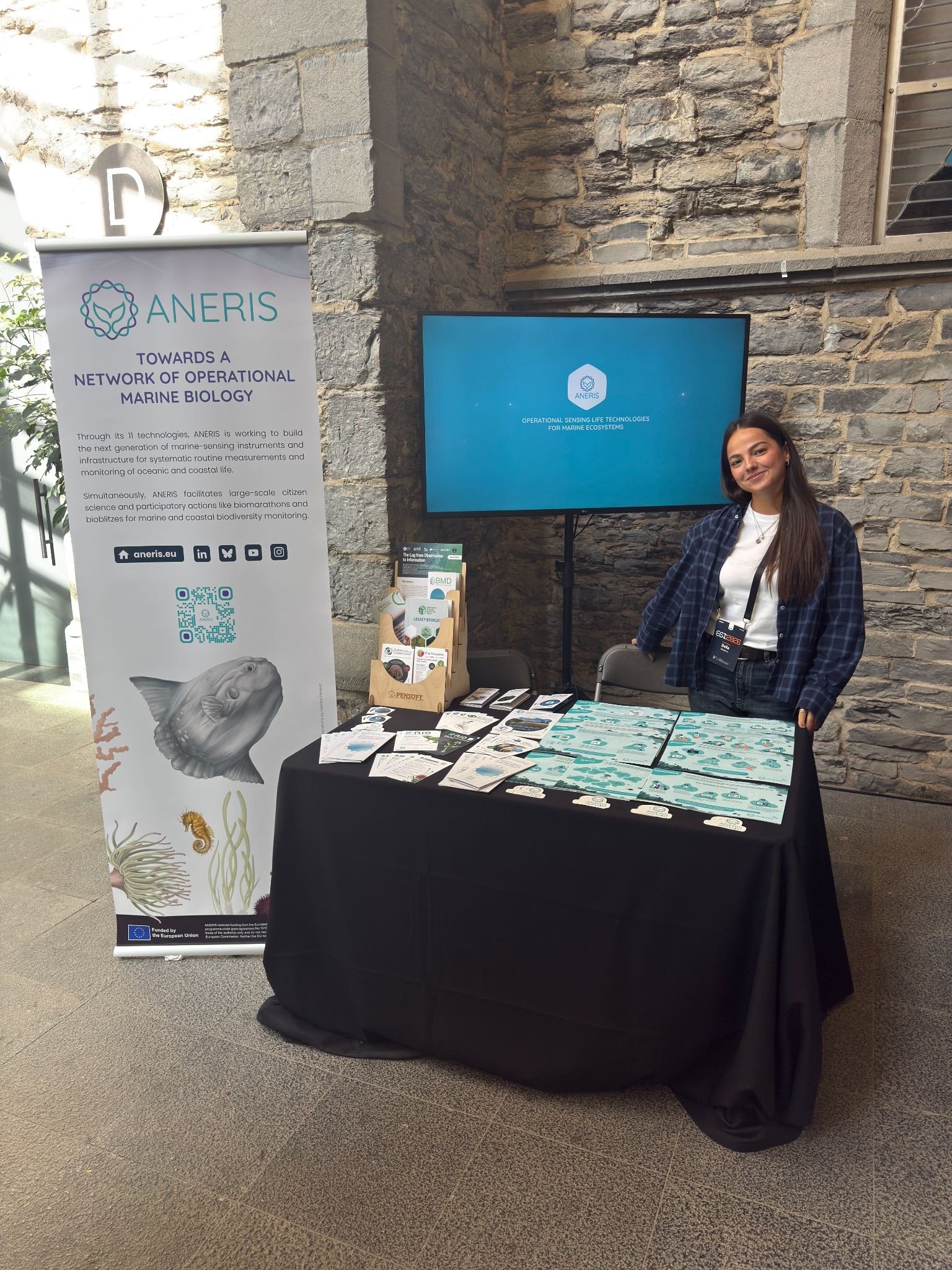
ANERIS booth at EGI2026 in Ghent.
During the opening ceremony, all exhibitors were invited to present their projects and initiatives to the audience in short pitches. Pensoft’s Communication Officer Bella Dimitrova used the opportunity to introduce ANERIS and its concept of Operational Marine Biology. Many attendees later came by the booth specifically to learn more about the project.
ANERIS materials.
The ANERIS booth welcomed a steady stream of visitors. Although most participants came from engineering and computing backgrounds, the project’s scientific illustrations and sticker sheets quickly became a highlight of the exhibition. The marine species featured on the stickers are among the most frequently observed and photographed during ANERIS citizen science campaigns. This made them a natural starting point for conversations about how volunteers, researchers and new technologies work together to monitor coastal biodiversity. Visitors also showed strong interest in the project’s newly produced case study factsheets and infographics, which made their print debut at the conference.
At the booth, attendees could also learn more about Pensoft’s expertise and experience as a scientific publisher through a selection of journals aligned with the conference themes. They could also find out about Pensoft’s role as an active consortium member in the COAST-SCAPES, B-Cubed and Biodiversity Meets Data projects.
Funded by the European Union’s Horizon Europe programme and coordinated by the Institute of Marine Sciences (ICM-CSIC), ANERIS brings together 25 partners from 13 countries. Over four years, the consortium has developed 11 technologies for marine life sensing and monitoring. They cover AI-assisted imaging of plankton and macrofauna, genomic and eDNA approaches and citizen science observatories such as MINKA.
As the project nears its end in December 2026, the focus is on making these tools usable beyond the project’s lifetime. This includes integrating them into European research infrastructures, which is why conversations with the EGI community were especially valuable. Combining large-scale imaging data, AI-based identification and citizen observations requires reliable storage, compute and data services. These are exactly the services EGI2026 participants build and operate.
The project’s results will be further showcased at the ANERIS Final Workshop “The future of marine monitoring – imaging, AI, and research infrastructures” on the 16th of November 2026. The hybrid event will be hosted by VLIZ in Oostende, Belgium. Through real-world case studies, partners will present tools including AI-driven underwater image restoration, automated organism identification platforms and integrated citizen science observatories. Shortly after, ANERIS will also take part in the 7th World Conference on Marine Biodiversity in Bruges.
Researchers have now described three new species of the conger eel genus Gnathophis, drawing on 130 specimens collected from the deep sea.
Researchers from National Taiwan Ocean University, University of Taipei and the Smithsonian Institution have now described three new species of the conger eel genus Gnathophis, drawing on 130 specimens collected from the deep sea. The findings raise the number of Gnathophis species known from Taiwan from two to five.
Members of this genus are medium-sized eels of tropical and subtropical deep waters, recognisable by a blunt tail tip, a fleshy snout that projects beyond the teeth, and a small fleshy keel on the underside of the snout.
The team compared vertebral counts, the pores of the sensory lateral line, colouring and tooth patterns, and for two of the species they added DNA barcoding to confirm the distinction. The two barcoded species differ from each other by roughly 4.4 to 4.9 per cent in the gene examined, well beyond the variation seen within a single species.
Each name tells a small story about where the eel was found or how it looks:
Gnathophis kbalanensis (Kbalan’s conger): named after “Kbalan”, an ancient name for the Yilan region of northeastern Taiwan, in use roughly 800 to 1,300 years ago. It is also known as Cabaran in Spanish and Kat-má-lán in Taiwanese. The largest specimen measured 472 millimetres, and the species is recognised by its blackish fins and a high vertebral count of 134 to 137.
Gnathophis melanurum (black tail conger): named from the Greek melan, meaning black, and urum, meaning tail, in reference to its black tail fin. Its dorsal and anal fins are pale, which makes the dark tail stand out. It was found off both northeastern and southwestern Taiwan, mostly at depths of around 200 to 300 metres.
Gnathophis nanhaiensis (Nan Hai’s conger): named after “Nan Hai”, the Chinese name for the South China Sea, where the holotype was collected at a depth of about 509 metres. The Latin ending -ensis means “originating in”. Known from only two specimens, it has pale fins and the highest vertebral count of the three, at 139 to 143.
Gnathophis kbalanensis sp. nov. Credit: Jian-Fu Huang, et al.
Gnathophis melanurum sp. nov. Jian-Fu Huang, et al.
Gnathophis nanhaiensis sp. nov. Jian-Fu Huang, et al.
The first two species share a feature that sets them apart from some of their relatives: the lateral line pores above the pectoral fin are raised, and the peritoneum, the lining of the body cavity, is black. Several of the specimens were ripe females carrying loose eggs, which suggests these waters may serve as spawning grounds.
The study also tidies up the regional record. An eel previously listed in Taiwan as Gnathophis xenica was confirmed to be a misidentification, and the researchers found no evidence to split the widespread G. heterognathos into separate species.
The work is dedicated to the late Dr David G. Smith, whose contribution to eel taxonomy inspired the first author.
Original source:
Huang J-F, Liao Y-C, Chan T-Y, Chen H-M, Smith DG (2026) The congrid eel genus Gnathophis in Taiwan (Anguilliformes, Congridae), with descriptions of three new species. ZooKeys 1287: 11-46. https://doi.org/10.3897/zookeys.1287.183842
For more articles on zoology, visit the ZooKeys website and follow the journal on BlueSky and Facebook.
New paper proposes using deep learning to collect richer ecological data, with the aim of better predicting how ecological communities change.
For decades, ecology has been very good at explaining the past. We can look at a collapsed fishery, a vanished pollinator population, or a coral reef bleaching event and piece together, after the fact, what went wrong. What ecology has struggled to do, and what it needs to get better at, is predicting these changes before they happen.
Conservation policymakers don’t just need to understand why an ecosystem collapsed last year. They need to know what will happen if we build a road through a forest, dam a river, or let a new pesticide into widespread use, before those decisions are made, not after the damage is done.
A new method paper by C. J. M. Musters and Geert R. de Snoo of Leiden University, published in Individual-based Ecology, explores whether combining deep learning with this individual-based framework could offer a way forward. They propose: closing the prediction gap requires not just better data, but an entirely different kind of data – and possibly, machines that sense the world the way animals do.
Why Predicting Ecosystems Is So Hard
Ecological communities are dazzlingly complex. Every organism in a habitat is constantly responding to its environment and to every other organism around it, like competing for food, avoiding predators, seeking mates, adjusting behavior with the seasons. Traditional ecology often simplifies this complexity by grouping organisms into species-level categories.
Example of an ecosystem. Credit to goodstudio via Canva.
Musters and de Snoo point to the work of ecologist John Lawton, who argued that this kind of unpredictability is strongest at “intermediate” scales – not in small populations of a single species, not across whole biomes, but somewhere in between. The authors define this middle ground as spaces of roughly 1 to 1,000,000 km² over 10 to 100 years. Unhelpfully, that’s also roughly the scale at which conservation decisions actually get made.
Organism-based Ecology or Individual-based Ecology takes a different starting point. Instead of assuming species behave as uniform units, it treats individual organisms as the fundamental actors whose actions and interactions generate the patterns we see in ecosystems. That’s a more realistic picture – but also a far more complicated one. Communities become vast networks of individual organisms, each constantly gathering and responding to information from their surroundings and from each other.
Where Deep Learning Comes In
Binary codes. Credit to RDGraphics via Canva.
Deep learning (DL), the technology behind everything from image recognition to language models, is extraordinarily good at finding patterns in complex data. In principle, DL combined with organism-based ecology, the study of how individual organisms behave and interact, could be used to build models that predict how a community will shift as conditions change.
However, deep learning is only as good as the data you feed it, and the data ecology currently collects wasn’t designed with this goal in mind.
Traditional ecological datasets tend to record outcomes: population counts, species distributions, migration patterns. What they largely fail to capture is something more fundamental – the raw sensory information that organisms actually use to make decisions. A bird doesn’t respond to “average temperature over the season.” It responds to what it can see, smell, hear, and feel, moment to moment, in its environment.
Flow diagram of the first three time-steps of a Recurrent Neural Network to predict changes in the state of community. Credit to Musters & de Snoo GR, 2026.
If deep learning models are going to predict how organisms actually behave and interact, the authors argue, they need training data that reflects what the organisms themselves are sensing rather than just retrospective statistics ecologists usually collect.
Building “Artificial Sense Organs” for Ecology
To generate that new kind of data, Musters and de Snoo propose building sensory instruments that mimic the sense organs of the organisms themselves – broad-spectrum devices that continuously and non-invasively record the same signals animals, plants, fungi, and microbes use to make decisions. Paired with existing tools like camera traps, biologging, satellite imagery, and environmental DNA sampling, this could generate the rich, organism-centered datasets that deep learning models actually need.
A Call for Caution
Deep Learning models are black boxes, even when their predictions are accurate, it’s often unclear why. Models trained on incomplete or biased data can generate ecologically impossible results, like population sizes that go negative.
Also, models trained largely on data from wealthy, well-studied regions could embed cultural assumptions that don’t transfer elsewhere. The authors offer a vivid example, Black-tailed Godwits are cherished in the Netherlands but considered agricultural pests in parts of West Africa, where they feed on rice rather than soil invertebrates. Applying a European-trained model globally, without care, risks a kind of “unintentional colonialism” in conservation decision-making.
In their method paper, the authors are clear, that the models they describe don’t exist yet, and that building them will require new instruments, new interdisciplinary collaboration between ecologists and ethologists, and critically explicit, published testing of where these models work and where they don’t. What they’re offering instead is a roadmap, by starting small, building sensory prototypes, training experimental models on well-studied plots, and rigorously checking every prediction against reality before trusting it with real conservation decisions.
Whether “artificial sense organs” turn out to be the right way to get there remains to be seen. But the underlying challenge – teaching machines to understand ecosystems well enough to predict their future – is one of the more important questions facing conservation science today.
Original source:
Musters CJM, de Snoo GR (2026) Challenges and opportunities for Artificial Intelligence for predicting changes in ecological communities. Individual-based Ecology 2: e199762. https://doi.org/10.3897/ibe.2.199762
Scientists from Yibin University and collaborating institutions have formally described Indotyphlops gyirongensis, the Gyirong blind snake.
High on the Qinghai-Xizang Plateau, often called the “Roof of the World,” a new species of snake waits beneath the stones…
Scientists from Yibin University and collaborating institutions have formally described Indotyphlops gyirongensis, the Gyirong blind snake, a discovery that adds a new member to one of the least understood branches of the snake family tree.
General (top) and ventral (below) views of the holotype of Indotyphlops gyirongensis sp. nov. in life (by Peng Guo).
Blind snakes are small, burrowing reptiles that spend nearly their entire lives underground. Their secretive habits and similar appearances make them notoriously difficult to study.
The family Typhlopidae contains roughly 280 species, yet its relationships remain poorly resolved, and new species continue to surface wherever researchers look carefully. Until now, no blind snake had ever been recorded in the Xizang Autonomous Region, which makes this find a first for the area.
The single specimen, an adult female, was collected in August 2025 at an elevation of 2,262 metres, close to the border between China and Nepal. She was resting beneath a stone at the edge of an evergreen broad-leaved forest, where deep humus and a thick layer of fallen leaves create ideal conditions for a creature that lives by burrowing. Among her neighbours were a Himalayan pit viper and a Himalayan toad!
Microhabitat of the type specimen of Indotyphlops gyirongensis sp. nov. in Gyirong, Xizang, China (by Peng Guo).
The snake itself is slender and elegant. At 265 millimetres, it is large by the standards of its genus, yet it measures just 3.5 millimetres across at midbody. Its glossy scales are light brown, each one darker on its rear half, which gives the body a delicate and finely patterned sheen. The underside is cream and so thin-skinned that it is partly transparent to the internal organs.
Most distinctive is its pale cream head cap, which lacks pigment as far back as the eye. The eye itself is only a dark spot, with no visible pupil or iris, fitting for an animal that navigates by touch and chemical cues rather than sight. Its tail ends in a small nubbin rather than a sharp spine.
Some of the most telling differences are hidden in the arrangement of the scales along the lip. Blind snakes are classified partly by how their upper lip scales overlap the shields above them. In nearly all of the snake’s relatives, the third scale overlaps the one beside the eye, a pattern known as T-III.
The Gyirong blind snake shows a rarer arrangement, called T-V, in which both the second and third lip scales overlap the shields above. Few documented members of its genus share this feature, which provides a clean and reliable way to separate it from most of its kin.
Anatomy alone did not settle the matter. The team sequenced two mitochondrial genes and placed the snake within a broad evolutionary tree. It nested firmly within Indotyphlops, as the sister lineage to I. albiceps, but its genetic divergence was substantial. For one gene, it differed from its closest relatives with available data by more than 24 per cent, and for another by more than 18 per cent, margins far beyond what is typically seen within a single species.
The name honours the place of discovery. Gyirongensis refers to Gyirong Town in Gyirong County, where the holotype was found, and it is formed as a noun in apposition. The authors propose the English common name “Gyirong blind snake” and the Chinese name 吉隆盲蛇 (Jílóng Mángshé).
Map showing the locality of the new species in Gyirong, Xizang, China.
Because the type locality sits so close to the Nepalese border, the researchers consider it highly likely that the species also lives on the other side, thus pending further fieldwork.
Original source:
Lyu B, Tan S, Zhao Z, Wallach V, Liu Q, Guo P (2026) A new species of blind snake, Indotyphlops (Serpentes, Typhlopidae), from the Qinghai-Xizang Plateau, China. ZooKeys 1292: 261-273. https://doi.org/10.3897/zookeys.1292.197322
For more articles on zoology, visit the ZooKeys website and follow the journal on BlueSky and Facebook.
Last week marked another annual meeting of the Biodiversity Information Standards network, otherwise known as TDWG, with the Norwegian capital Oslo hosting the event between 20 and 25 September.
Last week marked another annual meeting of the Biodiversity Information Standards network, otherwise known as TDWG, with the Norwegian capital Oslo hosting the event between 21 and 25 September.
TDWG is the international, non-profit organisation formerly known as the Taxonomic Databases Working Group, which develops and maintains the standards, such as Darwin Core, that allow biodiversity data to be shared, integrated and understood across institutions worldwide.
The six-day programme was a meeting point for over 300 stakeholders from research, practitioner and corporate circles, with proceedings centred around one central topic – “Research and Robot-Ready Biodiversity Data Standards”. In that sense, the themes of accessibility, responsibility, innovation and collaboration were foremost on the minds of participants as they contemplated how information on the biosphere should be extracted, consolidated and shared in the years to come.
As a long-standing partner of TDWG, Pensoft Publishers served as both a sponsor and an exhibitor for the event. In the latter capacity, the company contributed with a joint booth for three of the EU-funded projects it is leading the outreach efforts for:
BMD – an initiative working towards a Biodiversity Explorer for high-throughput biodiversity monitoring tools, biodiversity data and biodiversity analyses for better conservation across Europe
TETTRIX – a new arrival building a next-generation taxonomic system connecting knowledge, expertise and innovation for all across the Old Continent
ANERIS – a pan-European effort to mobilise a network of operational marine biology via a new technological infrastructure
The Pensoft team at the joint booth of the BMD, TETTRIX and ANERIS projects.
A number of other projects from Pensoft’s communication portfolio also found a place in the display, including BEAGLE, OneSTOP, B-Cubed, MAMBO, OBSGESSION and BioAgora. Furthermore, 14 of the company’s journals were in the spotlight, including Biodiversity Information Science and Standards (BISS), the official journal of the TDWG community (where all of the conference’s abstracts are set to be published).
Crucially, the event also saw the official launch of ORPHO, Pensoft’s new collaborative workspace for scientific writing. Founder and CEO Prof. Lyubomir Penev and CTO Teodor Georgiev conducted live demos of the tool, showcasing how manuscripts crafted within it with full version control for authors become discoverable, interoperable and FAIR-compliant.
In the context of TDWG2026’s agenda, they also presented ORPHO’s integrated semantic annotation and communication instruments as part of the workshop “How Literature Services can Support & Benefit from Biodiversity Publication and Data Standards?” on 24 September. The workspace was received with anticipation and enthusiasm by attendees, with many expressing a desire to test it out for themselves.
They were also treated with a tease of Pensoft’s next large-scale endeavour, as Senior Communications Officer Peter Bozakov pulled the curtain behind the forthcoming communication platform for research projects Scientiana.
Pensoft’s CTO Teodor Georgiev introduces the collaborative scientific workspace ORPHO.
As for other notable contributions to the wider conference agenda by researchers affiliated with Pensoft’s publishing or project activities:
The session “Operationalising Biodiversity Digital Twins within Data Space Ecosystems”, which was co-led by BMD coordinator and long-time author and reviewer across several Pensoft journals, including Biodiversity Data Journal and Research Ideas and Outcomes, Niels Raes, and showcased a number of innovative outputs from the project. As such, it was an important occasion to assess the initiative’s progress towards unifying Europe’s Data Space within a single Biodiversity Explorer.
Niels Raes presenting “Mainstreaming high-throughput biodiversity monitoring using AI” at TDWG 2026.
The symposium “Publishing and Communications Promoting Biodiversity, Natural History Collections, People, Data and Data Standards”, for which Deborah Paul (co-Editor-in-Chief of the Natural History Collections and Museomics (NHCM) journal) had the role of co-organiser. Within it, the TETTRIX project’s vision for the automated tracking of taxonomic research activities was laid out by consortium member David Fichtmüller. Moreover, Shelley James (co-Editor-in-Chief for NHCM) delivered an insightful talk on the creative promotion of biodiversity data and standards for success and recognition.
Co-Editors-in-Chief of NHCM, Shelley James and Deborah Paul, presenting “Hit or miss? Creative promotion of biodiversity data and standards for success and recognition” at TDWG 2026.
Notably, the Biodiversity Information Science and Standards (BISS) journal is the home for TDWG conference abstracts. TDWG 2026 presenters can currently submit their abstracts there and publish them in an extended abstract or mini-paper format completely free of charge. The journal also hosts abstracts from conferences held over the past decade. You can browse the TDWG 2026 collection here.
Last but not least, the company’s sponsorship supported two awards at TDWG2026 (with a free publication in a Pensoft journal as an accompanying prize):
Best Student Oral Presentation – awarded to Yeshan Qui for “Reporting structure and sampling-bias correction in citizen-science bird data across Asian cities”
Best Student Poster – awarded to Claudia Campanini for “Improving marine fieldwork documentation and metadata with Adaptable Standardised Methods Reporting (ASMR)”
Claudia Campanini receiving the Pensoft Best Student Poster Award at TDWG 2026.
Overall, TDWG2026 proved itself a crucial forum for mapping out the future of biodiversity monitoring and the management of the myriad data streams that emerge from it. Pensoft is proud to be an important actor in this process, contributing with innovative tools and solutions at the heart of the interface between research and practice. As summarised by Prof. Penev:
“Given its status as a large-scale conference centred around the future of biodiversity sciences in the age of AI, TDWG2026 was a crucial venue for unveiling Pensoft’s forward-looking vision for academic publishing and science communication. The “pearl” of these pursuits is undoubtedly the ORPHO workspace, a tool that is well-placed to introduce a new standard when it comes to collaborative AI-FAIR research in Europe and beyond.”
Lissomus arawak measures under a centimetre long and is easily recognised by its shining and almost hairless black body, alongside its pale-yellow antennae segments.
A new species of click beetle with a glossy and highly domed black body has been described from cloud forest sites in the mountains of the Dominican Republic, and named in honour of the Arawak peoples who lived on the island before European colonisation.
Lissomus arawak measures under a centimetre long and is easily recognised by its shining and almost hairless black body, alongside its pale-yellow antennae segments. It is only the third species of the genus Lissomus known from Hispaniola, and the third recorded anywhere in the Greater Antilles.
Lissomus arawak, dorsal habitus. Image by J. Pirkl, 2025, used with permission.
Lissomus arawak, ventral habitus. Image by J. Pirkl, 2025, used with permission.
Lissomus arawak, lateral habitus. Image by J. Pirkl, 2025, used with permission.
The study, published in the open-access journal Alpine Entomology, was carried out by Paul J. Johnson of South Dakota State University and Jiri Hodecek of the Swiss Human Institute of Forensic Taphonomy, as part of an ongoing survey of Dominican insect life. Specimens were found at three sites in montane broadleaf and cloud forest between roughly 600 and 700 metres, near the Sierra de Bahoruco and in the Cordillera Septentrional.
Rather than resembling the two other Lissomus species already known from Hispaniola, the new beetle turned out to be structurally closer to species from Central and northern South America.
“The morphological differences suggest that the Lissomus species of Hispaniola may not all descend from a single colonisation event.
One possible explanation is therefore that ancestors of these beetles reached the Greater Antilles on at least two separate occasions. This remains a testable hypothesis rather than a demonstrated evolutionary history.”
The Research Team
The species is known from just five specimens, collected individually between 1985 and 2024, all of them female.
“With such a small sample, chance and the opportunistic nature of the collecting are probably the simplest explanations. This does not seriously weaken our confidence that L. arawak is distinct. All five females share a consistent and unique combination of morphological characters.”
The Research Team
Type locality of Lissomusarawak in Pedernales province (el. 700 m).
The name is a deliberate tribute to the island’s first inhabitants:
“We chose the name arawak to recognise the Indigenous history and continuing cultural heritage of the Antilles. We wanted the name of this distinctive endemic species to connect the biological history of the island with its human history.”
The discovery forms part of a wider effort, they added, “to document the island’s still incompletely known insect diversity,” with at least 15 further click beetle species thought to await description in the Dominican Republic alone.
The discovery forms part of EntomoDR, a long-term field and taxonomy project documenting the still incompletely known insect diversity of the Dominican Republic through repeated expeditions and collaboration with an international network of taxonomic specialists. More information about the project and its discoveries is available at https://entomodr.com
Original source:
Johnson PJ, Hodecek J (2026) Lissomus arawak sp. nov. (Coleoptera, Elateridae), a new species from the Dominican Republic. Alpine Entomology 10: 155-161. https://doi.org/10.3897/alpento.10.193434
Themed “Integrating the Diversity of Ecology”, the event welcomed over 1,000 researchers in the field from across career stages, who had the opportunity to enjoy conference talks across 36 thematic sessions, as many as six keynote talks, two poster sessions, several open society meetings and quite a few social events, including excursions and a conference dinner.
Conference delegates enjoying the musical clock installation mounted on an elevated balcony on the glass façade of the ODEON building, where the Nordic Oikos-GfÖ 2026 conference took place between 13 and 17 September 2026.
Beyond publishing solutions, a key focus was given to OBSGESSION: a Horizon Europe-funded project where Pensoft is actively involved. To better understand and predict changes in terrestrial and freshwater ecosystems, the OBSGESSION consortium integrates multi-source Earth Observation data (such as high-resolution satellite imagery and drone monitoring) with ground-based in-situ research, including advanced environmental DNA (eDNA) sampling. By coupling these data streams with cutting-edge detection-attribution modelling and machine learning algorithms, the project generates scalable Essential Biodiversity Variables (EBVs). These ecological approaches and analytical frameworks are actively tested and validated through six biodiversity pilots across diverse European ecosystems. In the open-science Research Ideas and Outcomes journal, you can find a collection of project outputs, including research papers, project reports and deliverables, and guideline papers published across journals and platforms.
At the Pensoft-OBSGESSION-branded booth, conference participants would stop by to chat with Pensoft’s Head of Journal development and PR: Iva Boyadzhieva and Senior Communications Officer: Desislava Raykova.
As a leader of the “Dissemination, Multi-stakeholder outreach and synergies” work package at OBSGESSION, Pensoft is tasked with stakeholder engagement and community building, ultimately contributing to the high impact of the resulting outputs, methodologies and policy recommendations that aim to strengthen public understanding of biodiversity change.
One of the six keynote talks was presented by Prof. Dr. Isabell Hensen (Martin Luther University Halle, Germany), who received the GfÖ Honorary Medal 2026 for her leading, forward-looking contributions to ecological research and the scientific community. Her work examines how genetic variation, environmental conditions, disturbance, and plant-animal interactions shape plant populations, with particular emphasis on rare species, biological invasions, and the regeneration of degraded forests.
In her talk, titled “One spark is enough: regeneration ecology of Andean forests under global change”, she reported on post-fire regeneration processes in tropical Andean forests, based on long-term field experiments and observational studies.
Hensen focused on the well-studied endemic plant genus Polylepis, which forms the world’s highest-elevation forests and illustrates how fire has shaped ecosystem dynamics over millennia. Her talk also mentioned a 2022 monograph of the genus, published in the Pensoft journal PhytoKeys by Tatiana Erika Boza Espinoza (Pontificia Universidad Católica del Perú) and Michael Kessler (University of Zurich), which brought together results from 35 years of field and herbarium experience.
On Wednesday, Pensoft’s Iva Boyadzhieva delivered a presentation titled “Scholarly Communication: Lessons from the Publisher’s Kitchen”. She highlighted the vital role publishers play in helping researchers communicate their insights not only to peers, but also to decision-makers and the public. Emphasizing the publisher’s responsibility to support authors with robust infrastructure and dedicated human expertise, she outlined how Pensoft works to FAIRify scholarly publishing and future-proof scientific knowledge in an era of rapid AI development and expanding research output.
*
Pensoft’s team was delighted to meet up with dedicated readers, authors, reviewers, and editors from across Pensoft’s portfolio, as well as introduce Pensoft journals to attendees discovering them for the first time.
Visitors were also particularly intrigued by several newly launched Pensoft journals. Developed in close collaboration with passionate researchers, these fresh outlets directly address key gaps in academic publishing.
One of the newly launched journals in the spotlight was Agricultural and Environmental Modelling (AEM), which provides a unique scholarly outlet thanks to its modern approach to publishing by increasing transparency, giving credit to research objects across the entire modelling research lifecycle. This is achieved through publishing specialised article types, such as: Formal Model, Model Testing and Calibration, Model Implementation and Documentation, Data Papers and Software Descriptions. These new publishing formats are designed to keep pace with advances in Modelling research and to make it FAIR (Findable, Accessible, Interoperable, and Reusable) by enabling scholarly credit for diverse research outputs, often created by different groups of authors. For the time being, AEM remains a Diamond Open Access journal, meaning that it will not charge authors for open-access publication.
Other recently founded journals addressing emerging and fast-developing disciplines within the ecological field that took the spotlight were:
Individual-Based Ecology: launched to support understanding and predicting ecological systems’ response to rapidly changing and novel conditions by linking individual responses to responses at higher levels of organisation.
Advances in Pollinator Research: a multidisciplinary journal publishing research on pollination ecology, pollinator-plant interactions, pollinator health and drivers of pollinator declines, crop and wild flower pollination, pollinator conservation practices, molecular ecology of pollinators, pollinator and pollination monitoring, decision support for policy and socio-economics.
Journal of Regeneration: a multidisciplinary journal for the dissemination of research results on regeneration and tissue repair across phyla. These mechanisms can be framed within an evolutionary framework and integrate a variety of cellular processes involving stem cells, dedifferentiating or even transdifferentiating cells.
All of these journals operate with no article fees for either authors, nor readers.
To receive updates on new publications and relevant news, sign up for Email Alerts on any journal’s homepage. Creating a Pensoft account also allows users to easily customise their notification preferences, follow additional journals, or filter updates by research topic. You can also follow journals on social media, including BlueSky, Facebook and Linkedin.
*
Supporting European Policy Through Priority Essential Biodiversity Variables (EBVs)
Delegates at the event showed strong interest in OBSGESSION’s first policy brief:“Prioritising Essential Biodiversity Variables (EBVs) to support European Union (EU) policy needs based on the EU’s Biodiversity Strategy for 2030.” To tackle a critical challenge in environmental monitoring, OBSGESSION focuses on prioritising key EBVs to directly support the EU Biodiversity Strategy 2030 – a roadmap designed to put Europe’s biodiversity on a path to recovery through 102 specific actions and sub-actions.
To align these policy needs with actionable data, the OBSGESSION team conducted an assessment to identify priority EBV candidates. By categorising EBV-applicable actions and indicators across different ecosystem realms and implementation stages, the project pinpointed the most essential variables needed to strengthen monitoring, reporting, and policy execution. The document is based on a deliverable by the project (D1.1 Policy Landscape and Needs Assessment).
This policy brief is part of a broader, ongoing effort within OBSGESSION to bridge the gap between biodiversity data and policy execution. To dive deeper into the science behind this topic, the project has hosted a dedicated seminar series exploring key aspects of the framework:
Bringing Methodologies to Life Across European Ecosystems
Beyond theoretical frameworks, OBSGESSION grounds its research in six biodiversity validation pilots across Europe. The case studies represent European biodiversity and ecosystem conservation challenges at scales varying from local to regional.Full details on each ecosystem pilot are now available in a collection of newly published pilot factsheets, which made their debut at the conference, where people could take a look at their digital versions.
Reading those materials gives an insight into the practical testing environment to demonstrate how Earth observation, field research, and ecological modelling come together to deliver actionable biodiversity insights. You can also check outOBSGESSION’s biodiversity pilots on the project’s website.
The OBSGESSION in a Nutshell video presents a concise overview of the project’s overarching mission and components.
*
To relive the conference by exploring the detailed programme alongside the full abstracts, visit the conference website.
The journal is an international, multidisciplinary academic journal supervised by Ho Chi Minh City University of Industry and Trade (HUIT).
Pensoft Publishers is pleased to announce the publication of the first issue of the Journal of Scientific and Technological Innovations (STI), an international journal for cutting-edge research across the scientific and technological spectrum.
The journal notably adopts Pensoft’s ARPHA platform, an innovative end-to-end full-featured publishing solution that streamlines the entire publication workflow – from initial manuscript submission to indexing, distribution, hosting and archiving through one coordinated platform. To date, ARPHA provides “a home” to about 100 open-access journals across scientific fields.
The Journal of Scientific and Technological Innovations is an international, multidisciplinary academic journal supervised by Ho Chi Minh City University of Industry and Trade (HUIT). The journal publishes original, peer-reviewed research contributions.
Its editorial purview encompasses a broad range of scientific and technological domains:
Food Science – biotechnology, traceability, safety and quality assurance, chemistry and toxicology, packaging, nanotechnology, sensory evaluation, sustainability, health and nutrition, and product innovation
Environmental Science – catalysis and energy conversion, carbon capture and utilisation, hydrogen and biomass technologies, agricultural and environmental biotechnology, bioremediation and wastewater treatment, sustainable chemistry, and computational approaches
Chemical Engineering – green and sustainable chemistry, computational methods, analytical and synthetic chemistry, pharmaceutical chemistry, catalytic technologies, and process development
Materials Science – nanomaterials, biomaterials, ceramics and composites, electronic and optical materials, polymers, surface coatings, eco-materials, and semiconductors
Editorial board
The journal is led by an international team of scholars:
The first issue of STI presents six contributions spanning food science, materials science, and applied food technology:
A cost-benefit analysis of small-holder floating-house fish farming in Chau Doc City, Vietnamese Mekong Delta
A study of 35 Mekong Delta fish farmers reveals significant disparities in farm profitability across different river reaches, with operations facing demographic vulnerabilities and heavy reliance on unpaid labour.
Read more: Farzana H, Tran DD, Nguyen TD, Park E (2026) A cost-benefit analysis of small-holder floating-house fish farming in Chau Doc City, Vietnamese Mekong Delta. Journal of Scientific and Technological Innovations 1: e209236. https://doi.org/10.3897/sti.e209236
Ultrasound-assisted pullulanase modification increases resistant starch content and alters the structure–function properties of water caltrop starch
A combined ultrasound and enzymatic treatment increased resistant starch content in water caltrop starch from 21.72% to 28.15%, whilst enhancing its water and oil absorption capacities. The approach offers potential for developing resistant starch-enriched functional food ingredients.
Read more: Phan VM, Ngo TMP, Do TTN, Luyen TTH, Duong TT, Tran NM, Tran CH (2026) Ultrasound-assisted pullulanase modification increases resistant starch content and alters the structure–function properties of water caltrop starch. Journal of Scientific and Technological Innovations 1: e209539. https://doi.org/10.3897/sti.e209539
Effects of Melatonin/β-cyclodextrin Treatment on Physicochemical and Bioactive Attributes of Cherry Tomatoes during Storage
Melatonin complexed with β-cyclodextrin reduced cherry tomato weight loss by up to 56% during refrigerated storage and proved more effective than free melatonin in preserving colour, acidity, and polyphenol content. The complex formation provides a viable strategy for extending shelf-life in harvested produce.
Read more: Tran THC, Dong TT, Nguyen PH,Le NH,Kuo C-H (2026) Effects of Melatonin/β-cyclodextrin Treatment on Physicochemical and Bioactive Attributes of Cherry Tomatoes during Storage. Journal of Scientific and Technological Innovations 1: e212043. https://doi.org/10.3897/sti.e212043
Design, Functionalities, and Emerging Applications of Ti3C2Tx MXene-Based Composites: A Review
This review synthesises current knowledge on titanium carbide-based MXenes, two-dimensional materials with exceptional conductivity and mechanical properties. MXene-based composites demonstrate applications in gas sensing, photocatalytic carbon dioxide reduction, and energy storage devices.
Chemical Composition, Bioactivities, and Cosmetic Applications of Coconut Oil and Its Derivatives
Recent evidence demonstrates that coconut oil, when appropriately applied, offers dermatological benefits, with antimicrobial, anti-inflammatory, and antioxidant properties. The research clarifies interactions between coconut oil and skin microflora and explains previous inconsistencies in published findings.
Read more: Dat NM, Phong DT, Long HB, Dat NT, Thy LTM (2026) Chemical Composition, Bioactivities, and Cosmetic Applications of Coconut Oil and Its Derivatives. Journal of Scientific and Technological Innovations 1: e205088. https://doi.org/10.3897/sti.e205088
Retention of bilberry anthocyanins in wood hemicelluloses coated microcapsules under the impact of humidity and packaging conditions
Storage at 8% relative humidity limited bilberry anthocyanin degradation to 17-22% over 24 weeks, with wood hemicelluloses providing comparable protection to conventional gum Arabic. The findings establish moisture control as important for developing shelf-stable natural functional powders with sustainable coating materials.
Read more: Halahlah A, Piironen V, Mikkonen KS, Ho TM (2026) Retention of bilberry anthocyanins in wood hemicelluloses coated microcapsules under the impact of humidity and packaging conditions. Journal of Scientific and Technological Innovations 1: e207689. https://doi.org/10.3897/sti.e207689
A platform for scientific advancement
The diversity of contributions in this first issue reflects STI’s multidisciplinary scope. Researchers interested in submitting manuscripts are invited to consult the journal’s guidelines and submission portal.
The inaugural conference took place in Sofia, Bulgaria, bringing together researchers, conservationists and practitioners to address gaps in small mammal research and monitoring.
The inaugural European Small Mammal Conservation Conference (SMCC 2026) took place in Sofia, Bulgaria, from 21 to 25 September 2026, bringing together researchers, conservationists and practitioners from across Europe and beyond to address gaps in small mammal research and monitoring.
This year’s conference was held jointly with the 33rd Hamster Working Group and the VIII European Ground Squirrel Meeting, making hamsters and sousliks the primary focus, alongside broader topics including renewable energy development, agricultural impacts, reintroductions, predator–prey interactions and innovative methodologies in small mammal research.
We were delighted to participate in SMCC 2026 with an exhibition booth, showcasing the breadth of publishing services we offer to the biodiversity and conservation community. It was a pleasure to present our portfolio of journals dedicated to advancing research across ecology, biodiversity and conservation.
Pensoft’s booth at SMCC 2026.
We were particularly proud to present the following journals:
Individual-based Ecology – exploring the physiological and behavioural mechanisms that shape ecological processes
Biodiversity Data Journal – an open-access venue for publishing primary biodiversity data and datasets
Pensoft’s journal portfolio exhibited at SMCC 2026.
Meeting delegates from across the small mammal research community was tremendously rewarding, and we thoroughly enjoyed discussing how our journals can support and amplify their work.
Beyond our academic offerings, we were particularly excited to showcase beautiful art prints illustrated by our in-house scientific illustrator, Denitsa Peneva. The collection featured stunning depictions of otters, olinguitos and hamsters.
Pensoft’s art prints at SMCC 2026.
Conference Highlights
The scientific programme was exceptional, and we were privileged to attend many outstanding presentations that demonstrated the importance of innovative monitoring approaches and conservation action.
Lessons from Citizen Science for Small Mammal Conservation Monitoring in Great Britain
We were delighted to attend a talk by Matt Larsen-Daw, Chief Executive of the Mammal Society (UK), which presented a portfolio of citizen science programmes designed to address distribution knowledge and population monitoring across Great Britain. The programmes, united by the Mammal Mapper smartphone app, included the National Harvest Mouse Survey, the Searching for Shrews initiative, and the University Mammal Challenge.
The presentation highlighted the value of standardised effort data, the differing trade-offs between structured and opportunistic recording, and the potential for these approaches to be applied across European contexts.
Matt Larsen-Daw presenting “Lessons from citizen science for small mammal conservation monitoring in Great Britain” at SMCC 2026.
Strong Decline of Hamster Populations in Bulgaria
We were equally impressed by Nedko Nedyalkov’s presentation documenting the significant decline in distribution and abundance of both the common hamster (Cricetus cricetus) and the Romanian hamster (Mesocricetus newtoni) across Bulgaria. The research revealed that population reductions, detected through owl pellet analysis and trapping methods, likely began in the 1950s with agricultural intensification and continue today.
Given that both species are strictly protected under the EU Habitats Directive yet lack active conservation projects, the presentation substantiated the urgent need for targeted conservation measures. We are also pleased to note that Nedko serves as a subject editor for two of our open-access journals, ZooKeys and the Biodiversity Data Journal.
Nedko Nedyalkov presenting “Strong decline of the distribution and abundance of Cricetus cricetus and Mesocricetus newtoni (Mammalia: Cricetinae) in Bulgaria” at SMCC 2026.
Reintroduced Saker Falcons and Their Dependence on European Ground Squirrels
Yana Andonova’s presentation on the diet of Bulgaria’s reintroduced saker falcon population provided compelling evidence of the breeding birds’ overwhelming dependence on the European ground squirrel (Spermophilus citellus) as a primary food source.
Through food-remain analysis, visual observations and camera-trap monitoring, the research documented that ground squirrels comprised over 80 per cent of identified prey items, with small rodents accounting for 89 per cent overall! It is also worth mentioning that Andonova is an author in our open-access Biodiversity Data Journal.
Yana Andonova presenting “Reintroduced Saker Falcons (Falco cherrug Gray, 1834) are dependent on European ground squirrels during the breeding period in Bulgaria” at SMCC 2026.
Looking Forward
Attending SMCC 2026 was a genuine pleasure and particularly meaningful given that the conference took place in Sofia, the city in which our company is based. Connecting with researchers and conservationists working at the forefront of small mammal conservation, and sharing our commitment to advancing biodiversity research through open-access publishing, reinforced our dedication to supporting this important field.
We look very much forward to engaging with this community again at future events!